Digital SAT Geometry & Trigonometry Guide
Review SAT geometry and trigonometry: angles, triangles, circles, area, volume, coordinates, right triangles, and trig ratios.
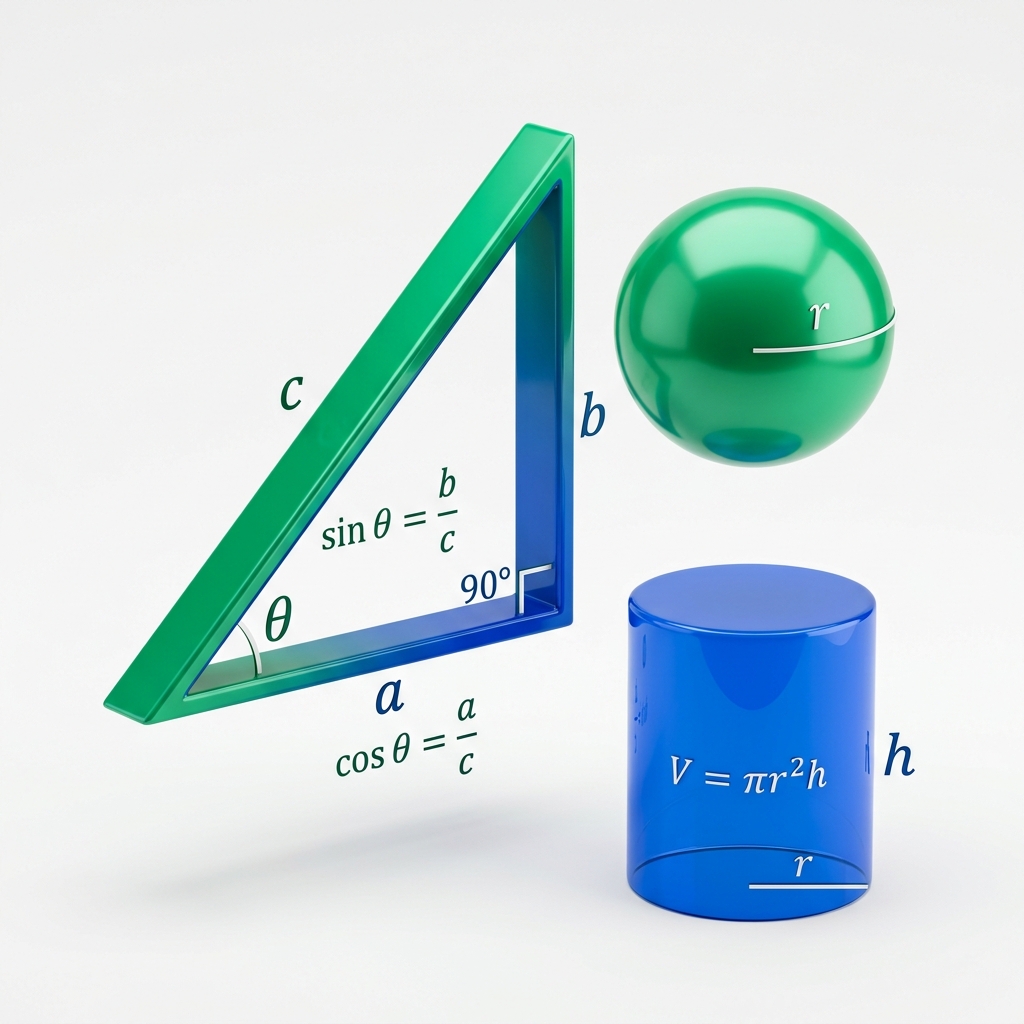
1. Introduction to SAT Geometry & Trigonometry
Geometry and trigonometry represent approximately 15% of the Digital SAT Math section. This means you will encounter between 5 and 7 questions out of the 44 total questions across both test modules. While this represents a smaller portion of the exam than Algebra or Advanced Math, mastering geometry and trigonometry is absolutely critical for students aiming for a top-tier score. Because these questions are highly formulaic and rule-based, they are among the most predictable and straightforward points on the entire test.
On the Digital SAT, these questions test your ability to apply spatial reasoning, algebraic modeling, and geometric theorems to solve both theoretical and real-world problems. The College Board organizes these concepts into four main categories:
- Area and Volume: Calculating the space occupied by two-dimensional shapes and three-dimensional solids.
- Lines, Angles, and Triangles: Analyzing angle relationships, congruent or similar triangles, and right triangles.
- Right-Triangle Trigonometry and Radians: Applying trigonometric ratios (\(\sin\), \(\cos\), \(\tan\)), complementary identities, and radian measurements.
- Circle Geometry: Analyzing arcs, sector areas, inscribed angles, and coordinate equations of circles.
In this guide, we will unpack each of these domains in rigorous detail, providing the mathematical proofs, conceptual derivations, and step-by-step strategies you need to score a perfect 800.
2. Fundamental Angle Rules and Parallel Lines
To solve complex SAT geometry problems, you must first master the fundamental vocabulary and relationships of angles in the coordinate plane.
Angles at an Intersection
When two straight lines intersect, they create four angles. The relationships between these angles are governed by two fundamental theorems:
          Line 1
            \     /
             \   /
           a  \ /  b
          -----X----- Line 2
           c  / \  d
             /   \
/ \- Vertical Angles: Opposite angles formed by intersecting lines are congruent (equal in measure). In the diagram above, \(\angle a = \angle d\) and \(\angle b = \angle c\).
- Linear Pairs (Supplementary Angles): Angles that form a straight line add up to \(180^\circ\). In the diagram, \(\angle a + \angle b = 180^\circ\), \(\angle b + \angle d = 180^\circ\), \(\angle d + \angle c = 180^\circ\), and \(\angle c + \angle a = 180^\circ\).
Parallel Lines Cut by a Transversal
When two parallel lines (\(l_1 \parallel l_2\)) are intersected by a third line, called a transversal (\(t\)), eight distinct angles are created. These angles fall into two families: one family of equal acute angles and one family of equal obtuse angles.
            t
            \
             \
       1  \   2
     ------\------ l1
       3  \   4
           \
            \
       5  \   6
     ------\------ l2
       7  \   8
             \
If \(l_1\) is parallel to \(l_2\), the following relationships are always true:
- Corresponding Angles: Angles in the same relative position at each intersection are congruent. \[\angle 1 = \angle 5, \quad \angle 2 = \angle 6, \quad \angle 3 = \angle 7, \quad \angle 4 = \angle 8\]
- Alternate Interior Angles: Angles on opposite sides of the transversal and inside the parallel lines are congruent. \[\angle 3 = \angle 6, \quad \angle 4 = \angle 5\]
- Alternate Exterior Angles: Angles on opposite sides of the transversal and outside the parallel lines are congruent. \[\angle 1 = \angle 8, \quad \angle 2 = \angle 7\]
- Consecutive (Same-Side) Interior Angles: Angles on the same side of the transversal and inside the parallel lines are supplementary (add up to \(180^\circ\)). \[\angle 3 + \angle 5 = 180^\circ, \quad \angle 4 + \angle 6 = 180^\circ\]
SAT Strategy: When you see parallel lines cut by a transversal on the SAT, write down “Acute = Acute” and “Obtuse = Obtuse”. Every acute angle is congruent, every obtuse angle is congruent, and any one acute angle plus any one obtuse angle equals \(180^\circ\).
Interior Angles of Polygons
For any convex polygon with \(n\) sides, the sum of the interior angles \(S\) is given by the formula: \[S = (n - 2) \times 180^\circ\]
- For a triangle (\(n = 3\)): \(S = (3 - 2) \times 180^\circ = 180^\circ\).
- For a quadrilateral (\(n = 4\)): \(S = (4 - 2) \times 180^\circ = 360^\circ\).
- For a pentagon (\(n = 5\)): \(S = (5 - 2) \times 180^\circ = 540^\circ\).
- For a hexagon (\(n = 6\)): \(S = (6 - 2) \times 180^\circ = 720^\circ\).
If the polygon is regular (meaning all sides are congruent and all interior angles are equal), you can find the measure of a single interior angle \(I\) by dividing the sum by the number of sides: \[I = \frac{(n - 2) \times 180^\circ}{n}\]
For instance, each interior angle of a regular hexagon is \(\frac{(6-2)\times 180^\circ}{6} = 120^\circ\).
3. Properties of Triangles
Triangles are the single most frequently tested shape on the SAT. Understanding their classifications, similarity, and side-length constraints is essential.
Classification of Triangles
- Equilateral Triangle: All three sides are equal, and all three interior angles are exactly \(60^\circ\).
- Isosceles Triangle: At least two sides are equal, and the angles opposite those sides (the base angles) are also equal. If a triangle has two congruent angles, it must have two congruent sides.
- Scalene Triangle: All three sides have different lengths, and all three interior angles have different measures.
- Right Triangle: One interior angle is exactly \(90^\circ\). The side opposite the right angle is the hypotenuse, and the other two sides are legs.
Triangle Theorems
- The Third Angle Theorem: If two angles of one triangle are congruent to two angles of another triangle, then the third angles must also be congruent.
- Exterior Angle Theorem: The measure of an exterior angle of a triangle is equal to the sum of the measures of its two remote interior angles.
              /|
             / |
            /  |
           /   |
          /    |
         /a   b|
        /------|-----
               c
\\(\angle c = \angle a + \angle b\\)-
Triangle Inequality Theorem: For any triangle with side lengths \(a\), \(b\), and \(c\), the sum of any two sides must be strictly greater than the third side: \[a + b > c, \quad a + c > b, \quad b + c > a\]
If you are given two side lengths \(a\) and \(b\), the length of the third side \(c\) must lie in the following range: \[|a - b| < c < a + b\]
Example: If a triangle has sides of length \(4\) and \(9\), the third side \(c\) must be greater than \(9 - 4 = 5\) and less than \(9 + 4 = 13\). The range is \(5 < c < 13\).
Similarity versus Congruence
-
Congruent Triangles: Have the exact same size and shape. Corresponding sides are equal, and corresponding angles are equal. You can prove congruence using:
- SSS (Side-Side-Side)
- SAS (Side-Angle-Side)
- ASA (Angle-Side-Angle)
- AAS (Angle-Angle-Side)
- HL (Hypotenuse-Leg, for right triangles only)
-
Similar Triangles: Have the same shape, but not necessarily the same size. Corresponding angles are congruent, and corresponding sides are proportional. You can prove similarity using:
- AA Similarity: If two angles of one triangle are congruent to two angles of another, the triangles are similar. (This is the most common similarity proof tested on the SAT).
- SAS Similarity: If two sides are proportional and their included angles are congruent.
- SSS Similarity: If all three pairs of corresponding sides are proportional.
Scale Factors and Area scaling
When two triangles (or any polygons) are similar with a side length scale factor of \(k\): \[\frac{\text{Side}_2}{\text{Side}_1} = k\] Then the ratio of their perimeters, medians, or altitudes is also \(k\): \[\frac{\text{Perimeter}_2}{\text{Perimeter}_1} = k\] However, the ratio of their areas is equal to the square of the scale factor: \[\frac{\text{Area}_2}{\text{Area}_1} = k^2\]
Example: If Triangle \(A\) is similar to Triangle \(B\) and each side of Triangle \(B\) is \(3\) times longer than the corresponding side of Triangle \(A\) (scale factor \(k = 3\)), then the area of Triangle \(B\) is \(3^2 = 9\) times the area of Triangle \(A\).
4. Right Triangles and the Pythagorean Theorem
Right triangles deserve their own section because they form the bridge between algebra, coordinate geometry, and trigonometry on the SAT.
The Pythagorean Theorem
For any right triangle with legs \(a\) and \(b\) and hypotenuse \(c\): \[a^2 + b^2 = c^2\]
Pythagorean Triples
To save time on the Digital SAT, you should memorize the most common integer combinations that satisfy the Pythagorean theorem. If you recognize these triples, you can solve for missing side lengths instantly without writing out calculations:
- \(3\text{-}4\text{-}5\) Family: Multiples include \(6\text{-}8\text{-}10\), \(9\text{-}12\text{-}15\), \(12\text{-}16\text{-}20\), etc.
- \(5\text{-}12\text{-}13\) Family: Multiples include \(10\text{-}24\text{-}26\), \(15\text{-}36\text{-}39\), etc.
- \(8\text{-}15\text{-}17\) Family: Multiples include \(16\text{-}30\text{-}34\).
- \(7\text{-}24\text{-}25\) Family: Multiples include \(14\text{-}48\text{-}50\).
Example: If a right triangle has a leg of length \(10\) and a hypotenuse of length \(26\), you can identify this as a \(2 \times (5\text{-}12\text{-}13)\) triangle. The missing leg must be \(2 \times 12 = 24\) units long.
Special Right Triangles
The SAT reference sheet provides the side-length ratios for two highly specific right triangles. Memorizing these is essential for solving problems involving angles of \(30^\circ\), \(45^\circ\), or \(60^\circ\).
The \(45^\circ\text{-}45^\circ\text{-}90^\circ\) Triangle (Isosceles Right Triangle)
This triangle is formed by cutting a square in half diagonally. The side lengths follow the ratio: \[1 : 1 : \sqrt{2}\]
               /|
              / |
         x\\(\sqrt{2}\\) /  | x
            /   |
           /____|
x- If the legs are length \(x\), the hypotenuse is \(x\sqrt{2}\).
- If you are given the hypotenuse \(H\) and need to find the legs, divide the hypotenuse by \(\sqrt{2}\): \[x = \frac{H}{\sqrt{2}} = \frac{H\sqrt{2}}{2}\]
The \(30^\circ\text{-}60^\circ\text{-}90^\circ\) Triangle
This triangle is formed by cutting an equilateral triangle in half. The side lengths follow the ratio: \[1 : \sqrt{3} : 2\]
               /|
              / |
             /  |
         2x /   | x\\(\sqrt{3}\\)
           /    |
          /30°  |
         /______|
x- Short leg (opposite the \(30^\circ\) angle) = \(x\)
- Long leg (opposite the \(60^\circ\) angle) = \(x\sqrt{3}\)
- Hypotenuse (opposite the \(90^\circ\) angle) = \(2x\)
SAT Strategy: Always scale from the short leg first.
- If you have the hypotenuse, divide by \(2\) to get the short leg.
- If you have the long leg, divide by \(\sqrt{3}\) to get the short leg.
- Once you have the short leg, you can easily calculate the other missing side.
5. Right-Triangle Trigonometry
Trigonometry on the SAT is limited to right-triangle definitions, radian-degree conversions, and a few fundamental identities. You do not need to know complex identities like double-angle formulas or sum-to-product identities.
SOH-CAH-TOA Definitions
For an acute angle \(\theta\) in a right triangle, the three primary trigonometric functions are defined as follows:
                    /|
                   / |
                  /  | Opp
             Hyp /   |
                /    |
               /θ    |
              /______|
Adj- Sine (\(\sin\)): Ratio of the opposite leg to the hypotenuse. \[\sin(\theta) = \frac{\text{Opposite}}{\text{Hypotenuse}} \quad (\text{SOH})\]
- Cosine (\(\cos\)): Ratio of the adjacent leg to the hypotenuse. \[\cos(\theta) = \frac{\text{Adjacent}}{\text{Hypotenuse}} \quad (\text{CAH})\]
- Tangent (\(\tan\)): Ratio of the opposite leg to the adjacent leg. \[\tan(\theta) = \frac{\text{Opposite}}{\text{Adjacent}} \quad (\text{TOA})\]
Note that tangent can also be defined in terms of sine and cosine: \[\tan(\theta) = \frac{\sin(\theta)}{\cos(\theta)}\]
Key Trigonometric Identities
You must memorize these three key identities for the SAT:
1. The Complementary Angle Identity (Co-function Identity)
In a right triangle, the two acute angles must add up to \(90^\circ\). Therefore, if one angle is \(\theta\), the other is \(90^\circ - \theta\). The sine of one acute angle equals the cosine of its complement: \[\sin(\theta) = \cos(90^\circ - \theta)\] \[\cos(\theta) = \sin(90^\circ - \theta)\]
In radian measures, since \(90^\circ = \frac{\pi}{2}\) radians: \[\sin(x) = \cos\left(\frac{\pi}{2} - x\right)\] \[\cos(x) = \sin\left(\frac{\pi}{2} - x\right)\]
This identity is tested frequently on the SAT. If a question states that \(\sin(x) = 0.6\), then \(\cos\left(\frac{\pi}{2} - x\right)\) is also exactly \(0.6\).
2. The Pythagorean Identity
For any angle \(\theta\): \[\sin^2(\theta) + \cos^2(\theta) = 1\]
This identity can be rearranged to solve for one trigonometric ratio when given the other: \[\sin(\theta) = \sqrt{1 - \cos^2(\theta)}\] \[\cos(\theta) = \sqrt{1 - \sin^2(\theta)}\]
6. Radians and Degree Conversions
Historically, angles have been measured in degrees (\(360^\circ\) for a full circle). However, in higher-level mathematics, angles are measured in radians. A radian is defined as the angle subtended at the center of a circle by an arc whose length is equal to the radius of the circle.
                    Arc Length (s) = r
                       .-----.
                     .  \     .
                    /    \     \
                   |      \ r   |
                   |       \    |
                   |        o---|
                    \      / r /
                     .    /   .
                       '-----'
                         θ = 1 Radian
Because a full circle’s circumference is \(2\pi r\), there are exactly \(2\pi\) radians in a full circle.
Conversion Formulas
Since \(360^\circ = 2\pi\) radians, it follows that \(180^\circ = \pi\) radians. This gives us our conversion factors:
- Degrees to Radians: Multiply by \(\frac{\pi}{180}\) \[\text{Radians} = \text{Degrees} \times \frac{\pi}{180}\]
- Radians to Degrees: Multiply by \(\frac{180}{\pi}\) \[\text{Degrees} = \text{Radians} \times \frac{180}{\pi}\]
Common Angle Equivalents
Memorizing these common equivalents will save you time:
| Degrees | Radians |
|---|---|
| \(30^\circ\) | \(\frac{\pi}{6}\) |
| \(45^\circ\) | \(\frac{\pi}{4}\) |
| \(60^\circ\) | \(\frac{\pi}{3}\) |
| \(90^\circ\) | \(\frac{\pi}{2}\) |
| \(120^\circ\) | \(\frac{2\pi}{3}\) |
| \(135^\circ\) | \(\frac{3\pi}{4}\) |
| \(150^\circ\) | \(\frac{5\pi}{6}\) |
| \(180^\circ\) | \(\pi\) |
| \(270^\circ\) | \(\frac{3\pi}{2}\) |
| \(360^\circ\) | \(2\pi\) |
7. Circle Geometry: Angles, Arcs, and Sectors
Circles are tested heavily on the SAT, both conceptually and algebraically. Let us review the fundamental properties of circle geometry.
Distance, Circumference, and Area
For a circle with radius \(r\) and diameter \(d = 2r\):
- Circumference (\(C\)): The perimeter of the circle. \[C = 2\pi r = \pi d\]
- Area (\(A\)): The space enclosed by the circle. \[A = \pi r^2\]
Arcs and Sectors
An arc is a portion of the circle’s circumference. A sector is a pie-slice-shaped portion of the circle’s area.
                       .-----.
                     .  \  Sector
                    /    \    \  Arc (s)
                   |      \    |
                   |   r   \   |
                   |        o  |
                    \      /  /
                     .    /  .
                       '-----'
The measures of arc lengths and sector areas are proportional to the measure of the central angle that defines them. We can set up ratios comparing the part to the whole:
Using Degrees (for a central angle of \(\theta^\circ\))
- Arc Length (\(s\)): \[\frac{s}{2\pi r} = \frac{\theta}{360} \quad \implies \quad s = \frac{\theta}{360} \times 2\pi r\]
- Sector Area (\(A_{\text{sector}}\)): \[\frac{A_{\text{sector}}}{\pi r^2} = \frac{\theta}{360} \quad \implies \quad A_{\text{sector}} = \frac{\theta}{360} \times \pi r^2\]
Using Radians (for a central angle of \(\theta\) radians)
Radians simplify these formulas significantly:
- Arc Length (\(s\)): \[s = r\theta\]
- Sector Area (\(A_{\text{sector}}\)): \[A_{\text{sector}} = \frac{1}{2}r^2\theta\]
Central and Inscribed Angles
- Central Angle: An angle whose vertex is the center of the circle.
- Inscribed Angle: An angle whose vertex lies on the circle’s circumference and whose sides are chords of the circle.
                         Inscribed Angle (x)
                                \
                               .a.
                             . / \ .
                            / /   \ \
                           | /  o  \ |
                           |/  / \  \|
                           |  /   \  |
                            \ \   / /
                             . \ / .
                               'b'
                        Central Angle (2x)
The relationship between central and inscribed angles that intercept the same arc is defined by the Inscribed Angle Theorem: \[\theta_{\text{central}} = 2 \cdot \theta_{\text{inscribed}}\]
Key Corollaries
- Thales’s Theorem: Any inscribed angle that subtends a diameter of a circle is a right angle (\(90^\circ\)).
- Angles inscribed in the same arc are congruent.
Tangent Lines to a Circle
A line is tangent to a circle if it intersects the circle at exactly one point. A critical rule is:
- A tangent line is always perpendicular (\(90^\circ\)) to the radius drawn to the point of tangency.
                         .-----.
                       .         .
                      /           \
                     |      o------|  Radius (r)
                      \           / \
                       .         .   \
                         '-----'      \ Tangent Line
                                       \
8. Standard Equations of a Circle
Coordinate geometry questions on the Digital SAT frequently require you to work with circle equations in the \(xy\)-plane.
Standard Form
The standard form equation of a circle with center \((h, k)\) and radius \(r\) is: \[(x - h)^2 + (y - k)^2 = r^2\]
Example: The equation \((x - 3)^2 + (y + 5)^2 = 16\) represents a circle centered at \((3, -5)\) with a radius of \(\sqrt{16} = 4\).
General Form and Completing the Square
Often, the SAT will present a circle equation in its expanded, general form: \[x^2 + y^2 + Dx + Ey + F = 0\]
To find the center and radius of this circle, you must convert it to standard form by completing the square for both \(x\) and \(y\).
Step-by-Step Completing the Square Method
Let’s convert \(x^2 + y^2 - 8x + 10y - 8 = 0\) to standard form.
- Group \(x\) and \(y\) terms, move the constant to the right side: \[(x^2 - 8x) + (y^2 + 10y) = 8\]
- Calculate the completing values:
- For the \(x\)-terms, take half of the coefficient of \(x\) and square it: \(\left(\frac{-8}{2}\right)^2 = 16\).
- For the \(y\)-terms, take half of the coefficient of \(y\) and square it: \(\left(\frac{10}{2}\right)^2 = 25\).
- Add these values to both sides of the equation to maintain equality: \[(x^2 - 8x + 16) + (y^2 + 10y + 25) = 8 + 16 + 25\]
- Factor the trinomials into perfect squares: \[(x - 4)^2 + (y + 5)^2 = 49\]
- Identify the center and radius:
- Center: \((4, -5)\)
- Radius: \(\sqrt{49} = 7\)
9. Area and Volume of 2D and 3D Figures
Although the Digital SAT provides standard reference formulas in the Bluebook interface, you must know how to apply them quickly, especially for composite figures and scaling problems.
Two-Dimensional Area Formulas
- Triangle: \(A = \frac{1}{2}bh\) (where \(b\) is the base and \(h\) is the height perpendicular to that base).
- Rectangle: \(A = lw\) (length \(\times\) width).
- Parallelogram: \(A = bh\) (base \(\times\) perpendicular height).
- Trapezoid: \(A = \frac{1}{2}(b_1 + b_2)h\) (average of bases \(\times\) perpendicular height).
Three-Dimensional Volume Formulas
- Rectangular Prism: \(V = lwh\)
- Cylinder: \(V = \pi r^2 h\) (area of circular base \(\times\) height)
- Sphere: \(V = \frac{4}{3}\pi r^3\)
- Cone: \(V = \frac{1}{3}\pi r^2 h\)
- Pyramid: \(V = \frac{1}{3}lwh\) (or \(V = \frac{1}{3}Bh\), where \(B\) is the area of the base)
Surface Area Formulas
While volume measures the space inside a 3D solid, surface area measures the total area covering the outside.
- Cylinder Surface Area: \(A = 2\pi r^2 + 2\pi rh\) (two circular lids + one rolled-out rectangular side)
- Sphere Surface Area: \(A = 4\pi r^2\)
- Rectangular Prism Surface Area: \(A = 2(lw + lh + wh)\)
10. Coordinate Geometry in 2D
Coordinate geometry problems merge algebraic linear equations with geometric shapes. Here are the core tools you must memorize.
Slope of a Line
The slope \(m\) of a line passing through points \((x_1, y_1)\) and \((x_2, y_2)\) is: \[m = \frac{y_2 - y_1}{x_2 - x_1} = \frac{\text{Rise}}{\text{Run}}\]
Midpoint Formula
The midpoint \(M\) of a line segment connecting points \((x_1, y_1)\) and \((x_2, y_2)\) is the average of their coordinates: \[M = \left(\frac{x_1 + x_2}{2}, \frac{y_1 + y_2}{2}\right)\]
Distance Formula
The distance \(d\) between two points \((x_1, y_1)\) and \((x_2, y_2)\) is derived from the Pythagorean theorem: \[d = \sqrt{(x_2 - x_1)^2 + (y_2 - y_1)^2}\]
Parallel and Perpendicular Lines
- Parallel Lines: Have identical slopes. \[m_1 = m_2\]
- Perpendicular Lines: Have negative reciprocal slopes. \[m_1 \cdot m_2 = -1 \quad \implies \quad m_2 = -\frac{1}{m_1}\]
Example: If a line has a slope of \(\frac{2}{3}\), any line parallel to it has a slope of \(\frac{2}{3}\), and any line perpendicular to it has a slope of \(-\frac{3}{2}\).
11. Diagram Strategies and Helper Lines
A major challenge in SAT geometry is solving questions that do not have diagrams, or solving questions with complex, unlabelled shapes. You can navigate these using several key drawing strategies.
1. Drawing Helper (Auxiliary) Lines
When faced with a strange polygon, look for ways to cut it into simpler shapes (like right triangles or rectangles) by adding helper lines.
- If you see an irregular quadrilateral, draw a diagonal to split it into two triangles.
- If you see a trapezoid, drop a perpendicular line from one vertex to create a rectangle and a right triangle.
       Trapezoid with Helper Line:
         .___________.
        /|           |
       / |           |
      /  |           |
     /___|___________|
    Right   Rectangle
   Triangle
2. Labeling Everything Immediately
Do not try to solve geometry in your head. As soon as you read a problem, sketch the diagram on your scratch paper and write down all known lengths, angles, and congruent markers. Fill in any values you can deduce immediately using basic rules (like supplementary angles or congruent triangle sides).
3. Trusting the Desmos Graphing Calculator
For coordinate geometry questions (like circle equations or line intersections), you can graph the equations directly in the Desmos calculator to find centers, radius bounds, and intersection points visually.
- Note: Desmos can plot circles instantly! Simply type the equation in standard or general form to see its exact graph. You can find the center coordinate visually by plotting it alongside the circle.
12. Common Pitfalls and Traps in SAT Geometry
Avoid these common mistakes to keep your score high:
Trap 1: Calculator in the Wrong Mode
If a question involves trigonometry, using the wrong angle mode (Degrees vs. Radians) will yield incorrect values.
- The Fix: Look at the angle measurement in the problem. If it has a degree symbol (\(^\circ\)), switch your calculator to Degree mode. If it contains \(\pi\) or has no unit symbol, switch to Radian mode.
Trap 2: Using Diameter instead of Radius
Circle area and volume formulas use the radius \(r\). The SAT will frequently state the diameter of a circle to trick students into using it directly.
- The Fix: Always write down \(r = \frac{d}{2}\) immediately when given a diameter.
Trap 3: Assuming Diagrams are to Scale
Unless a diagram explicitly states “not to scale”, it is generally drawn reasonably close to scale. However, you should never measure or guess angles based on appearances alone.
- The Fix: Rely strictly on geometric proofs, definitions, and calculations, not visual appearances.
Trap 4: Forgetting the Denominator in Radian Conversions
Students converting degrees to radians often invert the conversion factor and multiply by \(\frac{180}{\pi}\) instead of \(\frac{\pi}{180}\).
- The Fix: Think of unit cancellation. To convert degrees to radians, you want degrees in the denominator to cancel out, which means multiplying by \(\frac{\text{Radians}}{\text{Degrees}}\) (i.e., \(\frac{\pi}{180}\)).
13. Concept Drills & Worked Examples
Let us walk through 8 highly realistic Digital SAT Math geometry and trigonometry questions with detailed step-by-step solutions.
Example 1: Parallel Lines
Question: In the figure below, line \(l\) is parallel to line \(m\), and line \(k\) is a transversal. If the measure of \(\angle 1\) is \((3x + 15)^\circ\) and the measure of \(\angle 2\) is \((5x - 35)^\circ\), what is the value of \(x\)?
            k
            \
             \
        1 \
     ------\------ l
            \
             \
              \   2
     ----------\------ m
                \
Step-by-Step Solution:
- Identify the relationship between \(\angle 1\) and \(\angle 2\). Looking at the diagram, \(\angle 1\) is an obtuse angle, and \(\angle 2\) is also an obtuse angle. Since alternate exterior angles are congruent, \(\angle 1 = \angle 2\).
- Set their algebraic expressions equal to each other: \[3x + 15 = 5x - 35\]
- Subtract \(3x\) from both sides: \[15 = 2x - 35\]
- Add \(35\) to both sides: \[50 = 2x\]
- Divide by \(2\): \[x = 25\]
- Double-check by substituting \(x\) back into the expressions: \[\angle 1 = 3(25) + 15 = 75 + 15 = 90^\circ\] \[\angle 2 = 5(25) - 35 = 125 - 35 = 90^\circ\] The values are equal, so our answer is correct.
Example 2: Similar Triangles and Scaling
Question: Triangle \(ABC\) is similar to Triangle \(DEF\), where vertices \(A\), \(B\), and \(C\) correspond to vertices \(D\), \(E\), and \(F\), respectively. The length of side \(AB\) is \(12\) centimeters, and the length of the corresponding side \(DE\) is \(30\) centimeters. If the area of Triangle \(ABC\) is \(32\) square centimeters, what is the area, in square centimeters, of Triangle \(DEF\)?
Step-by-Step Solution:
- Determine the linear scale factor \(k\) from Triangle \(ABC\) to Triangle \(DEF\) by dividing the corresponding side lengths: \[k = \frac{DE}{AB} = \frac{30}{12} = \frac{5}{2} = 2.5\]
- Since the ratio of areas of similar figures is equal to the square of the linear scale factor: \[\frac{\text{Area}(DEF)}{\text{Area}(ABC)} = k^2\]
- Substitute the values we know: \[\frac{\text{Area}(DEF)}{32} = (2.5)^2\] \[\frac{\text{Area}(DEF)}{32} = 6.25\]
- Solve for \(\text{Area}(DEF)\): \[\text{Area}(DEF) = 32 \times 6.25 = 200\]
- The area of Triangle \(DEF\) is \(200\) square centimeters.
Example 3: Special Right Triangles
Question: An observer stands at a distance of \(15\sqrt{3}\) feet from the base of a vertical flagpole. The angle of elevation from the observer’s eyes at ground level to the top of the flagpole is \(30^\circ\). What is the height of the flagpole, in feet?
Step-by-Step Solution:
- Sketch a right triangle to model the scenario. The horizontal ground represents the adjacent side to the angle, which is \(15\sqrt{3}\) feet. The vertical flagpole represents the opposite side to the angle.
- The angle of elevation is \(30^\circ\). Since the angle between the ground and the flagpole is \(90^\circ\), this forms a \(30^\circ\text{-}60^\circ\text{-}90^\circ\) special right triangle.
- In a \(30^\circ\text{-}60^\circ\text{-}90^\circ\) triangle, the side lengths follow the ratio \(x : x\sqrt{3} : 2x\).
- The adjacent side opposite the \(60^\circ\) angle is the long leg: \(x\sqrt{3} = 15\sqrt{3}\) feet.
- Solving for \(x\) (the short leg opposite the \(30^\circ\) angle): \(x = 15\).
- The vertical flagpole is opposite the \(30^\circ\) angle, which is the short leg of length \(x\).
- Therefore, the height of the flagpole is exactly \(15\) feet.
Example 4: Trigonometric Complementary Identity
Question: In a right triangle, acute angle \(\theta\) satisfies \(\cos(\theta) = \frac{\sqrt{7}}{4}\). If angle \(\phi\) is the other acute angle in the triangle, what is the value of \(\sin(\phi)\)?
Step-by-Step Solution:
- Recognize that in a right triangle, the two acute angles \(\theta\) and \(\phi\) are complementary, meaning \(\theta + \phi = 90^\circ\) (or \(\phi = 90^\circ - \theta\)).
- Apply the complementary angle identity, which states that the cosine of an angle equals the sine of its complement: \[\sin(\phi) = \sin(90^\circ - \theta) = \cos(\theta)\]
- Since we are given that \(\cos(\theta) = \frac{\sqrt{7}}{4}\), it follows that: \[\sin(\phi) = \frac{\sqrt{7}}{4}\]
- The answer is \(\frac{\sqrt{7}}{4}\).
Example 5: Arc Length and Sectors
Question: A circle has a radius of \(18\) centimeters. An arc of the circle is intercepted by a central angle of \(\frac{2\pi}{3}\) radians. What is the length of the arc, in centimeters?
Step-by-Step Solution:
- State the formula for arc length \(s\) when the central angle \(\theta\) is measured in radians: \[s = r\theta\]
- Substitute the given values: \(r = 18\) and \(\theta = \frac{2\pi}{3}\): \[s = 18 \times \frac{2\pi}{3}\]
- Simplify the expression: \[s = \frac{18 \times 2\pi}{3} = 6 \times 2\pi = 12\pi\]
- The length of the arc is \(12\pi\) centimeters (approximately \(37.70\) centimeters).
Example 6: Circle Equations by Completing the Square
Question: The equation of a circle in the \(xy\)-plane is given by \(x^2 + y^2 - 12x + 6y - 19 = 0\). What is the radius of the circle?
Step-by-Step Solution:
- Rearrange the equation to group the \(x\) and \(y\) terms, moving the constant to the right side: \[(x^2 - 12x) + (y^2 + 6y) = 19\]
- Complete the square for both parts:
- For the \(x\)-terms: half of \(-12\) is \(-6\), and \((-6)^2 = 36\).
- For the \(y\)-terms: half of \(6\) is \(3\), and \(3^2 = 9\).
- Add these values to both sides of the equation: \[(x^2 - 12x + 36) + (y^2 + 6y + 9) = 19 + 36 + 9\]
- Factor the perfect square trinomials: \[(x - 6)^2 + (y + 3)^2 = 64\]
- In the standard circle equation \((x-h)^2 + (y-k)^2 = r^2\), the right side equals \(r^2\): \[r^2 = 64 \quad \implies \quad r = \sqrt{64} = 8\]
- Therefore, the radius of the circle is \(8\) units.
Example 7: Coordinate Geometry
Question: Line \(L_1\) passes through points \((2, 5)\) and \((6, 11)\). Line \(L_2\) is perpendicular to Line \(L_1\) and passes through the point \((4, -2)\). What is the \(y\)-intercept of Line \(L_2\)?
Step-by-Step Solution:
- Find the slope \(m_1\) of Line \(L_1\) using the slope formula: \[m_1 = \frac{y_2 - y_1}{x_2 - x_1} = \frac{11 - 5}{6 - 2} = \frac{6}{4} = \frac{3}{2}\]
- Since Line \(L_2\) is perpendicular to Line \(L_1\), its slope \(m_2\) must be the negative reciprocal of \(m_1\): \[m_2 = -\frac{2}{3}\]
- Write the equation of Line \(L_2\) in point-slope form using the point \((4, -2)\): \[y - y_1 = m_2(x - x_1) \quad \implies \quad y - (-2) = -\frac{2}{3}(x - 4)\] \[y + 2 = -\frac{2}{3}x + \frac{8}{3}\]
- Solve for \(y\) to write the equation in slope-intercept form (\(y = mx + b\)): \[y = -\frac{2}{3}x + \frac{8}{3} - 2\] Convert \(2\) to a fraction with a denominator of \(3\): \(2 = \frac{6}{3}\). \[y = -\frac{2}{3}x + \frac{8}{3} - \frac{6}{3}\] \[y = -\frac{2}{3}x + \frac{2}{3}\]
- The \(y\)-intercept \(b\) is \(\frac{2}{3}\).
Example 8: Area and Volume Scaling
Question: A cylinder has a volume of \(45\pi\) cubic inches. If the height of the cylinder is multiplied by \(3\) and the radius is doubled, what is the volume of the new cylinder, in cubic inches?
Step-by-Step Solution:
- Write the volume formula for a cylinder: \[V = \pi r^2 h\]
- Define the new dimensions in terms of the original radius \(r\) and height \(h\):
- New radius \(r’ = 2r\)
- New height \(h’ = 3h\)
- Substitute these new values into the volume formula to find the new volume \(V’\): \[V’ = \pi (r’)^2 h’\] \[V’ = \pi (2r)^2 (3h)\] \[V’ = \pi (4r^2)(3h)\] \[V’ = 12 \pi r^2 h\]
- Notice that the new volume is exactly \(12\) times the original volume: \[V’ = 12 \times V\]
- Substitute the original volume (\(45\pi\)): \[V’ = 12 \times 45\pi = 540\pi\]
- The new cylinder volume is \(540\pi\) cubic inches.
14. Practice Quiz
Test your understanding of Digital SAT geometry and trigonometry with these 5 practice questions. Detailed explanations follow the questions.
Questions
-
Question 1: In a triangle, the lengths of two sides are \(7\) centimeters and \(15\) centimeters. Which of the following could be the length, in centimeters, of the third side?
- A) 7
- B) 8
- C) 12
- D) 23
-
Question 2: If \(\sin(x) = \cos(y)\) and both \(x\) and \(y\) are acute angles measured in radians, which of the following equations must be true?
- A) \(x + y = 90\)
- B) \(x + y = \frac{\pi}{2}\)
- C) \(x - y = \pi\)
- D) \(x + y = 2\pi\)
-
Question 3: A circle in the \(xy\)-plane has its center at \((-2, 4)\). The point \((1, 8)\) lies on the circle’s boundary. Which of the following is the equation of the circle?
- A) \((x + 2)^2 + (y - 4)^2 = 25\)
- B) \((x - 2)^2 + (y + 4)^2 = 25\)
- C) \((x + 2)^2 + (y - 4)^2 = 5\)
- D) \((x - 2)^2 + (y + 4)^2 = 5\)
-
Question 4: An equilateral triangle has side lengths of \(8\) inches. What is the area of this triangle, in square inches?
- A) \(16\sqrt{3}\)
- B) \(32\sqrt{3}\)
- C) \(16\)
- D) \(64\sqrt{3}\)
-
Question 5: The volume of a sphere is \(36\pi\) cubic centimeters. What is the surface area of the sphere, in square centimeters?
- A) \(18\pi\)
- B) \(24\pi\)
- C) \(36\pi\)
- D) \(48\pi\)
Answer Key and Explanations
Question 1
- Correct Answer: C) 12
- Detailed Explanation:
- According to the Triangle Inequality Theorem, the third side length \(c\) must be strictly greater than the difference of the other two sides and strictly less than their sum: \[15 - 7 < c < 15 + 7\] \[8 < c < 22\]
- Evaluate the options:
- A) 7 is not in the range \(8 < c < 22\).
- B) 8 is not in the range \(8 < c < 22\) (it must be strictly greater than 8).
- C) 12 is in the range \(8 < c < 22\), so this could be the third side.
- D) 23 is not in the range \(8 < c < 22\).
- Therefore, C is the only possible length for the third side.
Question 2
- Correct Answer: B) \(x + y = \frac{\pi}{2}\)
- Detailed Explanation:
- The complementary angle identity states that \(\sin(x) = \cos(y)\) when the two angles \(x\) and \(y\) are complementary (add up to a right angle).
- If measured in degrees, their sum would be \(x + y = 90^\circ\).
- Since the problem specifies that the angles are measured in radians, we convert \(90^\circ\) to radians: \[90^\circ \times \frac{\pi}{180} = \frac{\pi}{2} \text{ radians}\]
- Therefore, \(x + y = \frac{\pi}{2}\) must be true. Option A is incorrect because it uses degree units without the degree symbol, which is mathematically invalid when radians are specified.
Question 3
- Correct Answer: A) \((x + 2)^2 + (y - 4)^2 = 25
- Detailed Explanation:
- The standard equation of a circle is \((x - h)^2 + (y - k)^2 = r^2\), where \((h, k)\) is the center coordinate.
- Given the center is \((-2, 4)\), substitute \(h = -2\) and \(k = 4\): \[(x - (-2))^2 + (y - 4)^2 = r^2 \quad \implies \quad (x + 2)^2 + (y - 4)^2 = r^2\] This immediately eliminates options B and D.
- To find \(r^2\), use the distance formula to calculate the radius from the center \((-2, 4)\) to the boundary point \((1, 8)\): \[r^2 = (x_2 - x_1)^2 + (y_2 - y_1)^2\] \[r^2 = (1 - (-2))^2 + (8 - 4)^2\] \[r^2 = (3)^2 + (4)^2 = 9 + 16 = 25\]
- Write the final equation: \[(x + 2)^2 + (y - 4)^2 = 25\]
- Therefore, A is the correct option.
Question 4
- Correct Answer: A) \(16\sqrt{3}\)
- Detailed Explanation:
- An equilateral triangle can be split into two \(30^\circ\text{-}60^\circ\text{-}90^\circ\) special right triangles by drawing an altitude from the top vertex to the base.
- The base of the equilateral triangle is split in half: each half is \(4\) inches.
- In the \(30^\circ\text{-}60^\circ\text{-}90^\circ\) triangle with hypotenuse \(8\) and short leg \(4\), the long leg (height of the triangle) is \(4\sqrt{3}\) inches.
- Calculate the area of the triangle using the base \(b = 8\) and height \(h = 4\sqrt{3}\): \[A = \frac{1}{2}bh = \frac{1}{2}(8)(4\sqrt{3}) = 4(4\sqrt{3}) = 16\sqrt{3}\]
- Alternatively, you can use the shortcut formula for the area of an equilateral triangle with side length \(s\): \[A = \frac{s^2\sqrt{3}}{4}\] Substitute \(s = 8\): \[A = \frac{8^2\sqrt{3}}{4} = \frac{64\sqrt{3}}{4} = 16\sqrt{3}\]
- Both methods confirm that A is the correct option.
Question 5
- Correct Answer: C) \(36\pi\)
- Detailed Explanation:
- Set the volume of a sphere formula equal to the given volume of \(36\pi\) to solve for the radius \(r\): \[V = \frac{4}{3}\pi r^3 = 36\pi\]
- Divide both sides by \(\pi\): \[\frac{4}{3}r^3 = 36\]
- Multiply by \(\frac{3}{4}\): \[r^3 = 36 \times \frac{3}{4} = 27\]
- Take the cube root: \[r = \sqrt[3]{27} = 3\]
- Use the radius \(r = 3\) to calculate the surface area \(A\) of the sphere: \[A = 4\pi r^2\] \[A = 4\pi (3)^2 = 4\pi (9) = 36\pi\]
- The surface area of the sphere is exactly \(36\pi\) square centimeters. Option C is correct.
15. Geometry & Trigonometry Formula Checklist
Here is a summary checklist of the formulas you must memorize for the SAT:
- Pythagorean Theorem: \(a^2 + b^2 = c^2\)
- Trigonometric Ratios:
- \(\sin(\theta) = \frac{\text{Opposite}}{\text{Hypotenuse}}\)
- \(\cos(\theta) = \frac{\text{Adjacent}}{\text{Hypotenuse}}\)
- \(\tan(\theta) = \frac{\text{Opposite}}{\text{Adjacent}}\)
- Complementary Trigonometric Identity:
- \(\sin(\theta) = \cos(90^\circ - \theta)\)
- \(\sin(x) = \cos\left(\frac{\pi}{2} - x\right)\)
- Degree-Radian Conversion:
- \(\text{Radians} = \text{Degrees} \times \frac{\pi}{180}\)
- \(\text{Degrees} = \text{Radians} \times \frac{180}{\pi}\)
- Circle Standard Equation: \((x-h)^2 + (y-k)^2 = r^2\)
- Arc Length (in Radians): \(s = r\theta\)
- Sector Area (in Radians): \(A_{\text{sector}} = \frac{1}{2}r^2\theta\)
- Coordinate Geometry Tools:
- Slope: \(m = \frac{y_2 - y_1}{x_2 - x_1}\)
- Midpoint: \(M = \left(\frac{x_1 + x_2}{2}, \frac{y_1 + y_2}{2}\right)\)
- Distance: \(d = \sqrt{(x_2 - x_1)^2 + (y_2 - y_1)^2}\)
- Perpendicular Slopes: \(m_1 \cdot m_2 = -1\)
Practice Application: Digital SAT Geometry & Trigonometry Guide
Original Math-Style Setup
Create an original problem that tests geometry and trigonometry with different numbers than the examples on this page.
Targeted Drill
Solve five targeted questions, then re-solve every miss without looking at the explanation.
Math Review Checklist
- I can identify the tested domain.
- I can solve once by hand or setup and once with Desmos when useful.
- I logged the exact reason for every miss.
Next Step
Move into timed Math practice after the untimed repair drill is accurate.
Continue practice →Official Source: SAT Math Section
Frequently Asked Questions
What percentage of the Digital SAT Math section is Geometry & Trigonometry?
Geometry and Trigonometry makes up approximately 15% of the Digital SAT Math section. This translates to 5 to 7 questions out of the 44 total questions across both modules. Because this domain requires memorizing and applying formulas, it represents one of the easiest areas to improve with targeted practice.
Are geometry formulas provided on the Digital SAT?
Yes, a reference sheet is built directly into the Bluebook testing app. It contains formulas for the area of a circle, rectangle, and triangle; circumference; volume of a rectangular prism, cylinder, sphere, cone, and pyramid; and special right triangles. However, you must memorize formulas for slope, midpoint, distance, coordinate circle equations, and trigonometric ratios, as they are not on the reference sheet.
How do I convert degrees to radians and vice versa?
To convert degrees to radians, multiply the degree measure by \\(\frac{\pi}{180}\\). To convert radians to degrees, multiply the radian measure by \\(\frac{180}{\pi}\\). For example, \\(60^\circ \times \frac{\pi}{180} = \frac{\pi}{3}\\) radians, and \\(\frac{3\pi}{4} \times \frac{180}{\pi} = 135^\circ\\).
What is the complementary angle identity in trigonometry?
The complementary angle identity states that the sine of an acute angle is equal to the cosine of its complement, and vice versa. Mathematically, \\(\sin(\theta) = \cos(90^\circ - \theta)\\) or in radians, \\(\sin(x) = \cos\left(\frac{\pi}{2} - x\right)\\). This is a highly tested concept on the Digital SAT.
How do I solve circle equations that are not in standard form?
If a circle equation is presented in the general form \\(x^2 + y^2 + Dx + Ey + F = 0\\), you must use the completing the square method for both the \\(x\\) and \\(y\\) terms. Group the \\(x\\) terms and \\(y\\) terms, move the constant \\(F\\) to the right side, add \\(\left(\frac{D}{2}\right)^2\\) and \\(\left(\frac{E}{2}\right)^2\\) to both sides, and rewrite the expressions as perfect square binomials to find the standard form \\((x-h)^2 + (y-k)^2 = r^2\\).
What are the Pythagorean triples and why should I memorize them?
Pythagorean triples are sets of three positive integers \\((a, b, c)\\) that satisfy the Pythagorean theorem \\(a^2 + b^2 = c^2\\). The most common triples tested on the SAT are \\((3, 4, 5)\\), \\((5, 12, 13)\\), \\((8, 15, 17)\\), and \\((7, 24, 25)\\), along with their integer multiples (such as \\(6\text{-}8\text{-}10\\) or \\(10\text{-}24\text{-}26\\)). Memorizing these allows you to solve right triangle side lengths instantly without writing out calculations.
What is the relationship between central angles and inscribed angles in circles?
A central angle has its vertex at the center of the circle, while an inscribed angle has its vertex on the circle's boundary. If a central angle and an inscribed angle intercept the same arc, the measure of the central angle is exactly twice the measure of the inscribed angle. Mathematically, \\(\theta_{\text{central}} = 2 \cdot \theta_{\text{inscribed}}\\).
How does changing the scale of a figure affect its area and volume?
If all linear dimensions of a three-dimensional figure are multiplied by a scale factor \\(k\\), then the perimeter (or any linear measure) is multiplied by \\(k\\), the surface area (or any 2D area) is multiplied by \\(k^2\\), and the volume is multiplied by \\(k^3\\). For instance, if you double the radius of a sphere, its surface area increases by a factor of \\(4\\) and its volume increases by a factor of \\(8\\).
What is the Triangle Inequality Theorem?
The Triangle Inequality Theorem states that the sum of the lengths of any two sides of a triangle must be strictly greater than the length of the remaining side. If the sides are \\(a\\), \\(b\\), and \\(c\\), then \\(a + b > c\\), \\(a + c > b\\), and \\(b + c > a\\). On the SAT, this is often used to find the range of possible values for a third side: \\(|a - b| < c < a + b\\).
What calculator settings should I check before starting the SAT?
Always verify whether your calculator is in Degree or Radian mode. The SAT Math section contains questions utilizing both angle systems. If a question asks for \\(\sin(30^\circ)\\), your calculator must be in Degree mode (returning \\(0.5\\)). If it asks for \\(\cos\left(\frac{\pi}{4}\right)\\), it must be in Radian mode. Using the wrong mode is one of the most common causes of preventable errors.