Digital SAT Math Algebra: The Complete Study Guide
Master linear equations, systems of equations, inequalities, graphs, and Desmos strategies for the Digital SAT. Includes original worked examples and a mini quiz.
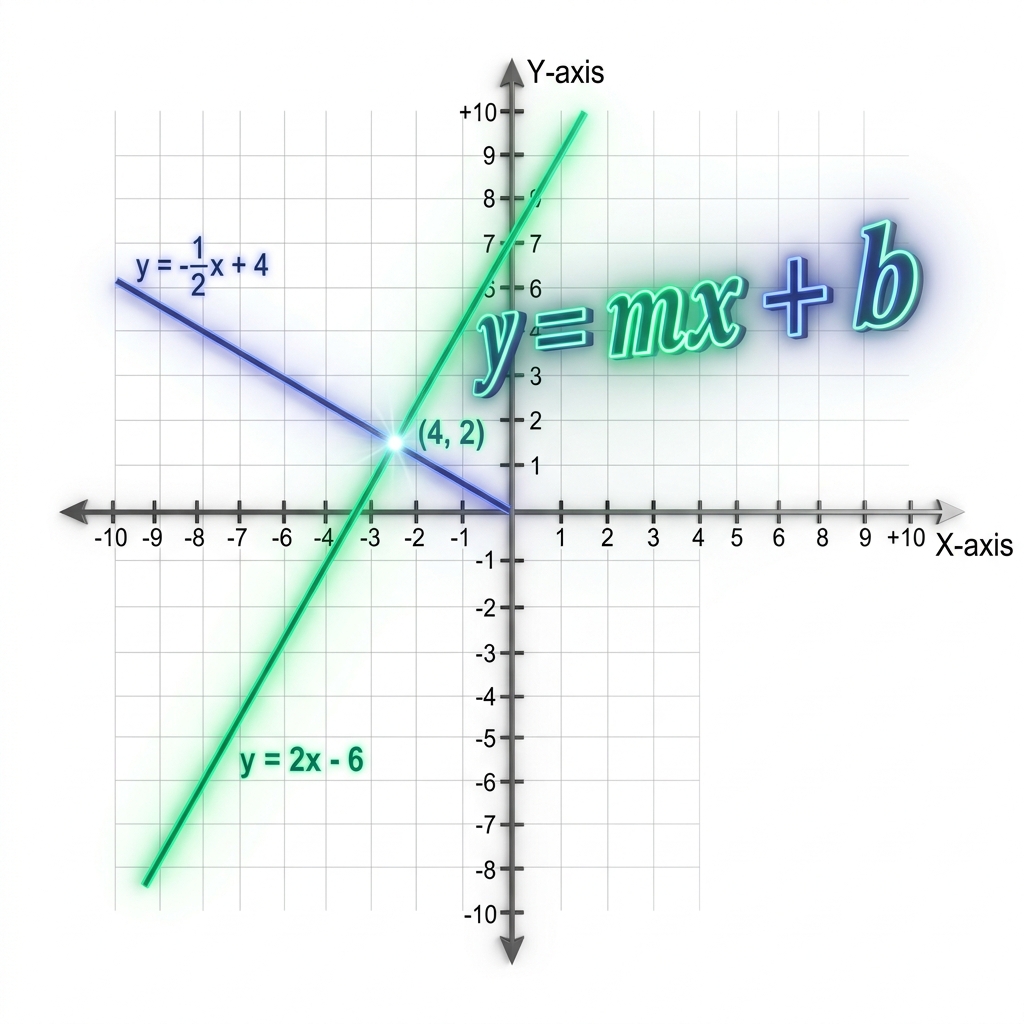
Algebra represents the bedrock of the Digital SAT Math section, accounting for approximately 35% of all active test items (or 13 to 15 questions out of the 44 total questions across both modules). Achieving an elite score of 700+ on the math section requires a deep, exhaustive mastery of algebraic structures. The College Board designs these items to assess your ability to create, analyze, simplify, and solve linear equations, linear inequalities, systems of linear equations, and linear functions in both theoretical contexts and real-world scenarios.
This guide is structured to take you from a foundational understanding of single-variable linear models to advanced graphical relationships and Desmos calculator strategies. By studying the core mechanics and worked examples below, you will build the mathematical intuition needed to identify algebraic shortcuts and avoid common traps on test day. Practice these concepts using our target keyword sat algebra questions and utilize our structured drills to refine your skills.
1. Introduction to SAT Algebra and Core Content Domains
The Algebra domain on the Digital SAT comprises several interrelated mathematical topics. The College Board groups these topics under three major cognitive targets: Conceptual Understanding, Procedural Skill and Fluency, and Applications. To master the Algebra domain, you must understand exactly how these categories translate into exam questions:
- Linear Equations in One Variable: Questions require you to solve for a single variable, determine the number of solutions (one, none, or infinitely many), or rewrite expressions in equivalent forms.
- Linear Equations in Two Variables: Items test your understanding of slope, intercepts, coordinate grids, and representing linear relationships as equations, tables, or graphs.
- Systems of Two Linear Equations: You must solve systems of equations algebraically or graphically, and determine the values of constants that yield specific solution counts (such as parallel or intersecting lines).
- Linear Inequalities in One or Two Variables: You will solve single-variable inequalities, interpret coordinate solution sets, and analyze shaded inequality systems on a graph.
- Algebraic Modeling & Word Problems: Real-world scenarios must be translated from textual descriptions into mathematical equations, inequalities, or functions.
To prepare effectively, you must balance conceptual knowledge with procedural speed. The introduction of the integrated Desmos graphing calculator has changed how students approach these problems, allowing you to bypass time-consuming manual calculations if you know how to leverage the tool properly. However, relying purely on the calculator without understanding the underlying math can lead to critical translation errors.
2. Linear Equations in One Variable
Solving single-variable linear equations is the most fundamental algebraic skill tested on the SAT. At its core, a linear equation in one variable represents a balance: whatever mathematical operation you apply to one side of the equation must be applied to the other side to maintain equality.
Basic Isolation Techniques
The standard form of a linear equation in one variable is: \[ax + b = cx + d\] where \(a\), \(b\), \(c\), and \(d\) are real numbers, and \(x\) is the variable to be isolated. To isolate \(x\), follow a systematic sequence of operations:
- Clear Parentheses: Apply the distributive law: \(a(b + c) = ab + ac\).
- Clear Fractions: If the equation contains fractional terms, multiply every term on both sides by the Least Common Multiple (LCM) of the denominators to eliminate fractions.
- Collect Variable Terms: Add or subtract variable terms so that all terms containing \(x\) are on one side of the equation.
- Collect Constant Terms: Add or subtract constant values to move them to the opposite side of the equation.
- Isolate the Variable: Divide by the coefficient of the variable to find the value of \(x\).
Let us solve a standard single-variable equation: \[3(2x - 5) - 4(x + 1) = 2x - 19\] First, distribute the constants: \[6x - 15 - 4x - 4 = 2x - 19\] Combine like terms on the left side: \[2x - 19 = 2x - 19\] Subtract \(2x\) from both sides: \[-19 = -19\] This is a true statement, indicating that the equation is an identity, and has infinitely many solutions.
Determining the Number of Solutions
On the SAT, you will frequently be asked to determine how many solutions a linear equation has without solving it completely. There are three possible outcomes for any linear equation in one variable:
- One Unique Solution: The equation simplifies to the form \(x = k\), where \(k\) is a constant. This occurs when the coefficients of the variable on both sides are different (e.g., \(2x + 5 = 3x - 1\)).
- No Solution: The equation simplifies to an impossible statement (like \(0 = 5\) or \(-2 = 7\)). This occurs when the variable coefficients are identical on both sides, but the constant terms are different (e.g., \(4x - 7 = 4x + 12\)).
- Infinitely Many Solutions: The equation simplifies to an identity (like \(x = x\) or \(0 = 0\)). This occurs when both the variable coefficients and the constant terms are identical on both sides (e.g., \(5x + 3 = 5x + 3\)).
Let’s represent this classification in a structured table for quick review during your sat algebra practice:
| Equation State | Variable Coefficients | Constant Terms | Example Equation | Solution Count |
|---|---|---|---|---|
| Distinct Slopes | Different (\(a \neq c\)) | Any value | \(3x + 4 = 5x - 2\) | Exactly One |
| Parallel/Disjoint | Equal (\(a = c\)) | Different (\(b \neq d\)) | \(2x - 5 = 2x + 8\) | Zero (No Solution) |
| Identical Lines | Equal (\(a = c\)) | Equal (\(b = d\)) | \(4(x - 3) = 4x - 12\) | Infinitely Many |
3. Linear Inequalities
Linear inequalities behave almost identically to linear equations, but instead of representing a single point of equality, they define an entire interval of numbers. The standard symbols used are:
- Less than: \(<\)
- Greater than: \(>\)
- Less than or equal to: \(\le\)
- Greater than or equal to: \(\ge\)
The Sign Inversion Rule
The single most critical rule when working with inequalities is the sign inversion rule:
When multiplying or dividing both sides of an inequality by a negative number, you must reverse the direction of the inequality sign.
Failure to do this is one of the most common causes of point loss on sat algebra questions. Let us review why this is true. Consider the true statement: \[-2 < 5\] If we multiply both sides of this inequality by \(-3\), we get: \[(-2) \cdot (-3) \text{ and } (5) \cdot (-3)\] \[6 \text{ and } -15\] Clearly, \(6 > -15\). Thus, we must reverse the inequality sign: \[6 > -15\]
Let us apply this to an algebraic inequality: \[7 - 3x \ge 22\] Subtract 7 from both sides: \[-3x \ge 15\] Divide both sides by \(-3\) and reverse the inequality sign: \[x \le -5\] The solution set consists of all real numbers less than or equal to \(-5\).
Compound Inequalities
A compound inequality consists of two inequalities joined by “and” or “or”. On the SAT, “and” inequalities are most common and are written in a three-part format: \[-12 < 2x - 4 \le 8\] To solve a compound inequality of this form, perform operations on all three parts simultaneously:
- Add 4 to all three parts: \[-8 < 2x \le 12\]
- Divide all three parts by 2: \[-4 < x \le 6\] The solution set is the interval \((-4, 6]\), meaning \(x\) is strictly greater than \(-4\) and less than or equal to \(6\).
4. Systems of Two Linear Equations
A system of two linear equations in two variables consists of two linear relationships that must be satisfied simultaneously. The coordinates of the solution point represent the intersection of the two lines on the xy-plane.
Algebraic Solution Methods
There are two primary algebraic methods for solving systems of equations: Substitution and Elimination. Selecting the more efficient method based on the structure of the equations can save valuable time during the test.
1. The Substitution Method
Use substitution when one of the variables is already isolated or can be easily isolated (i.e., has a coefficient of 1 or \(-1\)). Consider the system: \[\begin{cases} y = 3x - 5 \ 2x + 3y = 29 \end{cases}\] Since the first equation explicitly defines \(y\) in terms of \(x\), substitute \(3x - 5\) for \(y\) in the second equation: \[2x + 3(3x - 5) = 29\] Distribute the constant: \[2x + 9x - 15 = 29\] Combine like terms: \[11x - 15 = 29\] Add 15 to both sides: \[11x = 44\] Divide by 11: \[x = 4\] Now, substitute \(x = 4\) back into the first equation to find \(y\): \[y = 3(4) - 5 = 12 - 5 = 7\] The unique solution is the coordinate point \((4, 7)\).
2. The Elimination Method
Use elimination when both equations are written in standard form (\(Ax + By = C\)) and multiplying one or both equations by a constant allows you to eliminate one of the variables by addition or subtraction. Consider the system: \[\begin{cases} 3x - 2y = 13 \ 5x + 4y = 7 \end{cases}\] To eliminate \(y\), multiply the first equation by 2 so that the coefficients of \(y\) are opposites: \[2 \cdot (3x - 2y) = 2 \cdot 13\] \[6x - 4y = 26\] Now, add this modified equation to the second equation: \[(6x - 4y) + (5x + 4y) = 26 + 7\] \[11x = 33\] Divide by 11: \[x = 3\] Substitute \(x = 3\) back into the first equation to solve for \(y\): \[3(3) - 2y = 13\] \[9 - 2y = 13\] Subtract 9: \[-2y = 4\] Divide by \(-2\): \[y = -2\] The unique solution is the coordinate point \((3, -2)\).
Analyzing System Solution Counts
Just like single-variable equations, systems of linear equations can have one, zero, or infinitely many solutions. This is determined by comparing the slopes and y-intercepts of the two lines:
- Exactly One Solution: The lines are not parallel. They have different slopes: \[m_1 \neq m_2\]
- No Solution: The lines are parallel and never intersect. They have the same slope but different y-intercepts: \[m_1 = m_2 \quad \text{and} \quad b_1 \neq b_2\]
- Infinitely Many Solutions: The lines are identical (coincident). They have the same slope and the same y-intercept: \[m_1 = m_2 \quad \text{and} \quad b_1 = b_2\]
If the system is written in standard form: \[\begin{cases} a_1x + b_1y = c_1 \ a_2x + b_2y = c_2 \end{cases}\] We can analyze the ratios of the coefficients to determine the solution state:
- One solution: The ratios of the coefficients of \(x\) and \(y\) are not equal: \[\frac{a_1}{a_2} \neq \frac{b_1}{b_2}\]
- No solution: The ratios of the variable coefficients are equal, but different from the ratio of the constants: \[\frac{a_1}{a_2} = \frac{b_1}{b_2} \neq \frac{c_1}{c_2}\]
- Infinitely many solutions: All coefficient ratios are identical: \[\frac{a_1}{a_2} = \frac{b_1}{b_2} = \frac{c_1}{c_2}\]
This ratio shortcut is incredibly useful for solving linear equations sat problems involving constants like \(k\) or \(a\).
5. Linear Functions, Slope, and Coordinate Geometry
Linear functions describe relationships that change at a constant rate. In coordinate geometry, this constant rate of change is called the slope.
Formulas for Slope
If a line passes through the points \((x_1, y_1)\) and \((x_2, y_2)\), its slope \(m\) is defined as the ratio of the change in \(y\) (vertical change) to the change in \(x\) (horizontal change): \[m = \frac{\Delta y}{\Delta x} = \frac{y_2 - y_1}{x_2 - x_1}\]
The direction and steepness of a line are determined by its slope value:
- Positive Slope (\(m > 0\)): The line rises from left to right.
- Negative Slope (\(m < 0\)): The line falls from left to right.
- Zero Slope (\(m = 0\)): The line is horizontal, represented by the equation \(y = k\).
- Undefined Slope: The line is vertical, represented by the equation \(x = k\).
Three Forms of Linear Equations
Depending on the information provided, you can write the equation of a line in three different ways:
- Slope-Intercept Form: \[y = mx + b\] where \(m\) is the slope and \(b\) is the y-intercept, represented as the coordinate point \((0, b)\).
- Point-Slope Form: \[y - y_1 = m(x - x_1)\] where \(m\) is the slope and \((x_1, y_1)\) is a specific point on the line.
- Standard Form: \[Ax + By = C\] where \(A\), \(B\), and \(C\) are integers (preferably with \(A \ge 0\)). The slope of a line in standard form is \(m = -\frac{A}{B}\), and the y-intercept is \((0, \frac{C}{B})\).
Parallel and Perpendicular Lines
The relationships between the slopes of two lines determine if they are parallel, perpendicular, or neither:
- Parallel Lines: Parallel lines run in the same direction and never intersect. Their slopes are equal: \[m_1 = m_2\]
- Perpendicular Lines: Perpendicular lines intersect at a right angle (\(90^\circ\)). Their slopes are negative reciprocals of each other, meaning their product is \(-1\): \[m_1 \cdot m_2 = -1 \quad \implies \quad m_2 = -\frac{1}{m_1}\]
Let us apply this to find the equation of a perpendicular line. Suppose a line \(L_1\) is given by the equation: \[3x - 4y = 8\] Convert \(L_1\) to slope-intercept form to find its slope: \[-4y = -3x + 8 \quad \implies \quad y = \frac{3}{4}x - 2\] The slope of \(L_1\) is \(m_1 = \frac{3}{4}\). A line \(L_2\) that is perpendicular to \(L_1\) must have a slope \(m_2\) equal to the negative reciprocal of \(\frac{3}{4}\): \[m_2 = -\frac{4}{3}\] If \(L_2\) passes through the origin \((0, 0)\), its equation in slope-intercept form is: \[y = -\frac{4}{3}x\]
6. Word Problems and Algebraic Modeling
The SAT Math section heavily features word problems that test your ability to construct algebraic models from textual descriptions. The challenge of these questions lies primarily in translation: converting English sentences into mathematical operations and equations.
Common Translation Guide
Review this translation guide to quickly set up equations from text during your sat algebra questions practice:
| English Phrase | Mathematical Translation |
|---|---|
| ”Is”, “was”, “equals”, “represents”, “yields” | \(=\) |
| “Added to”, “increased by”, “sum”, “more than” | \(+\) |
| “Subtracted from”, “decreased by”, “less than” | \(-\) |
| “Times”, “product of”, “twice”, “of” (with percentages) | \(\cdot\) |
| “Ratio of”, “divided by”, “per”, “out of” | \(/\) |
| “At least”, “minimum of”, “no less than” | \(\ge\) |
| “At most”, “maximum of”, “no more than” | \(\le\) |
Setting Up Linear Models
A standard linear model represents a scenario with a constant rate of change and an initial value: \[\text{Total Cost} = (\text{Rate of Change} \cdot \text{Quantity}) + \text{Flat Fee}\] In algebraic terms, this is the slope-intercept form \(y = mx + b\):
- Slope (\(m\)): The variable rate or unit cost (e.g., $15 per hour, $0.50 per mile).
- Y-intercept (\(b\)): The fixed cost, flat fee, or starting value (e.g., a $20 registration fee, an initial deposit of $100).
Let us translate a word problem:
A landscaping company charges an initial consultation fee of $50 plus $30 per hour for labor. If a customer’s total bill is $260, how many hours of labor were performed?
Let \(h\) represent the number of hours of labor. The consultation fee is the y-intercept (\(50\)), and the hourly labor rate is the slope (\(30\)). The total cost is \(C(h) = 30h + 50\). We set the cost equal to 260: \[30h + 50 = 260\] Subtract 50: \[30h = 210\] Divide by 30: \[h = 7\] The company performed 7 hours of labor.
7. Graphs and Tables Analysis
Analyzing tables of values and coordinate graphs is a core component of the Algebra section. These questions assess your ability to move fluidly between different representations of linear functions.
Calculating Equations from tables
A table of values represents coordinate points that lie on a line. To find the linear equation that represents the table:
- Select any two rows from the table to establish coordinate pairs \((x_1, y_1)\) and \((x_2, y_2)\).
- Calculate the slope using the slope formula.
- Use the point-slope form with one of the coordinate pairs to solve for the y-intercept.
Let us analyze the table below:
| \(x\) | \(f(x)\) |
|---|---|
| 2 | 11 |
| 5 | 23 |
| 8 | 35 |
Select the points \((2, 11)\) and \((5, 23)\). Calculate the slope: \[m = \frac{23 - 11}{5 - 2} = \frac{12}{3} = 4\] Now, use the point-slope form with the point \((2, 11)\): \[y - 11 = 4(x - 2)\] \[y - 11 = 4x - 8\] \[y = 4x + 3\] The linear function is \(f(x) = 4x + 3\). We can verify this with the third row: \(f(8) = 4(8) + 3 = 32 + 3 = 35\), which matches the table.
8. Common Traps and Pitfalls in SAT Algebra
SAT-style incorrect answer choices often reflect common student errors. Knowing these trap patterns beforehand can help you avoid them without claiming access to unpublished College Board item-writing rules.
Trap 1: Mismatched Units
Many word problems introduce units that do not match the rate units. For example, a rate might be given in miles per hour, but the time is given in minutes. You must convert the units to ensure consistency before setting up your equation.
Example: A vehicle travels at a constant rate of 60 miles per hour. How many miles does it travel in 15 minutes?
The Trap: Calculating \(60 \cdot 15 = 900\) miles.
The Fix: Convert 15 minutes to hours: \(\frac{15}{60} = 0.25\) hours. Calculate \(60 \cdot 0.25 = 15\) miles.
Trap 2: Coordinate Swap
When calculating slope or intercepts, students often switch the \(x\) and \(y\) values or reverse the terms in the slope formula (putting \(\Delta x\) on top instead of \(\Delta y\)).
Example: Finding the slope between \((1, 3)\) and \((4, 5)\).
The Trap: Calculating \(m = \frac{4 - 1}{5 - 3} = \frac{3}{2}\).
The Fix: Always write down the formula: \(m = \frac{y_2 - y_1}{x_2 - x_1} = \frac{5 - 3}{4 - 1} = \frac{2}{3}\).
Trap 3: Solving for the Wrong Expression
If an algebraic question asks for the value of \(2x - 5\), the choices will always include the value of \(x\) alone. Students who solve for \(x\) often select it immediately without completing the final calculation.
The Fix: Read the question stem twice. Circle or write down the target expression (e.g., “Find \(x + 4\)”) to remind yourself of the final step before bubbling your answer.
9. Elite Desmos Graphing Calculator Strategies
Mastering the integrated Desmos Graphing Calculator is one of the most effective ways to boost your speed and accuracy on the Digital SAT. Below are three advanced Desmos strategies specifically for Algebra questions.
Strategy 1: The Visual Systems Solver
If you are asked to solve a system of linear equations, you do not need to perform substitution or elimination.
- Type both equations exactly as they appear in the question into separate input lines in Desmos.
- Desmos will plot both lines. Zoom in or out to locate their intersection point.
- Click the intersection point on the graph. Desmos will display a grey dot and show the coordinates \((x, y)\). Clicking the dot locks the coordinates on the screen.
This technique is completely immune to arithmetic sign slips and takes less than 10 seconds.
Strategy 2: Tabular Linear Regression
When you are given a table of coordinates and asked to identify the equation of the line, Desmos can calculate it for you:
- Click the plus icon in the top-left of the Desmos interface and select Table.
- Input the \(x\) and \(y\) values from the table into the columns labeled \(x_1\) and \(y_1\).
- In a new input line, type the regression model: \[y_1 \sim m x_1 + b\]
- Desmos will immediately calculate and display the values of the slope \(m\) and the y-intercept \(b\).
Strategy 3: Graphing Inequalities and Solution Sets
Desmos can easily graph inequalities, including systems of inequalities:
- Type the inequalities directly into Desmos (e.g., \(y < 2x - 3\) and \(y \ge -x + 1\)).
- Desmos will display solid lines for inclusive inequalities (\(\ge, \le\)) and dashed lines for strict inequalities (\(>, <\)).
- The solution set is the overlapping shaded region. If the question asks if a coordinate point lies in the solution set, type the coordinate point (e.g., \((3, 1)\)) into Desmos and check if it falls inside the overlapping shaded area.
10. Concept Drills and Worked Examples
Let us practice these strategies with eight original algebra questions, showing both the manual algebraic method and the Desmos calculator approach.
Worked Example 1 (Linear Equation Solving)
Question: If \(\frac{2}{3}(x - 4) - \frac{1}{2}(x + 2) = 5\), what is the value of \(x\)?
Algebraic Solution: To eliminate the fractions, identify the least common multiple of the denominators 3 and 2, which is 6. Multiply every term in the equation by 6: \[6 \cdot \left(\frac{2}{3}(x - 4)\right) - 6 \cdot \left(\frac{1}{2}(x + 2)\right) = 6 \cdot 5\] \[4(x - 4) - 3(x + 2) = 30\] Distribute the coefficients: \[4x - 16 - 3x - 6 = 30\] Combine like terms: \[x - 22 = 30\] Add 22 to both sides: \[x = 52\]
Desmos Strategy:
Type the equation 2/3(x-4) - 1/2(x+2) = 5 into line 1. Desmos will plot a vertical line. Zoom out to find where the line crosses the x-axis. Click the intersection point to reveal the x-coordinate: \(x = 52\).
Worked Example 2 (Slope from Coordinates)
Question: Line \(L\) passes through the points \((-3, 5)\) and \((2, -5)\) in the xy-plane. What is the slope of line \(L\)?
Algebraic Solution: Use the slope formula \(m = \frac{y_2 - y_1}{x_2 - x_1}\) with coordinates \((x_1, y_1) = (-3, 5)\) and \((x_2, y_2) = (2, -5)\): \[m = \frac{-5 - 5}{2 - (-3)} = \frac{-10}{2 + 3} = \frac{-10}{5} = -2\] The slope of line \(L\) is \(-2\).
Desmos Strategy:
Click the plus icon and select Table. Input the coordinate points into the table: row 1 as (-3, 5) and row 2 as (2, -5). In line 2, type y1 ~ m*x1 + b. Desmos will output \(m = -2\).
Worked Example 3 (System of Equations with No Solution)
Question: A system of equations is shown below: \[\begin{cases} kx - 3y = 7 \ 8x - 6y = 15 \end{cases}\] If the system has no solution, what is the value of the constant \(k\)?
Algebraic Solution: For a system to have no solution, the two lines must be parallel, meaning their slopes are equal but their y-intercepts are different. Convert both equations to slope-intercept form. First equation: \[-3y = -kx + 7 \quad \implies \quad y = \frac{k}{3}x - \frac{7}{3}\] The slope is \(m_1 = \frac{k}{3}\). Second equation: \[-6y = -8x + 15 \quad \implies \quad y = \frac{8}{6}x - \frac{15}{6} \quad \implies \quad y = \frac{4}{3}x - \frac{5}{2}\] The slope is \(m_2 = \frac{4}{3}\). Equate the slopes: \[\frac{k}{3} = \frac{4}{3} \quad \implies \quad k = 4\]
Desmos Strategy: Type the second equation (8x - 6y = 15\) into line 1. In line 2, type (kx - 3y = 7\) and add a slider for (k\). Set the value of (k\) to different options until the two lines on the graph are parallel. When (k = 4\), the lines will be parallel.
Worked Example 4 (Linear Inequality Boundary)
Question: If \(5 - 2x > 3(x - 5)\), which of the following describes all possible values of \(x\)? A) \(x < 4\) B) \(x > 4\) C) \(x < -4\) D) \(x > -4\)
Algebraic Solution: Distribute the constant on the right side: \[5 - 2x > 3x - 15\] Subtract \(3x\) from both sides: \[5 - 5x > -15\] Subtract 5 from both sides: \[-5x > -20\] Divide both sides by \(-5\) and reverse the inequality sign: \[x < 4\] The correct choice is A.
Desmos Strategy:
Type 5 - 2x > 3(x - 5) into line 1. Desmos will shade the region representing the solution set. The boundary of the shaded region is a dashed vertical line at \(x = 4\), and the shading lies to the left of the line. This indicates the inequality is \(x < 4\).
Worked Example 5 (Perpendicular Line Equation)
Question: Line \(L\) passes through the point \((4, -1)\) and is perpendicular to the line represented by the equation \(y = 2x + 5\). What is the y-intercept of line \(L\)?
Algebraic Solution: The slope of the given line is \(m_1 = 2\). Since line \(L\) is perpendicular to it, the slope of line \(L\) is the negative reciprocal: \[m_2 = -\frac{1}{2}\] Use the point-slope form with the slope \(m_2 = -\frac{1}{2}\) and the point \((4, -1)\): \[y - (-1) = -\frac{1}{2}(x - 4)\] \[y + 1 = -\frac{1}{2}x + 2\] Subtract 1 from both sides to convert to slope-intercept form: \[y = -\frac{1}{2}x + 1\] The y-intercept of line \(L\) is \((0, 1)\), so the value is \(1\) (or y-intercept = 1).
Desmos Strategy:
Type y = 2x + 5 into line 1. In line 2, type the perpendicular slope equation y - (-1) = -1/2 * (x - 4). Zoom in to see where this second line crosses the y-axis. It crosses at \((0, 1)\), so the y-intercept is 1.
Worked Example 6 (Algebraic Translation Word Problem)
Question: A local tech rental company charges a base reservation fee of $25 plus an hourly fee of $8.50 to rent a tablet. A school district rented a tablet for a certain number of hours and was billed a total of $93. For how many hours did the district rent the tablet?
Algebraic Solution: Let \(x\) represent the number of hours the tablet was rented. The base fee is a flat constant ($25) and the hourly rate is the slope ($8.50). The equation representing the total bill is: \[8.50x + 25 = 93\] Subtract 25: \[8.50x = 68\] Divide by 8.50: \[x = \frac{68}{8.50} = 8\] The district rented the tablet for 8 hours.
Desmos Strategy:
Type the equation 8.50x + 25 = 93 into line 1. Desmos will plot a vertical line at \(x = 8\). Click the point where the line crosses the x-axis to find the value, which is 8.
Worked Example 7 (Linear Function from a Table)
Question: The linear function \(f\) is defined by the table of values below:
| \(x\) | \(f(x)\) |
|---|---|
| \(-1\) | \(-7\) |
| 1 | \(-1\) |
| 3 | 5 |
What is the value of \(f(10)\)?
Algebraic Solution: First, select the coordinates \((-1, -7)\) and \((1, -1)\) to calculate the slope of function \(f\): \[m = \frac{-1 - (-7)}{1 - (-1)} = \frac{-1 + 7}{1 + 1} = \frac{6}{2} = 3\] Now, use the slope \(m = 3\) and the coordinate \((1, -1)\) to write the equation of the function: \[y - (-1) = 3(x - 1)\] \[y + 1 = 3x - 3\] \[y = 3x - 4\] The linear function is \(f(x) = 3x - 4\). To find \(f(10)\), substitute \(x = 10\) into the equation: \[f(10) = 3(10) - 4 = 30 - 4 = 26\]
Desmos Strategy:
Input the table values into Desmos. Run the linear regression model y1 ~ m*x1 + b. Desmos will output \(m = 3\) and \(b = -4\). Now, define the function in line 3 as f(x) = 3x - 4. In line 4, type f(10). Desmos will output the value 26.
Worked Example 8 (System of Linear Inequalities)
Question: Which of the following coordinate points lies within the solution set of the system of inequalities shown below? \[y > x + 3\] \[y \le -2x + 6\] A) \((0, 0)\) B) \((1, 5)\) C) \((-1, 4)\) D) \((3, -2)\)
Algebraic Solution: Test each coordinate choice by substituting the \(x\) and \(y\) values into both inequalities.
- Let’s test Choice A: \((0, 0)\). First inequality: \(0 > 0 + 3 \implies 0 > 3\) (False). Rule out A.
- Let’s test Choice B: \((1, 5)\). First inequality: \(5 > 1 + 3 \implies 5 > 4\) (True). Second inequality: \(5 \le -2(1) + 6 \implies 5 \le 4\) (False). Rule out B.
- Let’s test Choice C: \((-1, 4)\). First inequality: \(4 > -1 + 3 \implies 4 > 2\) (True). Second inequality: \(4 \le -2(-1) + 6 \implies 4 \le 2 + 6 \implies 4 \le 8\) (True). Since Choice C satisfies both inequalities, it lies in the solution set.
Desmos Strategy:
Type the two inequalities y > x + 3 and y <= -2x + 6 into Desmos. Plot the coordinate points: (0, 0), (1, 5), (-1, 4), and (3, -2). Visually inspect which point falls inside the overlapping shaded region. The point \((-1, 4)\) lies inside the region.
11. Algebra Practice Mini Quiz
Use the five original algebra checks below to test whether you can identify the equation structure, choose an efficient method, and explain the final step. Detailed explanations follow the questions.
Quiz Questions
Question 1
The table of values below represents points on the line of function \(g\):
| \(x\) | \(g(x)\) |
|---|---|
| 2 | \(-5\) |
| 4 | \(-1\) |
| 6 | 3 |
Which of the following equations defines function \(g\)? A) \(g(x) = 2x - 9\) B) \(g(x) = -2x - 1\) C) \(g(x) = 4x - 13\) D) \(g(x) = \frac{1}{2}x - 6\)
Question 2
A system of two linear equations is shown below: \[\begin{cases} y = ax + 3 \ 4x - 2y = -6 \end{cases}\] If the system has infinitely many solutions, what is the value of the constant \(a\)? A) \(-2\) B) \(-1\) C) 2 D) 4
Question 3
Which of the following represents the solution set for the inequality \(-2(x - 3) + 4 \ge 5x - 11\)? A) \(x \le 3\) B) \(x \ge 3\) C) \(x \le -3\) D) \(x \ge -3\)
Question 4
A membership plan at a local climbing gym charges an initial registration fee of $45 plus a monthly rate of $35. If a member has been billed a total of $325 since joining, how many months of membership does this represent? (Enter your numerical answer in the box).
Question 5
Line \(P\) is defined by the equation \(y = -\frac{3}{5}x + 4\). Line \(Q\) is perpendicular to Line \(P\) and passes through the point \((6, 2)\). What is the y-intercept of Line \(Q\)? A) \(-8\) B) \(-6\) C) 4 D) 8
Quiz Answers and Explanations
Question 1
Correct Answer: A Explanation: To find the equation of function \(g\), first calculate the slope \(m\) using two points from the table, \((2, -5)\) and \((4, -1)\): \[m = \frac{-1 - (-5)}{4 - 2} = \frac{-1 + 5}{2} = \frac{4}{2} = 2\] Since the slope is 2, we can rule out Choices B, C, and D. Next, use the slope \(m = 2\) and the point \((2, -5)\) to find the y-intercept: \[y - (-5) = 2(x - 2)\] \[y + 5 = 2x - 4\] \[y = 2x - 9\] The equation is \(g(x) = 2x - 9\).
- Choice B is incorrect and results from a sign error when calculating the slope.
- Choice C is incorrect and represents a slope of 4.
- Choice D is incorrect and represents a slope of \(\frac{1}{2}\).
Question 2
Correct Answer: C Explanation: For a system to have infinitely many solutions, the two lines must be identical. Let us write the second equation in slope-intercept form to compare coefficients: \[4x - 2y = -6\] Subtract \(4x\) from both sides: \[-2y = -4x - 6\] Divide by \(-2\): \[y = 2x + 3\] Compare this to the first equation \(y = ax + 3\). The y-intercepts are already identical (both are 3). For the lines to be identical, the slopes must also be equal. Therefore, \(a = 2\).
- Choice A is incorrect and represents a sign error when dividing by \(-2\).
- Choice B is incorrect.
- Choice D is incorrect.
Question 3
Correct Answer: A Explanation: Distribute the constant on the left side of the inequality: \[-2x + 6 + 4 \ge 5x - 11\] Combine constant terms on the left: \[-2x + 10 \ge 5x - 11\] Subtract \(5x\) from both sides: \[-7x + 10 \ge -11\] Subtract 10 from both sides: \[-7x \ge -21\] Divide both sides by \(-7\) and reverse the inequality sign: \[x \le 3\] The correct choice is A.
- Choice B is incorrect and results from failing to reverse the inequality sign when dividing by the negative number \(-7\).
- Choice C is incorrect.
- Choice D is incorrect.
Question 4
Correct Answer: 8 Explanation: Write the linear model representing the total cost. The base registration fee is the flat value ($45) and the monthly rate is the slope ($35). Let \(m\) represent the number of months. The total cost function is: \[35m + 45 = 325\] Subtract 45 from both sides: \[35m = 280\] Divide by 35: \[m = \frac{280}{35} = 8\] The user has been a member for 8 months.
Question 5
Correct Answer: A Explanation: The slope of Line \(P\) is \(m_1 = -\frac{3}{5}\). Since Line \(Q\) is perpendicular to Line \(P\), its slope \(m_2\) is the negative reciprocal: \[m_2 = \frac{5}{3}\] Use the point-slope form with slope \(m_2 = \frac{5}{3}\) and the point \((6, 2)\) to write the equation of Line \(Q\): \[y - 2 = \frac{5}{3}(x - 6)\] Distribute the slope: \[y - 2 = \frac{5}{3}x - 10\] Add 2 to both sides to write in slope-intercept form: \[y = \frac{5}{3}x - 8\] The y-intercept of Line \(Q\) is \(-8\).
- Choice B is incorrect.
- Choice C is incorrect and is the y-intercept of Line \(P\).
- Choice D is incorrect.
Practice Application: Digital SAT Math Algebra: The Complete Study Guide
Original Math-Style Setup
Create an original problem that tests algebra with different numbers than the examples on this page.
Targeted Drill
Solve five targeted questions, then re-solve every miss without looking at the explanation.
Math Review Checklist
- I can identify the tested domain.
- I can solve once by hand or setup and once with Desmos when useful.
- I logged the exact reason for every miss.
Next Step
Move into timed Math practice after the untimed repair drill is accurate.
Continue practice →Official Source: SAT Math Section
Frequently Asked Questions
What percentage of the Digital SAT Math section is Algebra?
Algebra makes up approximately 35% of the Digital SAT Math section, representing 13 to 15 questions out of the 44 total questions across both modules. This makes it the largest single domain on the math portion of the exam, meaning a strong foundation in algebraic manipulation, linear models, and systems of equations is essential for achieving an elite score.
Can I use the Desmos calculator for all Algebra questions?
Yes, you can use the integrated Desmos Graphing Calculator on every single question in the Math section of the Digital SAT. For Algebra, Desmos is extremely powerful for finding line intersections, checking coordinate solutions, graphing inequalities, and running regressions on tabular data. However, you should still understand the algebraic concepts to avoid setup errors.
What is the mathematical condition for a system of linear equations to have no solution?
A system of two linear equations has no solution if the two lines are parallel. Geometrically, this means they never intersect. Algebraically, it means the lines have the exact same slope but different y-intercepts. If the lines are represented in slope-intercept form as \\(y = m_1x + b_1\\) and \\(y = m_2x + b_2\\), the conditions are \\(m_1 = m_2\\) and \\(b_1 \neq b_2\\).
How do I avoid sign errors when solving linear inequalities?
The most important rule in solving inequalities is to reverse the direction of the inequality sign whenever you multiply or divide both sides by a negative number. For example, if you have the inequality \\(-3x < 12\\), dividing both sides by \\(-3\\) requires you to flip the sign, yielding \\(x > -4\\). If you multiply or divide by a positive number, the inequality sign remains unchanged.
What are the rules for parallel and perpendicular lines on the SAT?
On the coordinate plane, parallel lines have identical slopes. If line 1 has slope \\(m_1\\) and line 2 has slope \\(m_2\\), then \\(m_1 = m_2\\). Perpendicular lines have slopes that are negative reciprocals of each other, meaning their product is \\(-1\\). Mathematically, this is expressed as \\(m_1 \cdot m_2 = -1\\) or \\(m_2 = -\frac{1}{m_1}\\). Horizontal lines (slope = 0) and vertical lines (slope = undefined) are perpendicular.
How do I translate complex word problems into linear equations?
To translate word problems, assign variable names to unknown quantities (like \\(x\\) for the number of hours or \\(y\\) for total cost). Translate key phrases into operations: 'is' or 'equals' translates to \\(=\\), 'per' or 'each' indicates a rate (slope), and 'flat fee' or 'initial value' represents the y-intercept. For example, 'a rental costs $20 plus $5 per hour' translates to \\(C(h) = 5h + 20\\).
What is the best way to find the slope of a line from a table of values?
To find the slope from a table, select any two coordinate pairs \\((x_1, y_1)\\) and \\((x_2, y_2)\\) from the table. Apply the slope formula \\(m = \frac{y_2 - y_1}{x_2 - x_1}\\). It is a good practice to choose coordinates with small integers or zeros to make the calculation simpler and reduce the risk of arithmetic errors.
What should I do if a system of equations contains constants like a or k?
If a system contains constants and specifies the number of solutions (e.g. no solution or infinitely many), write both equations in the same form (like slope-intercept form \\(y = mx + b\\) or standard form \\(Ax + By = C\\)). Then, equate the coefficients of the terms. For infinitely many solutions, the ratio of all coefficients must be equal. For no solutions, the ratios of the variable coefficients must be equal, but different from the constant terms.
Are there any grid-in formatting rules I should know for Algebra answers?
Yes. Student-Produced Responses can be positive or negative in the digital response field as long as the answer fits the allowed character space. If your answer is a fraction, it can be entered unreduced as long as it fits (e.g., \\(4/8\\) is accepted, but \\(100/200\\) is too long and must be reduced to \\(1/2\\) or entered as \\(0.5\\)). Repeating decimals must fill the entry field as precisely as allowed (e.g., \\(2/3\\) can be entered as \\(.666\\) or \\(.667\\)).
How can I verify my algebraic answers using Desmos?
To verify your algebraic work, type the original equations or expressions into Desmos, and type your calculated solution as a constant or coordinate point. If you solved for \\(x\\), check that the vertical line \\(x = \text{your answer}\\) passes through the correct intersection point or root on the graph. This visual verification takes only a few seconds and prevents simple arithmetic slip-ups.