Digital SAT Math Advanced Math: The Complete Study Guide
Review SAT advanced math topics: quadratics, exponential functions, polynomials, radicals, transformations, and Desmos strategies.
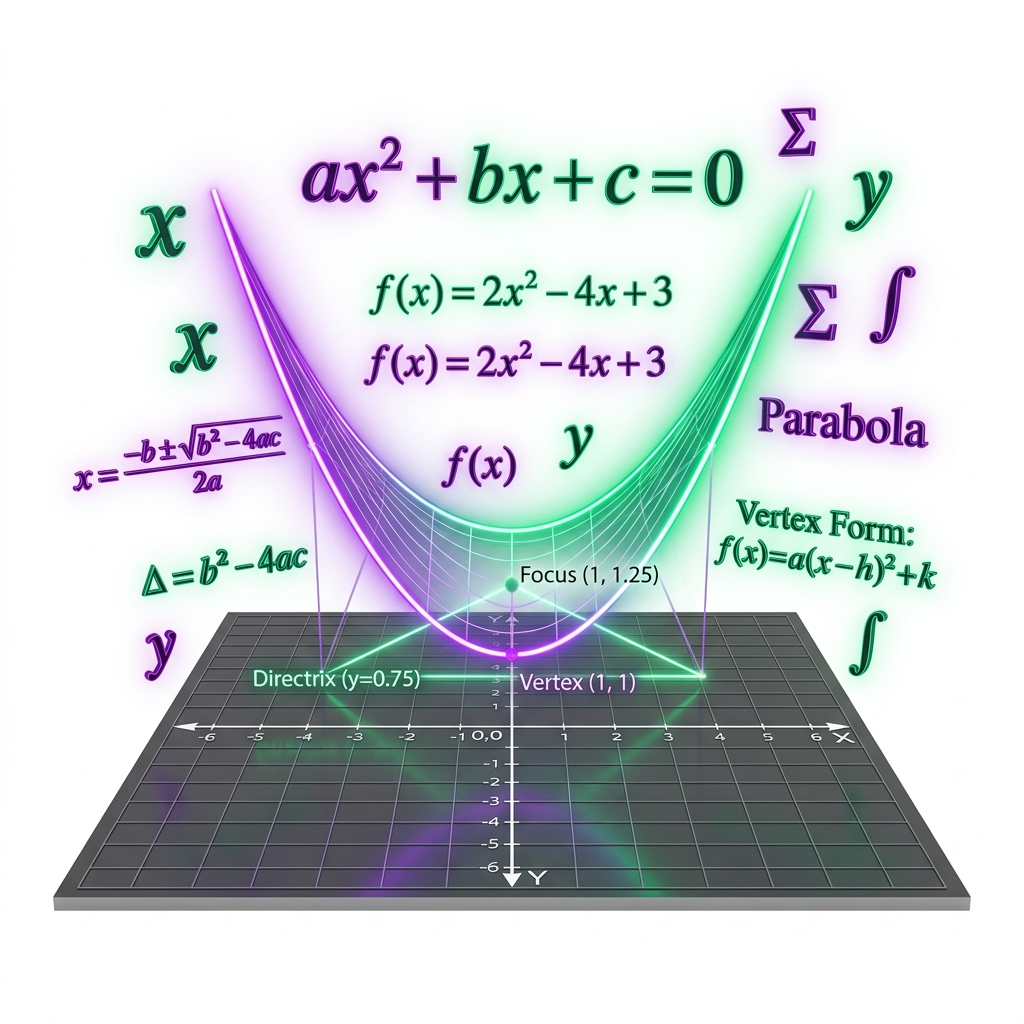
While foundational algebra forms the base of the Digital SAT Math section, Advanced Math is what separates average scores from elite scores. Accounting for approximately 35% of all active test items (or 13 to 15 questions out of the 44 total questions across both modules), this domain contains the most cognitively demanding questions on the exam. The College Board uses these questions to assess your familiarity with quadratic functions, exponential growth and decay models, polynomial factoring, radical manipulations, function operations, and graphing coordinate transformations.
This guide provides an exhaustive review of Advanced Math concepts, detailed algebraic derivations, Desmos calculator shortcuts, and original worked examples. By mastering these non-linear relationships, you will build the mathematical tools required to tackle hard Module 2 questions efficiently. Practice these skills using our primary keyword sat advanced math to maximize your score.
1. Introduction to SAT Advanced Math and Core Concepts
Advanced Math covers relationships that are non-linear, meaning their rate of change is not constant. On a graph, instead of a straight line, these relationships produce curves—such as parabolas, exponential curves, or wavy polynomial graphs. The College Board categorizes these questions under three primary topics:
- Quadratics and Parabolas: Solving quadratic equations using multiple methods, identifying vertex forms, interpreting maximums and minimums, and analyzing intercept spacing.
- Exponential Functions: Modeling scenarios where values increase or decrease by a constant percentage, interpreting compound interest, half-life decay, and doubling intervals.
- Polynomials and Rational Functions: Applying divisibility rules, factoring cubic or higher-degree polynomials, applying the Remainder Theorem, and simplifying rational algebraic fractions.
- Radicals and Exponent Rules: Converting between fractional powers and roots, simplifying radical expressions, and resolving variable expressions with negative or fractional exponents.
- Functions and Transformations: Analyzing function notation, evaluating composite functions like \(f(g(x))\), and shifting, stretching, or reflecting graphs on the coordinate plane.
Success in this domain requires more than memorizing formulas; you must understand what the parameters in these non-linear models represent in real-world contexts. Let us explore each of these topics in depth.
2. Quadratic Equations and Parabolas
Quadratic equations are polynomial equations of degree 2. Geometrically, a quadratic function produces a symmetric U-shaped curve called a parabola.
The Three Algebraic Forms
A quadratic function can be written in three distinct forms, each revealing specific characteristics of the graph:
1. Standard Form:
\[y = ax^2 + bx + c\]
- The y-intercept is located at the point \((0, c)\).
- The value of \(a\) determines the direction the parabola opens: if \(a > 0\), the parabola opens upward (concave up), and if \(a < 0\), it opens downward (concave down).
- The x-coordinate of the vertex is calculated using the formula: \[h = -\frac{b}{2a}\]
2. Vertex Form:
\[y = a(x - h)^2 + k\]
- The coordinate point \((h, k)\) represents the vertex (the turning point, which is either the absolute minimum if \(a > 0\), or the absolute maximum if \(a < 0\)).
- The vertical line \(x = h\) represents the axis of symmetry.
- Trap Warning: The sign inside the parentheses is negative. For example, the function \(f(x) = 3(x - 5)^2 + 12\) has its vertex at \((5, 12)\), not \((-5, 12)\). Conversely, \(f(x) = 3(x + 5)^2 + 12\) has its vertex at \((-5, 12)\).
3. Factored Form:
\[y = a(x - r_1)(x - r_2)\]
- The constants \(r_1\) and \(r_2\) represent the roots, zeros, or x-intercepts of the function, located at the coordinate points \((r_1, 0)\) and \((r_2, 0)\).
- By symmetry, the x-coordinate of the vertex lies exactly halfway between the roots: \[h = \frac{r_1 + r_2}{2}\]
Solving Quadratic Equations
To find the roots of a quadratic equation (i.e., the values of \(x\) that satisfy \(ax^2 + bx + c = 0\)), you can use four methods:
- Factoring: Rewriting the quadratic as a product of linear binomials. For example, \(x^2 - 5x - 6 = 0\) factors into \((x - 6)(x + 1) = 0\), yielding roots \(x = 6\) and \(x = -1\).
- Taking Square Roots: Used when the equation lacks a linear term (e.g., \(3x^2 = 75 \implies x^2 = 25 \implies x = \pm 5\)).
- Completing the Square: Useful for converting standard form into vertex form. Add and subtract \(\left(\frac{b}{2}\right)^2\) to create a perfect square trinomial.
- The Quadratic Formula: A universal method that works for any quadratic equation: \[x = \frac{-b \pm \sqrt{b^2 - 4ac}}{2a}\]
The Role of the Discriminant
The expression under the radical in the quadratic formula is called the discriminant, represented by the Greek letter delta (\(\Delta\)): \[\Delta = b^2 - 4ac\] The value of the discriminant determines the number and type of solutions to the quadratic equation \(ax^2 + bx + c = 0\):
- \(\Delta > 0\): The equation has two distinct real solutions. The graph of the parabola intersects the x-axis at two separate points.
- \(\Delta = 0\): The equation has exactly one real solution (a repeated root). The graph is tangent to the x-axis, with its vertex sitting directly on the x-axis.
- \(\Delta < 0\): The equation has zero real solutions (and two complex conjugate solutions). The graph does not touch the x-axis, remaining entirely above or below it.
Let us summarize these discriminant relationships in a table:
| Discriminant Value | Solution Count | Graphical Representation (Parabola) |
|---|---|---|
| \(\Delta = b^2 - 4ac > 0\) | 2 Real | Intersects the x-axis at two distinct coordinate points |
| \(\Delta = b^2 - 4ac = 0\) | 1 Real | Tangent to the x-axis; the vertex lies on the x-axis |
| \(\Delta = b^2 - 4ac < 0\) | 0 Real | Never touches the x-axis; lies entirely above or below |
3. Exponential Growth and Decay
Exponential functions describe processes where a quantity grows or decays at a constant percentage rate per unit time. This contrasts with linear models, which grow or decay at a constant numerical rate.
The General Exponential Model
The standard mathematical model for an exponential function is: \[y = a(b)^x\] where:
- \(a\) represents the initial value (the y-intercept, since \(y = a(b)^0 = a \cdot 1 = a\)).
- \(b\) represents the growth or decay factor:
- If \(b > 1\), the model represents exponential growth.
- If \(0 < b < 1\), the model represents exponential decay.
- The value of \(b\) can be expressed using the percentage rate of change \(r\) (expressed as a decimal):
- For growth: \(b = 1 + r\)
- For decay: \(b = 1 - r\)
For example, if a population of bacteria starts at 500 and increases by 12% every hour, the growth rate is \(r = 0.12\), and the growth factor is \(b = 1 + 0.12 = 1.12\). The population after \(x\) hours is modeled by: \[P(x) = 500(1.12)^x\] Conversely, if a computer’s value depreciates by 15% each year, the decay rate is \(r = 0.15\), and the decay factor is \(b = 1 - 0.15 = 0.85\). The value after \(t\) years is modeled by: \[V(t) = V_0(0.85)^t\]
Advanced Exponent Scenarios (Interval Models)
On the SAT, you will frequently see exponential models where the growth or decay occurs over specific time intervals (such as doubling every 3 days or halving every 8 hours). These are modeled as: \[y = a(c)^{\frac{t}{p}}\] where:
- \(c\) is the growth/decay base (e.g., \(c = 2\) for doubling, \(c = 3\) for tripling, \(c = 0.5\) for halving).
- \(p\) is the period required for the growth/decay cycle to occur.
- \(t\) is the elapsed time in the same units as \(p\).
Let us model half-life:
A radioactive isotope has a half-life of 24 hours. If a scientist starts with a 100-gram sample, how much remains after \(t\) hours?
The base is \(c = 0.5\) (or \(\frac{1}{2}\)), the cycle period is \(p = 24\), and the initial quantity is \(a = 100\). The mass \(M(t)\) after \(t\) hours is: \[M(t) = 100(0.5)^{\frac{t}{24}}\] If we want to know how much remains after 48 hours, we substitute \(t = 48\): \[M(48) = 100(0.5)^{\frac{48}{24}} = 100(0.5)^2 = 100(0.25) = 25 \text{ grams}\]
4. Polynomials, Divisibility, and Factor Theorems
A polynomial function of degree \(n\) has the standard form: \[P(x) = a_n x^n + a_{n-1} x^{n-1} + \dots + a_1 x + a_0\] The SAT tests your ability to identify roots, analyze factors, and interpret division remainders.
The Factor Theorem
The Factor Theorem connects the roots of a polynomial with its algebraic factors:
A polynomial \(P(x)\) has a linear binomial factor \(x - c\) if and only if \(P(c) = 0\).
Geometrically, if \(P(c) = 0\), the graph of the polynomial has an x-intercept at the coordinate point \((c, 0)\).
The Remainder Theorem
The Remainder Theorem is one of the most useful tools for Advanced Math questions:
If a polynomial \(P(x)\) is divided by the linear binomial \(x - c\), the numerical remainder of this division is equal to the value of the function evaluated at \(c\): \[R = P(c)\]
For example, if you divide \(P(x) = x^3 - 4x^2 + 5x - 7\) by \(x - 2\), you do not need to perform long division or synthetic division to find the remainder. Simply evaluate \(P(2)\): \[R = P(2) = (2)^3 - 4(2)^2 + 5(2) - 7 = 8 - 16 + 10 - 7 = -5\] The remainder is \(-5\).
5. Radicals and Rational Exponents
Rational exponents are another representation of radical expressions. Understanding exponent rules allows you to simplify complex expressions and solve equations containing fractional exponents.
Core Exponent Rules
Memorize these operations to improve speed on sat advanced math items:
- Product Rule: \(x^a \cdot x^b = x^{a+b}\)
- Quotient Rule: \(\frac{x^a}{x^b} = x^{a-b}\)
- Power to a Power Rule: \((x^a)^b = x^{ab}\)
- Negative Exponent Rule: \(x^{-n} = \frac{1}{x^n}\)
- Rational Exponent Rule: \[x^{\frac{a}{b}} = \sqrt[b]{x^a} = (\sqrt[b]{x})^a\]
Let us simplify a variable expression containing fractional powers: \[\frac{\sqrt[3]{x^4} \cdot \sqrt{x}}{\sqrt[6]{x^5}}\] First, convert all radical expressions to rational exponents:
- \(\sqrt[3]{x^4} = x^{\frac{4}{3}}\)
- \(\sqrt{x} = x^{\frac{1}{2}}\)
- \(\sqrt[6]{x^5} = x^{\frac{5}{6}}\)
Now, rewrite the expression: \[\frac{x^{\frac{4}{3}} \cdot x^{\frac{1}{2}}}{x^{\frac{5}{6}}}\] Apply the product rule to the numerator by adding the exponents: \[\frac{4}{3} + \frac{1}{2} = \frac{8}{6} + \frac{3}{6} = \frac{11}{6} \quad \implies \quad x^{\frac{11}{6}}\] Now, apply the quotient rule by subtracting the denominator’s exponent: \[\frac{11}{6} - \frac{5}{6} = \frac{6}{6} = 1\] The expression simplifies to: \[x^1 = x\]
6. Function Notation and Graphing Transformations
Functions are rules that map inputs to outputs. Graphing transformations describe how modifying a function’s algebraic expression shifts or stretches its graph on the coordinate plane.
Evaluating Functions and Composites
Function notation is represented by \(f(x)\). A composite function \(f(g(x))\) means that the output of function \(g(x)\) becomes the input for function \(f(x)\). Consider: \[f(x) = 2x + 5 \quad \text{and} \quad g(x) = x^2 - 3\] To evaluate \(f(g(4))\):
- First, find \(g(4)\): \[g(4) = (4)^2 - 3 = 16 - 3 = 13\]
- Next, substitute 13 into function \(f(x)\): \[f(13) = 2(13) + 5 = 26 + 5 = 31\] Therefore, \(f(g(4)) = 31\).
To find the general expression for the composite function \(g(f(x))\): \[g(f(x)) = (2x + 5)^2 - 3\] Expand the binomial square: \[g(f(x)) = 4x^2 + 20x + 25 - 3 = 4x^2 + 20x + 22\]
The Geometry of Graphing Transformations
If you know the graph of \(y = f(x)\), you can predict the graph of its transformed version based on these mathematical rules:
- Vertical Shift:
- Up by \(c\): \(y = f(x) + c\)
- Down by \(c\): \(y = f(x) - c\)
- Horizontal Shift (Note the sign reversal):
- Left by \(c\): \(y = f(x + c)\)
- Right by \(c\): \(y = f(x - c)\)
- Reflections:
- Over the x-axis: \(y = -f(x)\) (negates all y-coordinates)
- Over the y-axis: \(y = f(-x)\) (negates all x-coordinates)
- Stretches and Compressions:
- Vertical Stretch: \(y = a \cdot f(x)\) where \(a > 1\)
- Vertical Compression: \(y = a \cdot f(x)\) where \(0 < a < 1\)
Let us apply this to transform the vertex of a parabola. Suppose the function \(f(x) = (x - 3)^2 + 4\) represents a parabola with its vertex at \((3, 4)\). If we define a new function \(g(x) = f(x + 2) - 5\), let us find the vertex of the new parabola:
- The term \(f(x + 2)\) shifts the graph horizontally to the left by 2 units. The x-coordinate shifts from \(3\) to \(3 - 2 = 1\).
- The term \(- 5\) shifts the graph vertically down by 5 units. The y-coordinate shifts from \(4\) to \(4 - 5 = -1\). The vertex of the transformed parabola \(g(x)\) is located at \((1, -1)\).
7. Word Problems and Nonlinear Modeling
Non-linear word problems on the SAT model real-world scenarios such as projectile motion, radioactive decay, animal populations, and depreciating assets.
Projectile Motion (Quadratic Modeling)
A projectile thrown into the air follows a parabolic path. Its height \(h(t)\) over time \(t\) is represented by: \[h(t) = -at^2 + vt + h_0\] where:
- \(-at^2\) represents the downward acceleration due to gravity (usually \(-4.9t^2\) in meters or \(-16t^2\) in feet).
- \(v\) is the initial vertical velocity.
- \(h_0\) is the initial launch height.
On the SAT, you will be asked to identify:
- The Maximum Height: This is the y-coordinate of the vertex (\(k\)).
- The Time to Reach Maximum Height: This is the x-coordinate of the vertex (\(h\)).
- The Total Time in Flight: The time when the projectile hits the ground, found by setting \(h(t) = 0\) and solving for positive values of \(t\) (the positive root).
Let us solve a projectile problem:
A ball is launched from a platform. Its height in feet after \(t\) seconds is modeled by \(h(t) = -16t^2 + 64t + 80\). What is the maximum height the ball reaches?
First, identify the coefficients: \(a = -16\), \(b = 64\), \(c = 80\). Calculate the time to reach maximum height (vertex x-coordinate): \[t = -\frac{b}{2a} = -\frac{64}{2(-16)} = -\frac{64}{-32} = 2 \text{ seconds}\] Now, substitute \(t = 2\) back into the function to find the maximum height (vertex y-coordinate): \[h(2) = -16(2)^2 + 64(2) + 80 = -16(4) + 128 + 80 = -64 + 128 + 80 = 144 \text{ feet}\] The maximum height reached by the ball is 144 feet.
8. Common Mistakes and Error Patterns
Advanced Math contains several algebraic relationships that are prone to conceptual errors. Review these common pitfalls to protect your score:
Error Pattern 1: Incorrectly Squaring Binomials
Students often square binomials by simply squaring the terms individually.
The Error: \((x + 5)^2 = x^2 + 25\).
The Correction: A squared binomial must be expanded using FOIL or the perfect square trinomial formula: \[(x + 5)^2 = (x + 5)(x + 5) = x^2 + 5x + 5x + 25 = x^2 + 10x + 25\]
Error Pattern 2: Mixing Vertex Signs
In the vertex form \(y = a(x - h)^2 + k\), the constant inside the parentheses is subtracted, while the constant outside is added.
The Error: Stating that the vertex of \(y = (x - 3)^2 - 4\) is at \((-3, -4)\).
The Correction: The x-coordinate has the opposite sign, while the y-coordinate retains its sign. The vertex is at \((3, -4)\).
Error Pattern 3: Failing to Verify Extraneous Roots
When solving equations involving radicals, squaring both sides can introduce numerical solutions that are algebraically correct but violate the positive root definition of radicals.
Example: Solve \(\sqrt{x + 2} = x\).
The Step: Square both sides: \(x + 2 = x^2 \implies x^2 - x - 2 = 0 \implies (x - 2)(x + 1) = 0\), yielding \(x = 2\) and \(x = -1\).
The Trap: Claiming both are solutions.
The Correction: Substitute both roots into the original radical equation.
- For \(x = 2\): \(\sqrt{2 + 2} = \sqrt{4} = 2\) (True).
- For \(x = -1\): \(\sqrt{-1 + 2} = \sqrt{1} = 1\), but the right side is \(-1\). Thus, \(1 = -1\) (False). Only \(x = 2\) is a valid solution; \(x = -1\) is an extraneous root.
9. Elite Desmos Graphing Calculator Strategies
mastering the integrated Desmos Graphing Calculator is one of the most effective ways to boost your speed and accuracy on the Digital SAT. Below are three advanced Desmos strategies specifically for Advanced Math questions.
Strategy 1: Visual Vertex and Intercept Finder
For any quadratic or polynomial function, you can find vertices, roots, and intercepts instantly:
- Type the function into Desmos (e.g., \(y = -16x^2 + 64x + 80\)).
- Click on the curve. Desmos will mark key points with grey coordinate dots.
- Click on the dot at the peak or valley to lock the vertex coordinates on the screen. Click the dots along the x-axis to find the roots instantly.
This technique is completely immune to sign slips and takes less than 10 seconds.
Strategy 2: Checking Equivalent Expressions
Many Advanced Math questions ask you to identify which of four choices is equivalent to a complex expression. You can solve these visually:
- Type the original expression into line 1 (e.g., \((2x + 5)/(x - 2)\)).
- Type the four answer choices into lines 2, 3, 4, and 5.
- Observe the graphs. The correct answer choice will produce a curve that overlaps the original graph exactly. You can toggle the visibility icons next to each equation to verify.
This bypasses time-consuming algebraic manipulation and polynomial long division.
Strategy 3: Shaded Systems of Equations
When solving non-linear systems of equations (such as a line intersecting a parabola):
- Type both equations into Desmos.
- Zoom in or out to find where the graphs cross.
- Click the intersection points. Desmos will lock the coordinates \((x, y)\) on the screen. If the question asks for the sum of the solutions or coordinate values, you can read them directly.
10. Concept Drills and Worked Examples
Let us practice these strategies with eight original advanced math questions, showing both the manual algebraic method and the Desmos calculator approach.
Worked Example 1 (Vertex by Completing the Square)
Question: Which of the following represents the vertex form of the quadratic function \(f(x) = x^2 - 8x + 22\)? A) \(f(x) = (x - 4)^2 + 6\) B) \(f(x) = (x - 4)^2 + 22\) C) \(f(x) = (x + 4)^2 + 6\) D) \(f(x) = (x - 8)^2 + 6\)
Algebraic Solution: To convert the standard form \(x^2 - 8x + 22\) into vertex form, complete the square:
- Identify the coefficient of the linear term, which is \(-8\).
- Divide this coefficient by 2 and square the result: \(\left(\frac{-8}{2}\right)^2 = (-4)^2 = 16\).
- Add and subtract 16 within the function: \[f(x) = (x^2 - 8x + 16) - 16 + 22\]
- Rewrite the perfect square trinomial as a squared binomial and combine the constants: \[f(x) = (x - 4)^2 + 6\] The correct choice is A.
Desmos Strategy:
Type the original function y = x^2 - 8x + 22 into line 1. Click on the vertex of the generated parabola. Desmos reveals the vertex is at the coordinates \((4, 6)\). Graph the answer choices; only Choice A, y = (x - 4)^2 + 6, produces a parabola with its vertex at \((4, 6)\) that overlaps the original curve.
Worked Example 2 (Exponent Simplification)
Question: If \(x > 0\), which of the following is equivalent to the expression \(\left(x^4 \cdot y^{-2}\right)^{-\frac{1}{2}}\)? A) \(\frac{y}{x^2}\) B) \(\frac{x^2}{y}\) C) \(\frac{1}{x^2 y}\) D) \(x^2 y\)
Algebraic Solution: Apply the power of a power rule by multiplying each exponent inside the parentheses by the outer exponent of \(-\frac{1}{2}\): \[\left(x^4 \cdot y^{-2}\right)^{-\frac{1}{2}} = x^{4 \cdot \left(-\frac{1}{2}\right)} \cdot y^{-2 \cdot \left(-\frac{1}{2}\right)}\] Calculate the new powers: \[x^{-2} \cdot y^1\] Apply the negative exponent rule to move the variable to the denominator: \[\frac{y^1}{x^2} = \frac{y}{x^2}\] The correct choice is A.
Desmos Strategy:
Define values for \(x\) and \(y\) (e.g., let \(x = 3\) and \(y = 4\)). In line 1, evaluate the original expression: (3^4 * 4^(-2))^(-1/2). Desmos will compute the value \(\approx 0.4444\). Now evaluate the answer choices with the same inputs: Choice A evaluates to 4 / (3^2) = 4/9 \approx 0.4444. This confirms Choice A is correct.
Worked Example 3 (Polynomial Remainder Theorem)
Question: The polynomial function \(P(x)\) is divided by the binomial \(x - 3\). If the remainder of this division is \(5\), which of the following statements must be true? A) \(P(5) = 3\) B) \(P(3) = 5\) C) \(x - 3\) is a factor of \(P(x)\) D) \(P(-3) = 5\)
Algebraic Solution: According to the Remainder Theorem, if a polynomial \(P(x)\) is divided by \(x - c\), the remainder is equal to the value of the function evaluated at \(c\), or \(R = P(c)\). In this problem, the divisor is \(x - 3\), meaning \(c = 3\). The remainder is given as 5. Therefore, \(P(3) = 5\). The correct choice is B.
Desmos Strategy: This is a purely conceptual question. Memorize the Remainder Theorem statement: the divisor binomial \(x - c\) matches the input value \(c\) in the function, and the output matches the remainder.
Worked Example 4 (Exponential Half-Life Word Problem)
Question: A radioactive substance depreciates according to the function \(A(t) = 400\left(\frac{1}{2}\right)^{\frac{t}{12}}\), where \(A(t)\) represents the mass in grams remaining after \(t\) hours. Which of the following statements is true? A) The initial mass of the substance is 200 grams. B) The mass of the substance halves every 12 hours. C) The mass of the substance decreases by 50% every hour. D) The mass remaining after 24 hours is 0 grams.
Algebraic Solution: Let us analyze the exponential model:
- The initial value coefficient is \(400\), meaning the starting mass is 400 grams. This rules out Choice A.
- The base of the exponential term is \(\frac{1}{2}\), indicating decay by halving.
- The exponent is \(\frac{t}{12}\), indicating that the time \(t\) is scaled by 12. This means the halving cycle occurs once for every 12 units of time. Therefore, the mass halves every 12 hours. This matches Choice B.
- Choice C is incorrect because the decay occurs over a 12-hour period, not every single hour.
- Choice D is incorrect: after 24 hours, the remaining mass is \(A(24) = 400(0.5)^{\frac{24}{12}} = 400(0.5)^2 = 100\) grams. The correct choice is B.
Desmos Strategy:
You can graph the function y = 400 * (1/2)^(x / 12) in Desmos. Look at the y-intercept: it is at \((0, 400)\), proving the starting mass is 400. Locate the points along the curve: at \(x = 12\), the y-value is 200 (half of 400); at \(x = 24\), the y-value is 100 (half of 200). This confirms the quantity halves every 12 units on the x-axis (hours).
Worked Example 5 (Radical Equation and Extraneous Roots)
Question: What is the solution set for the equation \(\sqrt{3x + 16} - x = 2\)? A) \({-4}\) B) \({3}\) C) \({3, -4}\) D) \({3, 4}\)
Algebraic Solution: Isolate the radical on the left side of the equation: \[\sqrt{3x + 16} = x + 2\] Square both sides of the equation to eliminate the radical: \[3x + 16 = (x + 2)^2\] Expand the right side: \[3x + 16 = x^2 + 4x + 4\] Subtract \(3x\) and \(16\) from both sides to form a quadratic equal to zero: \[x^2 + x - 12 = 0\] Factor the quadratic equation: \[(x + 4)(x - 3) = 0\] This yields two potential solutions: \(x = -4\) and \(x = 3\). Now, substitute both values back into the original equation to check for extraneous roots.
- Test \(x = 3\): \[\sqrt{3(3) + 16} - 3 = \sqrt{9 + 16} - 3 = \sqrt{25} - 3 = 5 - 3 = 2 \quad \text{(True)}\]
- Test \(x = -4\): \[\sqrt{3(-4) + 16} - (-4) = \sqrt{-12 + 16} + 4 = \sqrt{4} + 4 = 2 + 4 = 6 \neq 2 \quad \text{(False)}\] The value \(x = -4\) is an extraneous root. The only valid solution is \(x = 3\). The correct choice is B.
Desmos Strategy:
Type the original equation sqrt(3x + 16) - x = 2 into Desmos. Desmos will plot a single vertical line at \(x = 3\). Click the intersection point to verify the solution: it is \(x = 3\). Note that Desmos does not show a line at \(x = -4\) because it automatically filters out extraneous roots.
Worked Example 6 (Coordinate Graph Transformations)
Question: If the graph of function \(f\) is a parabola with its vertex at \((-2, 5)\), what is the vertex of the parabola represented by the function \(g(x) = f(x - 3) - 7\)? A) \((1, -2)\) B) \((-5, -2)\) C) \((1, 12)\) D) \((-5, 12)\)
Algebraic Solution: Analyze the transformations applied to the parent function \(f(x)\):
- The term \(f(x - 3)\) represents a horizontal shift to the right by 3 units. Add 3 to the original x-coordinate: \[x_{new} = -2 + 3 = 1\]
- The term \(- 7\) represents a vertical shift down by 7 units. Subtract 7 from the original y-coordinate: \[y_{new} = 5 - 7 = -2\] The vertex of the transformed parabola \(g(x)\) is located at \((1, -2)\). The correct choice is A.
Desmos Strategy:
Define a test function in Desmos that matches the vertex criteria, for example: f(x) = (x + 2)^2 + 5 (which has its vertex at \((-2, 5)\)). In line 2, type the transformed function: g(x) = f(x - 3) - 7. Click the vertex of the newly plotted parabola; Desmos will display the coordinates \((1, -2)\).
Worked Example 7 (Quadratic-Linear Intersections)
Question: A system of equations is shown below: \[\begin{cases} y = 2x^2 - 3x + 4 \ y = mx + 2 \end{cases}\] If the system has exactly one solution, what is one possible value of the constant \(m\)?
Algebraic Solution: For the system to have exactly one solution, the line must be tangent to the parabola. Set the two equations equal to each other: \[2x^2 - 3x + 4 = mx + 2\] Subtract \(mx\) and 2 from both sides to form a quadratic equal to zero: \[2x^2 - (3 + m)x + 2 = 0\] This quadratic equation has exactly one solution when its discriminant \(\Delta = b^2 - 4ac\) is equal to zero. Identify the coefficients:
- \(a = 2\)
- \(b = -(3 + m)\)
- \(c = 2\) Set the discriminant to zero: \[\Delta = (-(3 + m))^2 - 4(2)(2) = 0\] \[(3 + m)^2 - 16 = 0\] \[(3 + m)^2 = 16\] Take the square root of both sides: \[3 + m = \pm 4\] This yields two possible values for \(m\):
- Case 1: \(3 + m = 4 \implies m = 1\)
- Case 2: \(3 + m = -4 \implies m = -7\) Thus, one possible value for the constant \(m\) is \(1\) (or \(-7\)).
Desmos Strategy: Type the parabola equation (y = 2x^2 - 3x + 4\) into Desmos. Type the line equation (y = mx + 2\) and add a slider for (m\). Adjust the value of (m\) until the line touches the parabola at exactly one point. You will observe this occurs when (m = 1\) or (m = -7\).
Worked Example 8 (Factor Theorem Application)
Question: If \(x + 2\) is a factor of the polynomial \(f(x) = x^3 + kx^2 - 4x + 12\), what is the value of the constant \(k\)?
Algebraic Solution: According to the Factor Theorem, if \(x + 2\) is a factor of \(f(x)\), then evaluating the function at \(x = -2\) must yield a value of zero: \[f(-2) = 0\] Substitute \(-2\) into the polynomial equation: \[(-2)^3 + k(-2)^2 - 4(-2) + 12 = 0\] Calculate the values: \[-8 + 4k + 8 + 12 = 0\] Simplify the constant terms: \[4k + 12 = 0\] Subtract 12: \[4k = -12\] Divide by 4: \[k = -3\] The value of the constant \(k\) is \(-3\).
Desmos Strategy:
Type f(x) = x^3 + kx^2 - 4x + 12 into line 1 and add a slider for k. Since \(x + 2\) is a factor, the graph must cross the x-axis at \(x = -2\). Adjust the slider for k until the curve passes through the coordinate point \((-2, 0)\). You will find this occurs when k = -3.
11. Practice Set (Mini Quiz)
Practice your Advanced Math skills with this five-question set. Detailed worked explanations follow the questions.
Quiz Questions
Question 1
What is the sum of the solutions to the quadratic equation \(3x^2 - 12x - 15 = 0\)? A) \(-5\) B) \(-4\) C) 4 D) 5
Question 2
If \(x > 0\), which of the following is equivalent to the expression \(\sqrt[3]{27x^6} \cdot \sqrt{16x^4}\)? A) \(12x^4\) B) \(12x^5\) C) \(432x^5\) D) \(432x^{10}\)
Question 3
The polynomial function \(P(x)\) is defined as \(P(x) = 2x^3 - 5x^2 + ax - 8\). If \(P(x)\) is divided by \(x - 2\), the remainder is \(-6\). What is the value of the constant \(a\)? A) 3 B) 4 C) 5 D) 6
Question 4
A population of fish in a local lake decreases at a rate of 8% per year. If the initial population was 1,500, which of the following functions models the population \(P(t)\) after \(t\) years? A) \(P(t) = 1500(0.08)^t\) B) \(P(t) = 1500(0.92)^t\) C) \(P(t) = 1500(1.08)^t\) D) \(P(t) = 1500 - 120t\)
Question 5
If the graph of \(y = f(x)\) contains the point \((4, -3)\), which coordinate point must lie on the graph of the transformed function \(y = -2f(x - 1) + 5\)? A) \((3, 11)\) B) \((5, 11)\) C) \((3, 1)\) D) \((5, 1)\)
Quiz Answers and Explanations
Question 1
Correct Answer: C Explanation: For any quadratic equation in the form \(ax^2 + bx + c = 0\), the sum of the roots is given by the formula: \[\text{Sum} = -\frac{b}{a}\] Identify the coefficients: \(a = 3\), \(b = -12\), and \(c = -15\). Apply the formula: \[\text{Sum} = -\frac{-12}{3} = \frac{12}{3} = 4\] Alternatively, solve by factoring: divide the entire equation by 3: \[x^2 - 4x - 5 = 0\] Factor the quadratic: \[(x - 5)(x + 1) = 0\] The roots are \(x = 5\) and \(x = -1\). The sum of these roots is \(5 + (-1) = 4\).
- Choice A is incorrect.
- Choice B is incorrect.
- Choice D is incorrect.
Question 2
Correct Answer: A Explanation: Simplify each radical expression individually:
- First term: \(\sqrt[3]{27x^6} = \sqrt[3]{27} \cdot \sqrt[3]{x^6} = 3 \cdot x^{\frac{6}{3}} = 3x^2\).
- Second term: \(\sqrt{16x^4} = \sqrt{16} \cdot \sqrt{x^4} = 4 \cdot x^{\frac{4}{2}} = 4x^2\). Multiply the simplified terms together: \[3x^2 \cdot 4x^2 = 12x^{2 + 2} = 12x^4\] The correct choice is A.
- Choice B is incorrect.
- Choice C is incorrect and results from multiplying coefficients before taking roots.
- Choice D is incorrect.
Question 3
Correct Answer: A Explanation: According to the Remainder Theorem, dividing \(P(x)\) by \(x - 2\) yields a remainder equal to \(P(2)\). We are given that this remainder is \(-6\). Therefore: \[P(2) = -6\] Substitute \(x = 2\) into the polynomial equation: \[2(2)^3 - 5(2)^2 + a(2) - 8 = -6\] Calculate the values: \[2(8) - 5(4) + 2a - 8 = -6\] \[16 - 20 + 2a - 8 = -6\] \[-12 + 2a = -6\] Add 12 to both sides: \[2a = 6\] Divide by 2: \[a = 3\] The value of the constant \(a\) is 3.
- Choice B is incorrect.
- Choice C is incorrect.
- Choice D is incorrect.
Question 4
Correct Answer: B Explanation: The population decreases by a constant percentage, which represents exponential decay. The general model is \(P(t) = a(b)^t\).
- The initial population is \(a = 1500\).
- The rate of decay is \(r = 8% = 0.08\).
- The decay factor is \(b = 1 - r = 1 - 0.08 = 0.92\). Substitute these values into the model: \[P(t) = 1500(0.92)^t\] The correct choice is B.
- Choice A is incorrect because \(0.08\) represents the decay rate, not the decay factor.
- Choice C is incorrect and represents exponential growth at 8% per year.
- Choice D is incorrect and represents a linear decay of 120 fish per year.
Question 5
Correct Answer: B Explanation: Start with the coordinate point \((x, y) = (4, -3)\) on the graph of \(y = f(x)\). Apply the transformations step-by-step:
- Horizontal Shift: The expression \(f(x - 1)\) shifts the graph to the right by 1 unit. Add 1 to the x-coordinate: \[x_{new} = 4 + 1 = 5\]
- Vertical Stretch and Reflection: The coefficient \(-2\) multiplies the y-coordinate of the function. Multiply the y-value by \(-2\): \[y_1 = -3 \cdot (-2) = 6\]
- Vertical Shift: The constant \(+5\) shifts the graph up by 5 units. Add 5 to the y-value: \[y_{new} = 6 + 5 = 11\] The new coordinate point on the transformed graph is \((5, 11)\). The correct choice is B.
- Choice A is incorrect.
- Choice C is incorrect.
- Choice D is incorrect.
Practice Application: Digital SAT Math Advanced Math: The Complete Study Guide
Original Math-Style Setup
Create an original problem that tests advanced math with different numbers than the examples on this page.
Targeted Drill
Solve five targeted questions, then re-solve every miss without looking at the explanation.
Math Review Checklist
- I can identify the tested domain.
- I can solve once by hand or setup and once with Desmos when useful.
- I logged the exact reason for every miss.
Next Step
Move into timed Math practice after the untimed repair drill is accurate.
Continue practice →Official Source: SAT Math Section
Frequently Asked Questions
What constitutes Advanced Math on the Digital SAT?
Advanced Math on the Digital SAT encompasses all non-linear equations, functions, and algebraic systems. This includes quadratic functions (parabolas), exponential equations (growth and decay models), polynomials of degree 3 or higher, rational and radical expressions, function notation and composite functions, and graphing coordinate transformations.
Why is Advanced Math so heavily weighted on the exam?
Advanced Math is heavily weighted because it tests the mathematical concepts required for college-level STEM courses, particularly Calculus and College Algebra. Along with Algebra, Advanced Math represents approximately 35% of the math section, meaning that mastery of parabolas, polynomials, and exponent rules is essential to secure a high math score.
What are the three algebraic forms of a quadratic function?
A quadratic function can be expressed in Standard Form: \\(y = ax^2 + bx + c\\); Vertex Form: \\(y = a(x - h)^2 + k\\), which directly identifies the vertex coordinate \\((h, k)\\); and Factored Form: \\(y = a(x - r_1)(x - r_2)\\), which directly identifies the roots or x-intercepts \\(r_1\\) and \\(r_2\\).
How do I find the vertex of a parabola from its equation?
If the quadratic is in Vertex Form \\(y = a(x - h)^2 + k\\), the vertex is simply \\((h, k)\\). If the quadratic is in Standard Form \\(y = ax^2 + bx + c\\), the x-coordinate of the vertex is found using the formula \\(h = -\frac{b}{2a}\\). The y-coordinate is then found by evaluating the function at that x-value: \\(k = f\left(-\frac{b}{2a}\right)\\).
What does the discriminant tell me about quadratic roots?
The discriminant is the expression under the square root in the quadratic formula, denoted as \\(\Delta = b^2 - 4ac\\). If \\(\Delta > 0\\), the equation has two distinct real roots (two x-intercepts). If \\(\Delta = 0\\), the equation has exactly one real root (one x-intercept, where the vertex touches the x-axis). If \\(\Delta < 0\\), the equation has zero real roots (no x-intercepts).
How do I distinguish between linear and exponential growth in word problems?
Linear growth increases or decreases by a constant numerical amount per unit time (e.g., adding 5 items per hour), represented by a constant slope \\(y = mx + b\\). Exponential growth increases or decreases by a constant percentage or multiplier per unit time (e.g., doubling every day, or losing 15% of value per year), represented by the equation \\(y = a(b)^x\\).
What is the Remainder Theorem, and how is it tested on the SAT?
The Remainder Theorem states that if a polynomial \\(P(x)\\) is divided by a linear binomial \\(x - c\\), the remainder of this division is equal to the value of the function evaluated at \\(c\\), or \\(R = P(c)\\). The SAT tests this by asking you to find the value of a function given its remainder, or asking if a binomial is a factor (meaning the remainder \\(P(c) = 0\\)).
How do I solve equations containing radicals or rational exponents?
To solve radical equations, isolate the radical expression on one side of the equation and raise both sides to the appropriate power (e.g., square both sides for a square root). This can introduce extraneous solutions—mathematically correct values from the squared equation that do not satisfy the original radical constraint. You must check all answers in the original equation.
What are the rules for graphing transformations?
For a function \\(y = f(x)\\), the transformation \\(y = f(x - c)\\) shifts the graph right by \\(c\\) units; \\(y = f(x) + c\\) shifts the graph up by \\(c\\) units; \\(y = -f(x)\\) reflects the graph over the x-axis; and \\(y = f(-x)\\) reflects the graph over the y-axis. Multiplying by a constant \\(y = a \cdot f(x)\\) stretches the graph vertically if \\(a > 1\\) and compresses it if \\(0 < a < 1\\).
How can I use Desmos to solve complex quadratic or exponential questions?
Type the equations directly into Desmos. For quadratic functions, click the vertex or intercepts to view their coordinates instantly. For intersections (systems containing quadratics or exponentials), click the intersection points on the screen. For expression matching, graph the original expression in line 1 and the choices in lines 2–5; the correct choice will produce an identical overlapping graph.