Digital SAT Study Guides
Browse a structured SAT study guide directory organized by decision: understand the test format, verify official policy, repair Math weaknesses, improve Reading & Writing accuracy, and choose a realistic study plan.
Curriculum Directory Overview
Standardized college preparation can feel overwhelming, which is why SATHELP24x7 organizes its content into structured guide clusters. This curriculum hub features our entire playbook: general registration and format guides, deep-dive math reviews, reading and writing rule sheets, and interactive practice planners. By organizing tutorials logically, we provide students and parents with a clear roadmap to self-study. All guides are designed to support the computer-adaptive test format using public College Board structure, domain, and scoring guidance. We suggest using our diagnostic exam to find your baseline before drilling specific review modules. Self-directed preparation requires tracking your progression across multiple subjects. Because College Board does not publish fixed routing cutoffs, students should focus on strong first-module accuracy, steady pacing, and evidence from official Bluebook practice rather than unofficial thresholds. We recommend setting up our score goal planner to determine how your target score relates to your study hours, ensuring you prioritize the most relevant tutorials.
Each topic in our catalog is maintained by volunteer educators and updated to reflect the latest testing specifications. Standardized testing requires a balance of conceptual understanding and tactical pacing. For example, in Math modules, you must combine traditional algebraic substitution with graphing calculator operations. In Reading and Writing modules, you must identify structural grammar rules and transitional categories to answer short-passage questions within the tight time limit. Browse the categories below to locate specific concept reviews.
Recommended Study Pathways
Select a recommended reading pathway below to align our guides with your study timeline and target score goals.
Beginner Pathway
New to prep? Follow this sequence to understand testing mechanics and build basic skills:
This path is designed for students who are just starting their prep process or are taking the test for the first time. The goal is to establish a solid conceptual foundation and understand test mechanics before drilling advanced problems. Milestone 1: Read the Start Here guide. Milestone 2: Verify the format parameters and question structures. Milestone 3: Download the Bluebook app and take the first available official practice test to identify your baseline score.
- Read the Start Here guide
- Review Digital SAT Format
- Setup the Bluebook App
- Verify official Registration
30-Day Pathway
Have a month remaining? Focus on highest-frequency concepts and structured review grids:
If you have roughly 4 to 6 weeks before your exam and need a structured, high-yield review schedule, this path focuses on high-frequency content areas such as algebra linear models and grammar conventions. Milestone 1: Analyze diagnostic score metrics to outline weak areas. Milestone 2: Review core guides for Algebra and grammar transitions. Milestone 3: Take weekly practice mock exams to gauge pacing improvements.
- Review scoring calculations
- Master algebra linear models
- Drill grammar standard conventions
- Implement the 8-Week plan
Last-Minute Pathway
Test day is next week? Maximize efficiency and prevent errors with final reviews:
For students testing in less than 7 days who need to maximize efficiency and prevent avoidable test-day mistakes, this path focuses on consolidating existing skills rather than learning new complex concepts. Milestone 1: Review formulas sheet and cheat guides. Milestone 2: Verify test center requirements and checklist rules. Milestone 3: Practice coordinate graphing on Desmos to avoid execution errors.
- Review formulas cheat sheet
- Learn Desmos calculator hacks
- Print the test-day checklist
- Run a timed mixed quiz
Score Booster Pathway
Stuck at a score plateau? Drill complex math topics and advanced verbal synthesis:
For high-scoring students stuck at a score plateau (e.g. 1400+) who need to secure the last remaining points, this path focuses on advanced math topics like quadratic vertices and systems of equations intersections. Milestone 1: Pinpoint specific modules where you drop points (e.g. system of equations or rhetorical synthesis). Milestone 2: Drill advanced math functions and text evidence questions. Milestone 3: Practice with zero-distraction mock tests.
- Study quadratic vertices
- Master rhetorical note synthesis
- Drill coordinate midpoint rules
- Take diagnostic exams
General Digital SAT Guides
This cluster covers the baseline logistics and systemic parameters of the Digital SAT. Understanding the administrative boundaries of the exam is just as important as mastering the content. Here you will find guides on registration flows, fee waivers, test-day checklists, and official dates. We also cover the computer-adaptive format, explaining how your performance in Module 1 influences whether Module 2 contains a lower- or higher-difficulty mix. Our scoring guide summarizes College Board's public explanation of Item Response Theory (IRT), illustrating why two students with the same number of correct answers can receive different scaled scores.
Bluebook™ Testing App Complete Guide
The definitive manual showing how to install, configure, and navigate the College Board's official digital testing application.
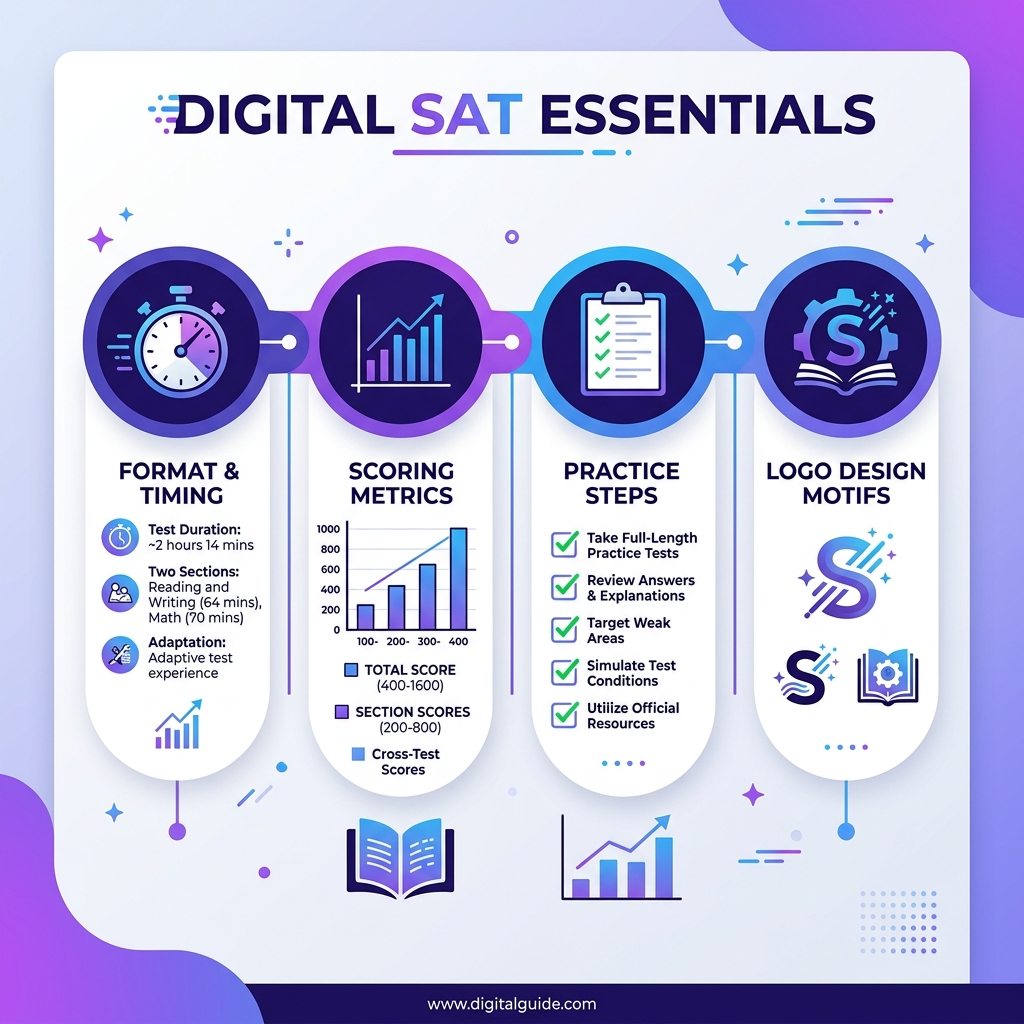
Digital SAT Essentials: Format, Timing, Scoring, and Practice
The complete guide to the Digital SAT format, timing schedules, item response theory scoring, and structured practice strategies.

Digital SAT Essentials Guide: The Ultimate Prep Manual
Learn Digital SAT timing, modules, scoring, Bluebook setup, Desmos strategy, and section practice with official-source reminders.
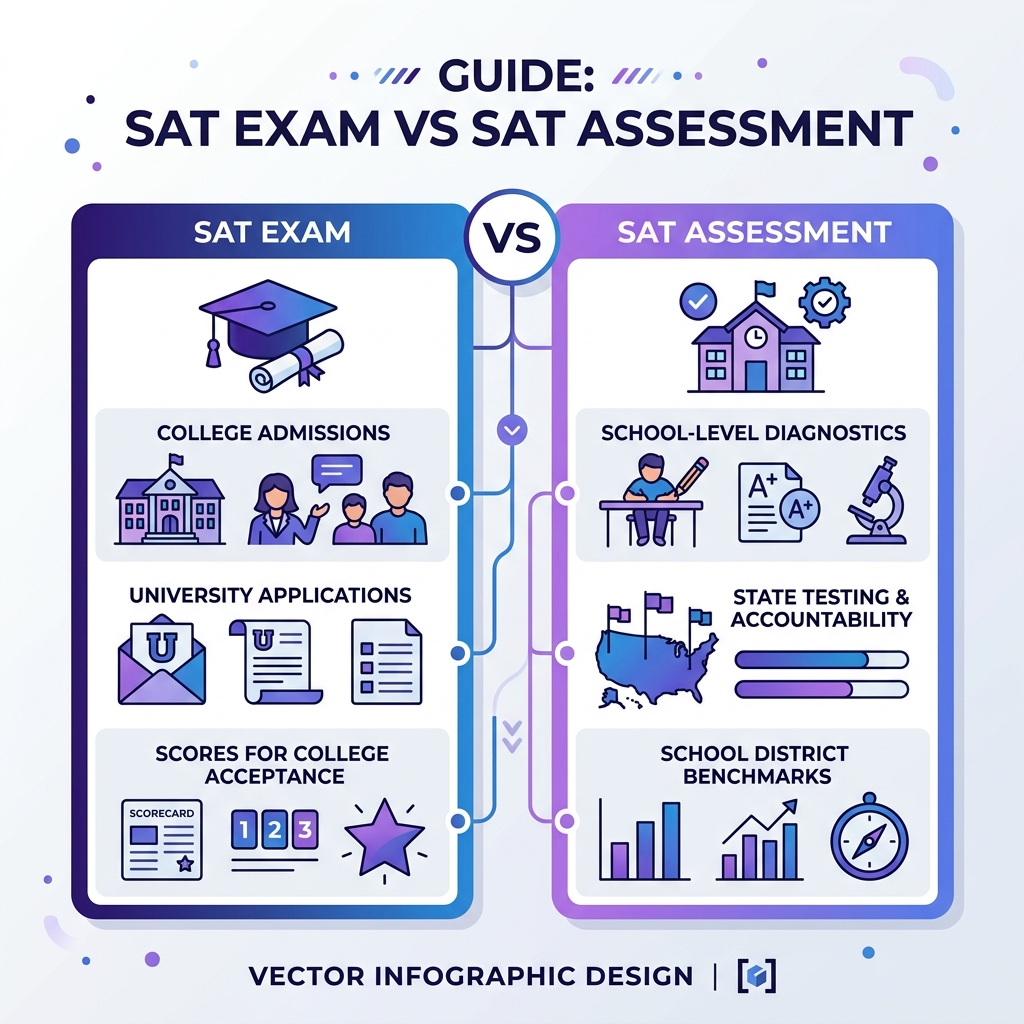
SAT Exam vs SAT Assessment: Meaning, Purpose, and Use
The complete guide to understanding the differences between the SAT Exam and the SAT School Day Assessment, including purposes, formatting, and practice strategies.

Digital SAT Format: The Ultimate Section-by-Section Breakdown
The definitive guide to the Digital SAT format. Master the timing, question types, adaptive modules, Desmos integration, and practice strategies.
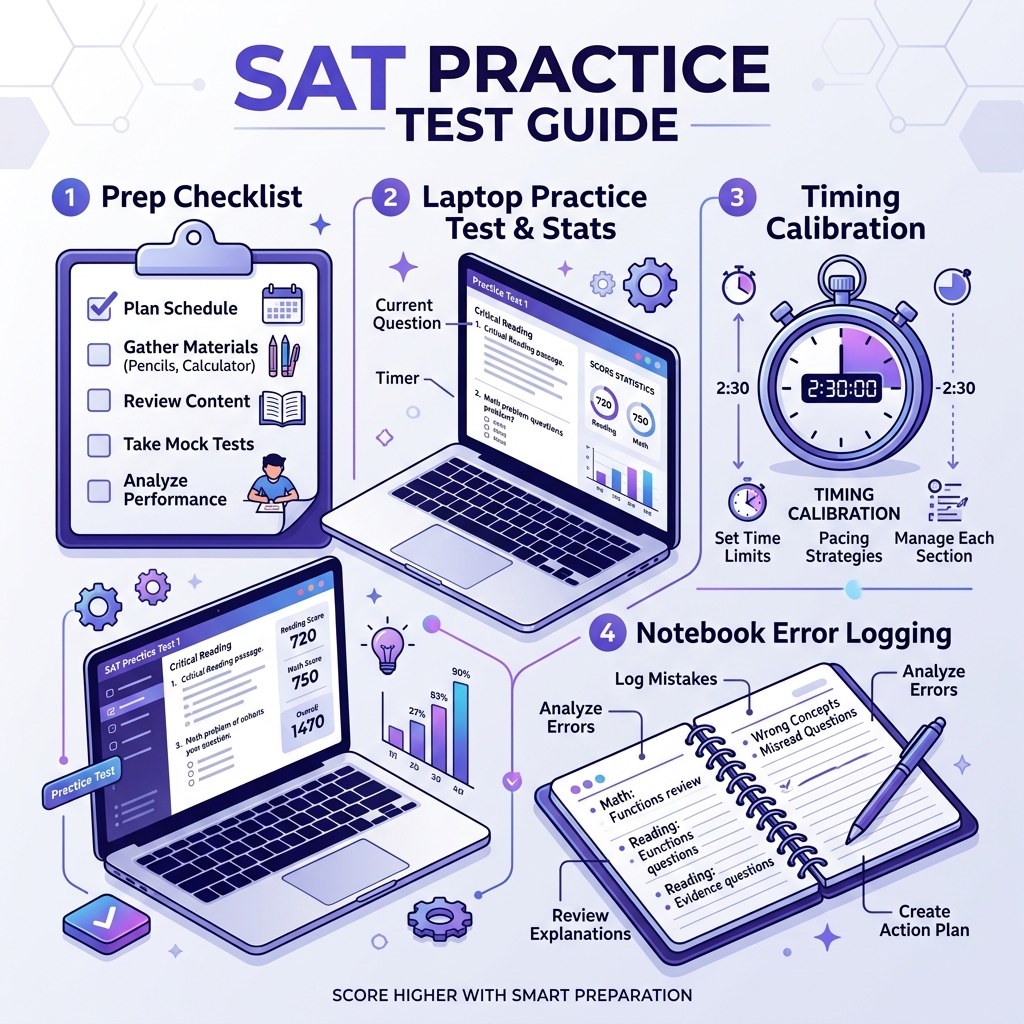
SAT Practice Test Guide: How to Use Practice Tests Correctly
The complete guide to taking, analyzing, and reviewing SAT practice tests, featuring error log protocols, timing strategies, and preparation loops.
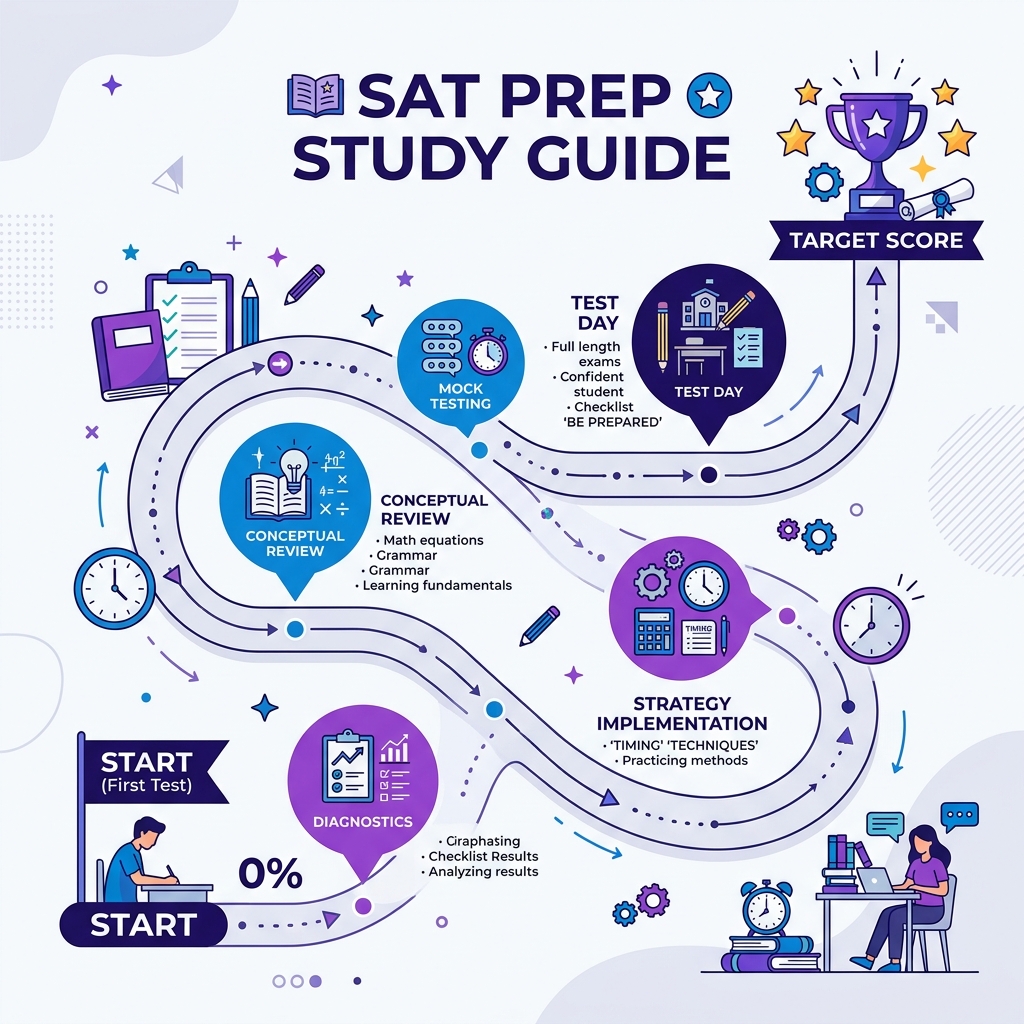
SAT Prep Roadmap: From Diagnostic to Target Score
Build an SAT prep roadmap from diagnostic test to target score with weekly milestones, mistake logs, content review, and pacing practice.

Digital SAT Registration: The Step-by-Step Guide
The complete step-by-step guide to registering for the Digital SAT. Navigate account setup, test centers, fee waivers, device loans, and deadlines.
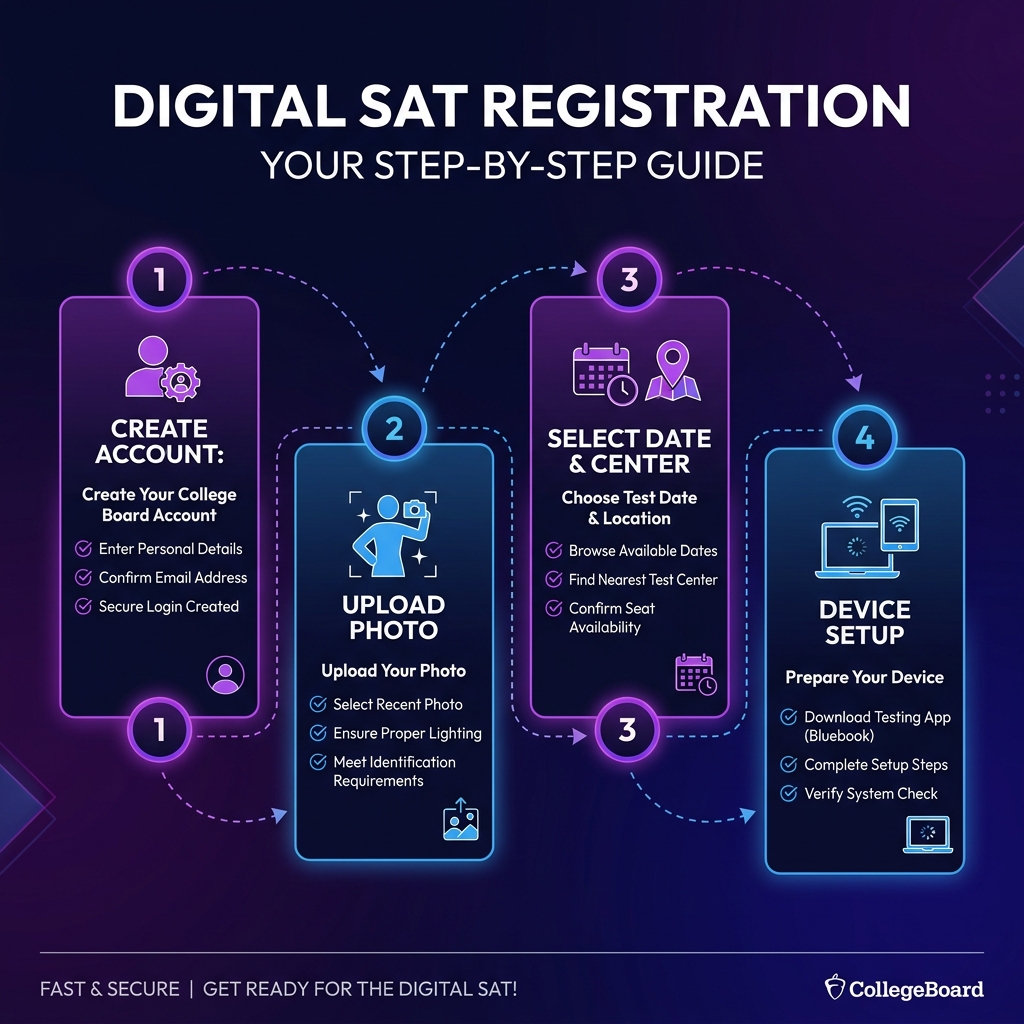
SAT Registration Guide: How to Register Without Mistakes
Avoid common errors when registering for the Digital SAT. A complete step-by-step guide to accounts, photo uploads, test centers, and device setup.
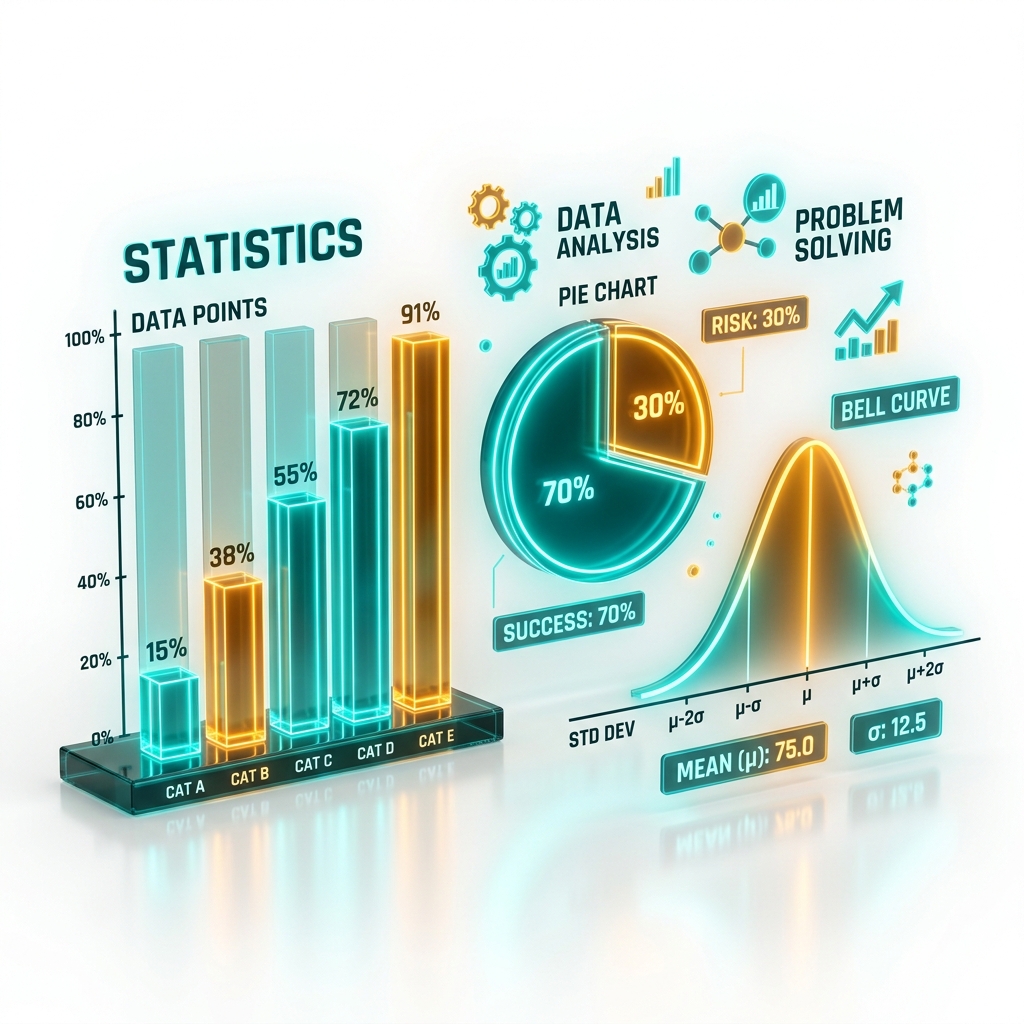
Digital SAT Scoring: The Definitive Score Guide
The complete guide to the Digital SAT scoring engine. Undergo a deep dive into Item Response Theory, score percentiles, superscores, and college admission score ranges.
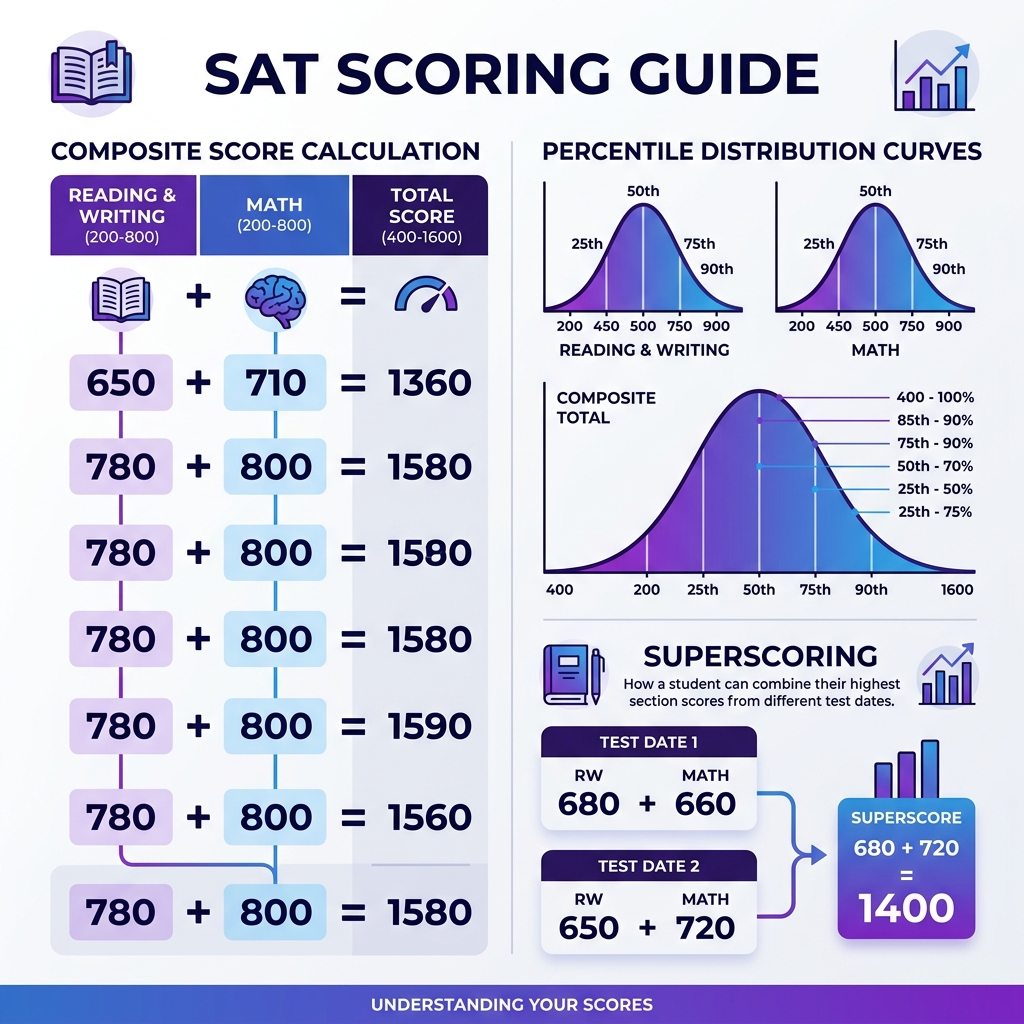
SAT Scoring Guide: How the 400-1600 Score Works
The complete guide to the SAT scoring scale. Master the composite math (400-1600), section scaling, Item Response Theory (IRT), and superscoring configurations.
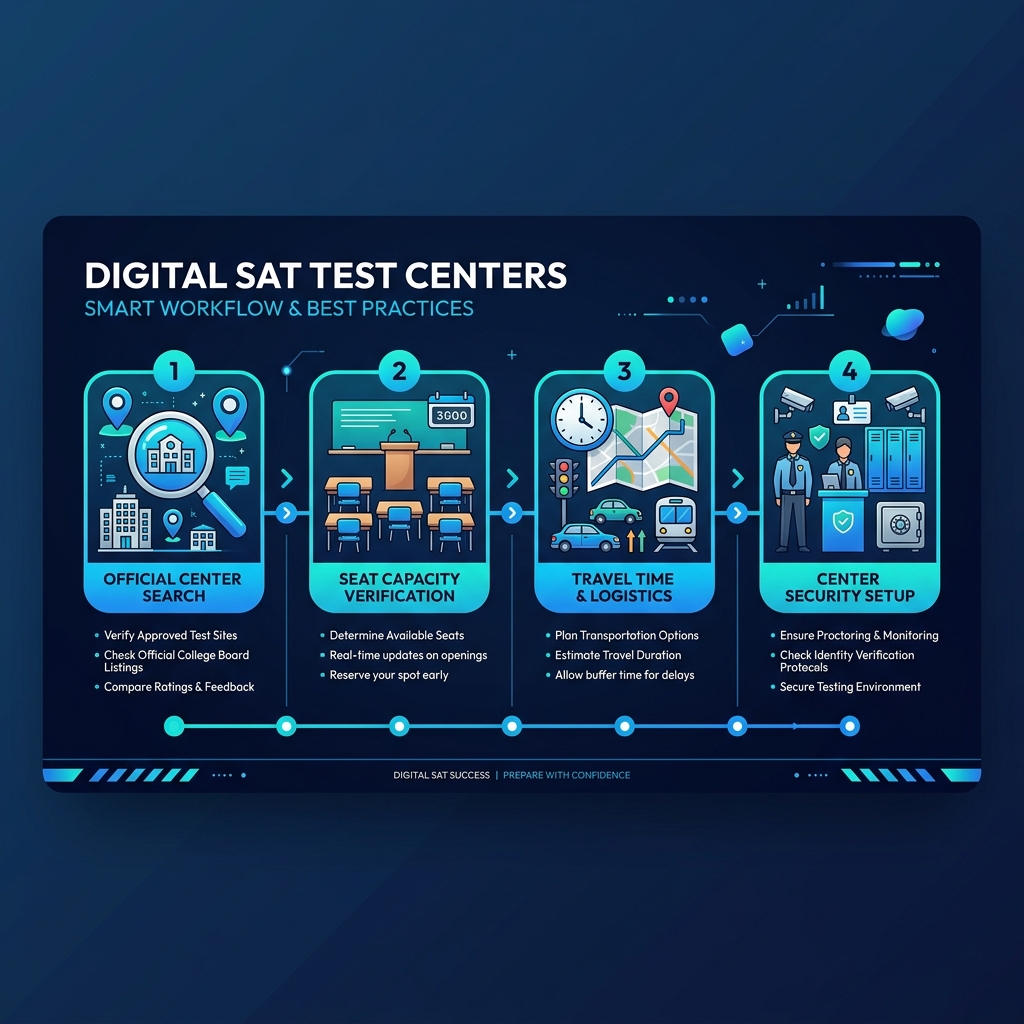
SAT Test Centers: Find a Safe Official Location
Master the SAT test center search. Learn how to locate official centers, navigate seat capacities, plan travel logistics, and verify facility conditions.

Digital SAT Test Dates & Deadlines: The Complete Guide
The definitive guide to the Digital SAT test dates, registration deadlines, and score release calendars. Plan your preparation and retake strategy.
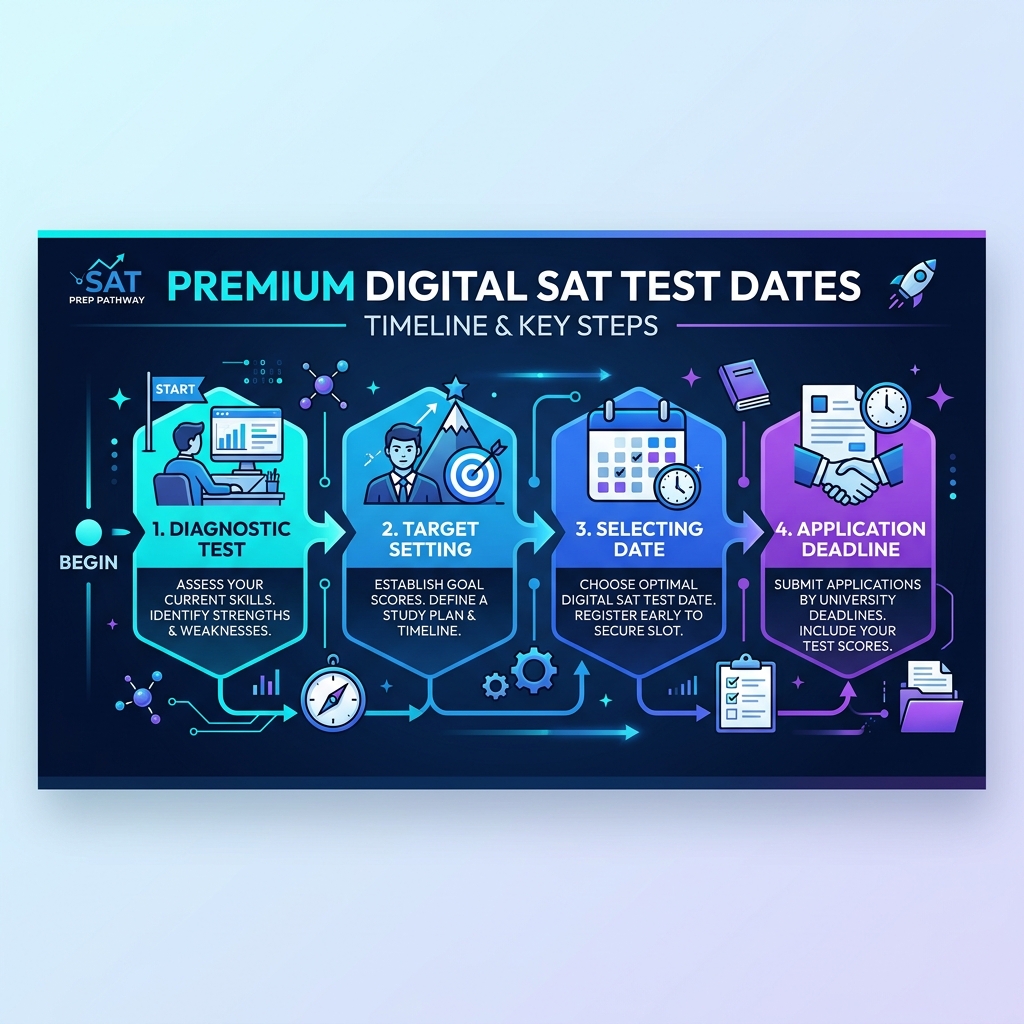
SAT Test Dates Guide: How to Choose the Right 2026 Test Date
Master the 2026 Digital SAT testing calendar. Learn how to align test dates with college deadlines, structure retakes, and plan your study timeline.
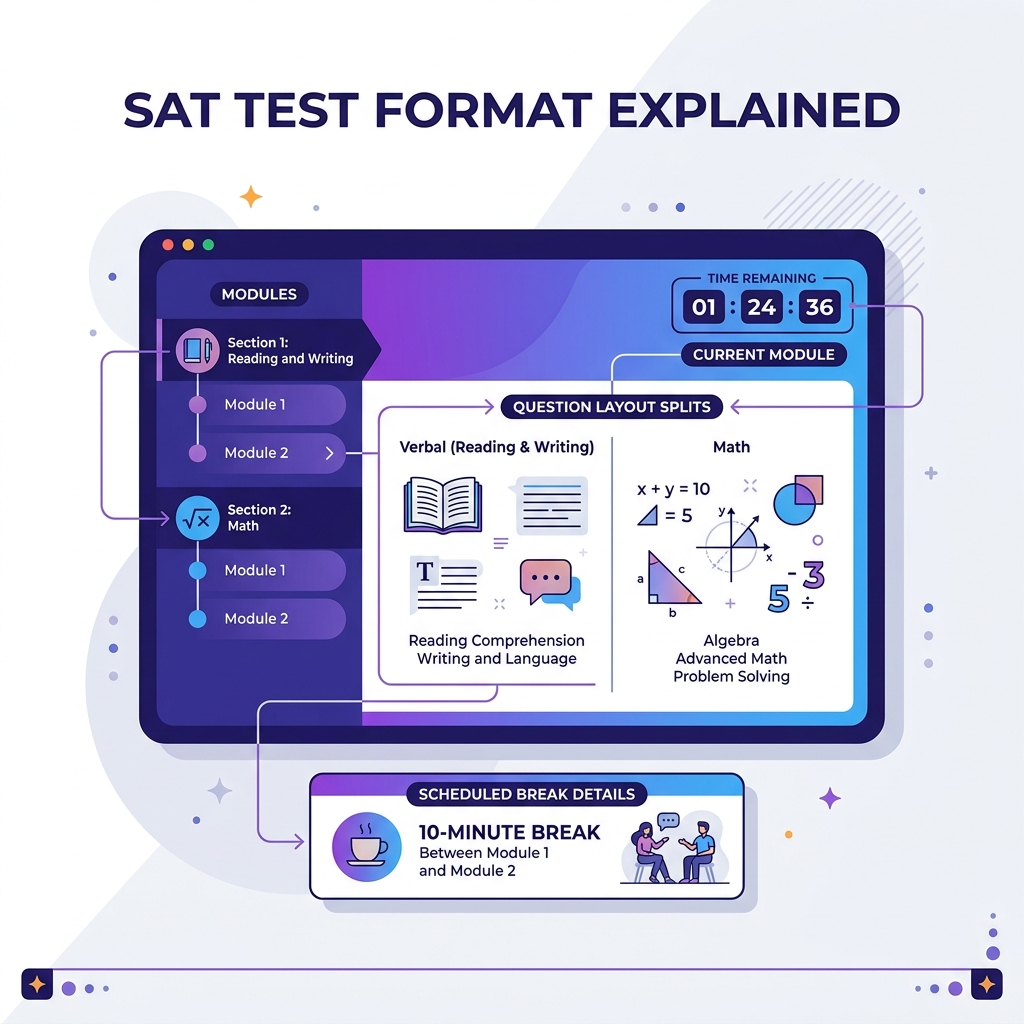
SAT Test Format: Modules, Timing, Questions, Breaks
The definitive guide to the Digital SAT structure, section-level adaptive modules, timing allocations, question counts, and break policies.

SAT® Test Day Checklist: What to Bring and Do
The definitive checklist and strategy guide for the Digital SAT test day. Learn exactly what to bring, what to leave at home, and how to survive the exam.
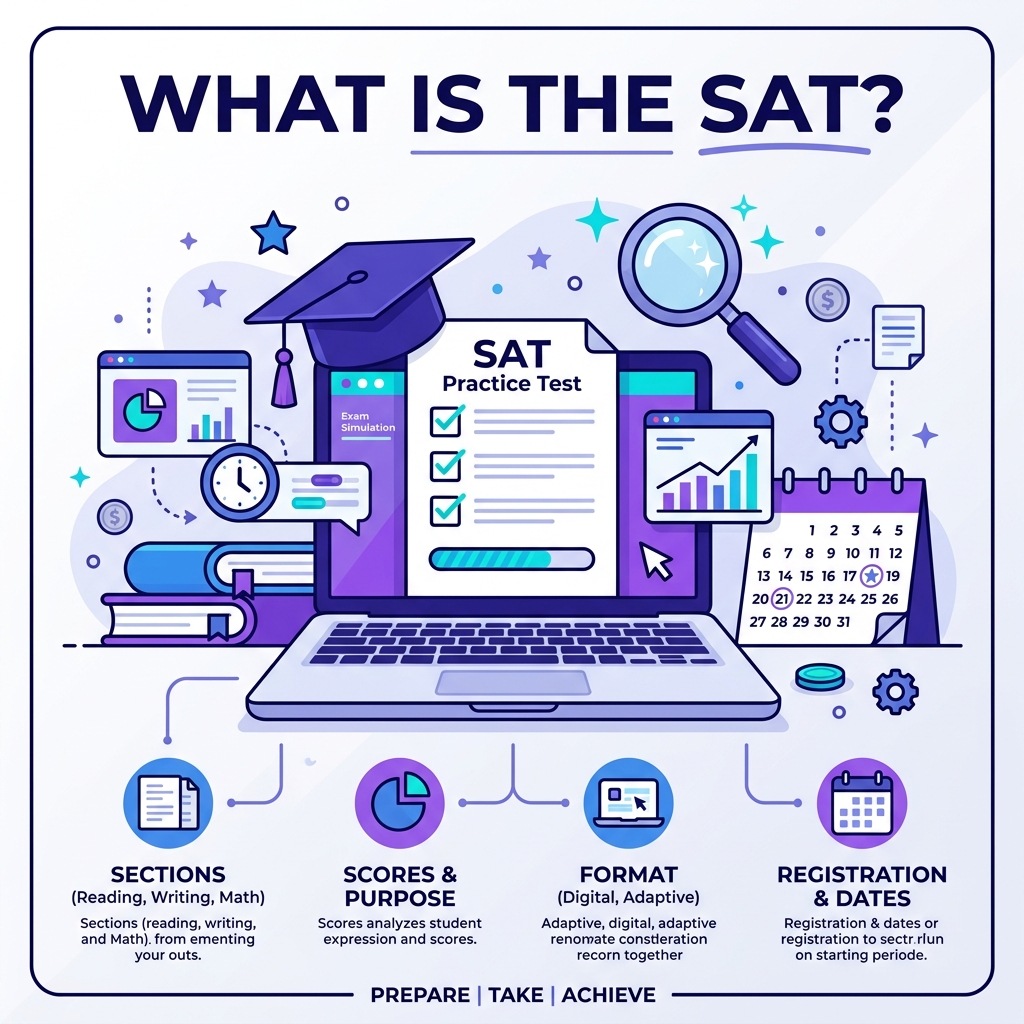
What Is the SAT? Complete Beginner Guide for 2026
The definitive guide to the SAT exam. Learn what the SAT is, who takes it, test structure, scoring, dates, and how to start preparing.
SAT Math Review Guides
Math modules on the Digital SAT test four main content areas: Algebra, Advanced Math, Problem Solving and Data Analysis, and Geometry and Trigonometry. Questions range from basic linear relationships to complex quadratic curves and circle equations. Our tutorials show you both the traditional algebraic methods and the modern calculator shortcuts. With a fully functional Desmos calculator built into the test app, learning how to graph intersections, trace coordinate vertices, and execute regressions is key. We outline essential equations like \(y = mx + b\) and midpoint coordinates \(\left(\frac{x_1+x_2}{2}, \frac{y_1+y_2}{2}\right)\) to help you solve problems quickly and avoid calculation errors.
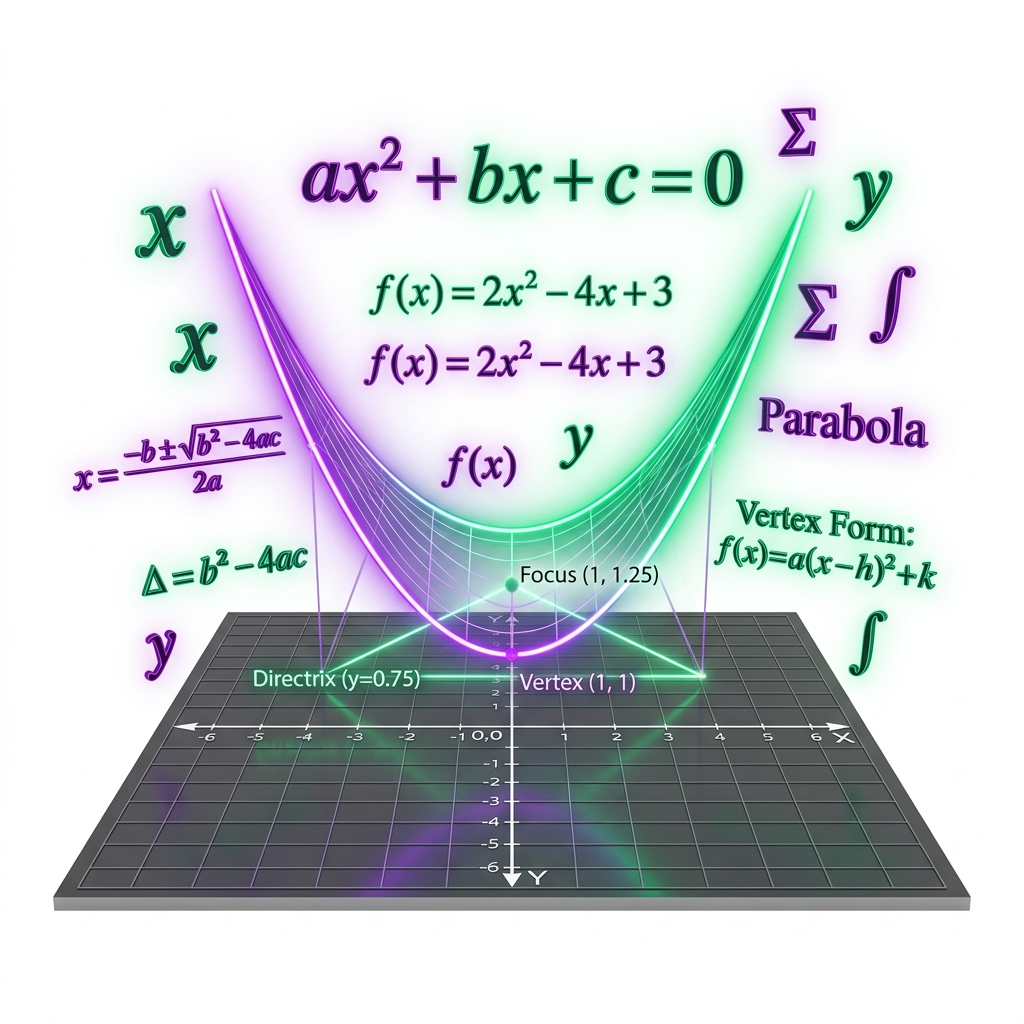
Digital SAT Math Advanced Math: The Complete Study Guide
Review SAT advanced math topics: quadratics, exponential functions, polynomials, radicals, transformations, and Desmos strategies.
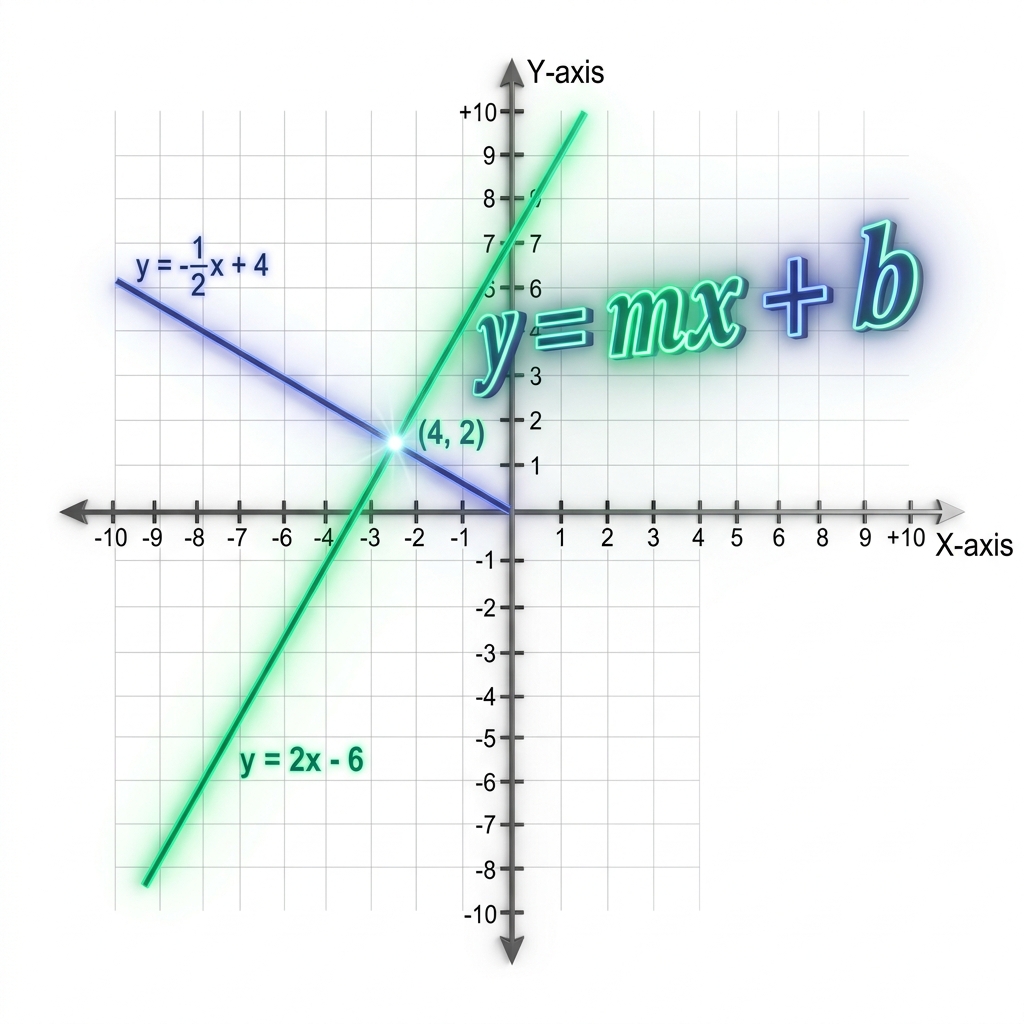
Digital SAT Math Algebra: The Complete Study Guide
Master linear equations, systems of equations, inequalities, graphs, and Desmos strategies for the Digital SAT. Includes original worked examples and a mini quiz.
Digital SAT Math: The Ultimate Desmos Calculator Guide
Master the integrated Desmos graphing calculator for the Digital SAT. Learn how to solve systems, extract roots, perform regressions, and apply graphing hacks.

Digital SAT Math Formulas Cheat Sheet
Review key SAT Math formulas for algebra, geometry, coordinates, and trigonometry with worked examples and practice prompts.

Digital SAT Geometry & Trigonometry Guide
Review SAT geometry and trigonometry: angles, triangles, circles, area, volume, coordinates, right triangles, and trig ratios.
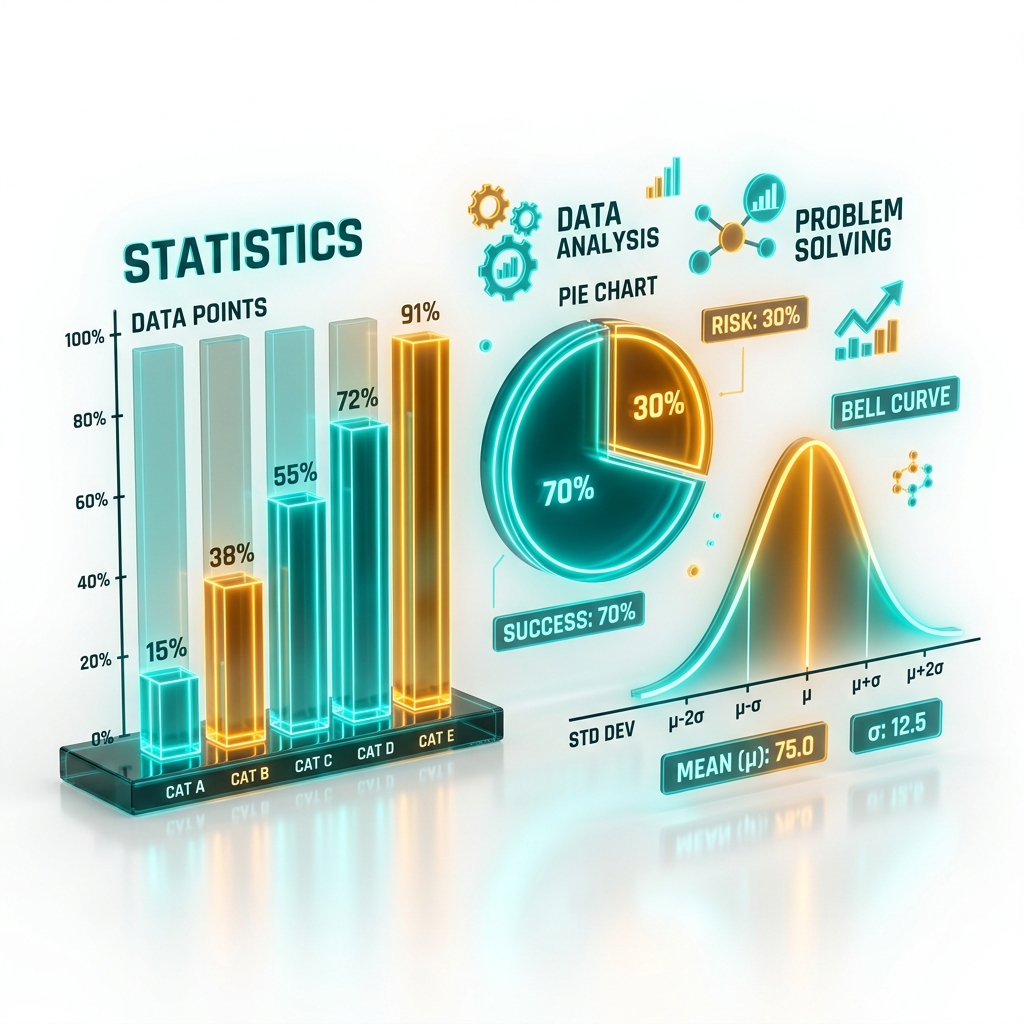
Digital SAT Data Analysis Study Guide
Practice SAT ratios, percentages, statistics, probability, scatterplots, two-way tables, and survey reasoning with worked examples.
SAT Student-Produced Responses Guide
Master the rules, formatting, and strategies for fill-in-the-blank questions on the Digital SAT. Avoid grid-in traps and ensure maximum precision.
Reading & Writing Guides
The Reading & Writing section is consolidated into single-paragraph passages testing four domains: Craft and Structure, Information and Ideas, Standard English Conventions, and Expression of Ideas. These guides outline the grammar rules you must know, including standard punctuation boundaries (semicolons, colons, dashes, and commas), subject-verb agreement, and transition words. We also review strategies for reading comprehension, such as the prediction method for vocabulary-in-context and the goal-matching checklist for rhetorical note synthesis.
Digital SAT Reading: Craft and Structure Study Guide
Study SAT Craft and Structure skills: vocabulary in context, text structure, author purpose, rhetoric, and cross-text comparisons.
Digital SAT Writing: Expression of Ideas Study Guide
Practice SAT Expression of Ideas skills: transitions, rhetorical synthesis, paragraph organization, precision, and concise wording.
Digital SAT Reading: Core Grammar Rules Master Guide
Review SAT grammar rules for punctuation, sentence boundaries, agreement, modifiers, pronouns, parallelism, and concise edits.
Digital SAT Reading: Information and Ideas Study Guide
Practice SAT Information and Ideas questions with central ideas, evidence, inferences, data graphics, and quantitative reasoning.
Digital SAT Reading: Rhetorical Synthesis Strategy Guide
Practice SAT rhetorical synthesis questions with note sets, goal-focused prompts, answer elimination, and worked examples.
SAT Standard English Conventions Grammar Guide
Review SAT grammar, punctuation, modifiers, agreement, and sentence-boundary rules with original examples and practice explanations.
Digital SAT Reading: Transitions Strategy Guide
Master SAT transition questions by classifying contrast, addition, cause, concession, sequence, and example relationships.
Digital SAT Reading: Vocabulary in Context Strategy Guide
Master SAT vocabulary in context with clue types, tone, prediction strategy, distractor traps, and original practice explanations.
Study Plans & Timelines
To tie your study reviews together, you need a structured preparation schedule. This cluster provides pre-built timelines, study plan templates, and diagnostic review guides. We compare different preparation durations (e.g., 3-month standard and 1-month express) to help you decide how many hours to allocate per week. Pairing these strategy guides with our interactive study planners and diagnostic mock tests ensures you can measure your progress and make data-driven adjustments to your calendar.
1-Week Cram Study Plan
A high-intensity study schedule designed for last-minute review, concept polish, and test-day strategy rehearsal.
2-Week Intensive Study Plan
A rapid, focused plan designed to address immediate weaknesses and polish pacing across sections.
30-Day Focused Study Plan
A comprehensive 4-week timeline to review all primary test domains, build section stamina, and target score improvement.
8-Week Balanced Study Plan
A complete, high-yield Digital SAT preparation plan mapping out weekly goals, daily tasks, and testing timelines.
90-Day Comprehensive study Plan
A deep-dive, multi-stage preparation guide designed for extensive foundation building and elite score targets.
Beginner Foundation Study Plan
A patient, step-by-step introduction to the Digital SAT format, core grammar, and basic algebraic concepts.
High-Score Elite Study Plan
Tailored for high-scoring students targeting upper-range score outcomes. Focuses on advanced problem solving and hard Module 2 simulation.
Math-Focused Study Plan
A 6-week quantitative bootcamp targeting linear systems, quadratics, functions, geometry, and Desmos calculator speed.
Reading & Writing-Focused Plan
A 6-week intensive verbal plan focusing on grammar conventions, clause boundaries, transitions, and reading comprehension.
Retake Score Booster Plan
Designed for students retaking the SAT. Focuses on identifying previous errors, concept gaps, and pacing failures.
Drill Concepts with Interactive Tools
Reading guides is only half the battle. Pair our written tutorials with interactive study widgets to turn concepts into measurable practice habits. Generate custom calendars, estimate study hours, drill flashcards, or take a timed practice test.
Each tool integrates with browser localStorage to preserve your preferences privately. Whether you are adjusting score sliders to map out target study hours, generating week-by-week calendars, or flipping active-recall flashcards, your data is kept completely on your device. We do not copy your progress or track search entries, matching our platform commitment to accessibility and student privacy.
Frequently Asked Questions
Find answers to common questions regarding study plans, guide structure, and prep timelines.
Q1: What is the best way to use this sat study guide directory?
This directory is designed to act as a centralized curriculum hub. We suggest starting with the recommended reading paths based on your timeline (e.g. beginner path or 30-day path). Each guide card directs you to a complete breakdown of rules, concepts, and practice problems. You can use our interactive tools like the study plan generator alongside these guides to build a structured schedule. For example, you can pair the Desmos Math guide with our interactive math quiz engine to drill coordinates and equations. By structuring your studies around these defined blocks, you ensure comprehensive coverage of all exam parameters without wasting time on redundant topics.
Q2: What are the key differences between the paper SAT and the digital sat prep guide?
The Digital SAT represents a major shift from the legacy paper format. The digital exam is section-adaptive: your Module 1 performance influences whether Module 2 contains a higher- or lower-difficulty mix, but College Board does not publish fixed routing cutoffs or score caps. In addition, the digital test is 2 hours and 14 minutes, allows a built-in Desmos graphing calculator on the entire Math section, and replaces long reading passages with short Reading & Writing texts. The Reading & Writing section combines reading and writing tasks in one section, testing transitions, grammar conventions, and text evidence concurrently. These changes require students to adjust their prep habits, focusing on digital annotation tools and calculator shortcuts rather than manual paper tricks.
Q3: Should I read the Math or the Reading & Writing guides first?
We recommend starting with a baseline diagnostic practice test to identify your natural strengths and weak areas. If your starting score in Math is lower, focus first on our Algebra and Advanced Math guides. If your Reading & Writing score is lagging, start with the Standard English Conventions and Transitions guides. Balancing both domains is ideal, but prioritizing your largest growth areas yields the fastest results. Additionally, tracking your progress using our local cache score goal planner helps you see how raising your Math or Reading & Writing score individually affects your composite goal, allowing you to allocate your weekly study hours more efficiently.
Q4: Is the built-in Desmos calculator enough for the Math section?
Yes. The built-in Desmos graphing calculator is a powerful tool that can solve a significant portion of the SAT Math section. Our Desmos guide reviews shortcuts for finding systems of equations intersections, plotting quadratic vertices, solving single-variable equations, and shading linear inequalities. Mastering these shortcuts saves valuable time and prevents manual calculation errors. However, you should still understand the underlying algebra principles. If a question asks for coordinate values of an intersection or root, Desmos can display the coordinates directly, but you must know how to input variables and expressions correctly to get the correct display.
Q5: How should I prepare using the Bluebook software guides?
The official Bluebook app by the College Board is the software you will use on test day. We recommend downloading the app, logging in, and taking at least one available official practice test under timed conditions. Our Bluebook guide explains how to navigate the interface, use the digital annotation tools, mark questions for review, and access the built-in calculator. Familiarizing yourself with this interface prevents test-day surprises. In addition, practicing with the built-in countdown clock and module navigation prepares you for the pressure of timed testing, ensuring that you can pace yourself during both Reading & Writing modules and Math modules without running out of time.
Q6: What is the recommended timeline for a 30-day prep plan?
In a 30-day preparation cycle, the first week should focus on format fundamentals and taking a diagnostic exam. Weeks 2 and 3 should target core content areas, reviewing specific guides like linear equations and grammar rules. Week 4 should be reserved for full-length timed mock tests under realistic testing conditions, followed by a final review of the test-day checklist and formulas sheet. This compressed timeline requires daily study segments of 60 to 90 minutes. If you encounter specific content plateaus during this cycle, use our suggested guide clusters to execute targeted reviews of formulas or transition lists to patch up conceptual weaknesses before test day.
Q7: Does this website promise score increases using these sat guides?
No. Our guides are written to align with current public College Board SAT structure and content domains, but score outcomes depend on individual study consistency, baseline skills, and test-day factors. We provide these resources 'as-is' for free, non-commercial study, and we make no score promises. We encourage students to cross-reference our guides with official practice materials on Khan Academy and College Board resources. Standardized testing score variations can depend on test center environments, device issues, or test-day anxiety, which is why we focus on practical strategy sheets rather than outcome claims.
Q8: Can high school counselors use this study guide hub for their classes?
Yes, high school counselors, teachers, and non-profit advisors are permitted to link to this guides hub and print checklists, calendars, or guides for distribution to their students, provided that all copies are distributed for free and retain the copyright tags and trademark disclaimers. We support counselor initiatives to make college prep resources more equitable. Many advisors use our 8-week study plan as a classroom syllabus, coordinating guide reading blocks with weekly paperless mock testing sessions to measure logged practice progress.
Q9: How do I report typos or errors in the math formulas guides?
We maintain high academic standards, but if you spot a typo in an explanation, formula, or coordinate, please visit our contact page and submit a correction request. Please include the URL of the guide and details of the typo. Our content review board reviews all submissions and publishes corrections within 24 hours to keep the index accurate. We value student and parent feedback, especially regarding complex equations or coordinate geometry explanations, as maintaining a precise database is crucial for students who are self-studying.
Q10: Is the SATHELP24x7 guide hub affiliated with the College Board?
No. SATHELP24x7.com is a completely independent, volunteer-led prep platform and is not affiliated with, sponsored by, or endorsed by the College Board. The College Board owns all rights to the registered trademark 'SAT'. Our references to their exams and software are strictly for nominative fair-use purposes to help students prepare. All mock practice engines, score estimators, and written checklists are created independently by our educators, and we do not host official test questions or copyright-restricted materials.
Disclaimer: SAT® is a registered trademark of the College Board, which is not affiliated with, and does not endorse, this website. All practice material, guides, flashcards, and study calculators are created independently by SATHELP24x7 to support academic preparation.