The SAT can feel bigger than it really is because it sits at the intersection of school, college admissions, scholarships, family expectations, and a very official testing day. But the exam itself is knowable. It has a fixed structure, a clear score scale, predictable skill areas, and a set of official tools that every student can use before test day.
This SAT 101 guide is written for students who are starting from scratch, parents who want a clear explanation without hype, and juniors or seniors who need one reliable reference before choosing a test date. It covers what the SAT is, who should take it, how the digital version works, what is tested, how scoring works, when to register, what to bring, how to prepare, and which official media and practice resources are worth using.
The details below are current as of May 20, 2026. Dates, fees, device policies, and college testing policies can change, so use this guide to understand the system and verify final deadlines on the official College Board pages before making a registration decision.
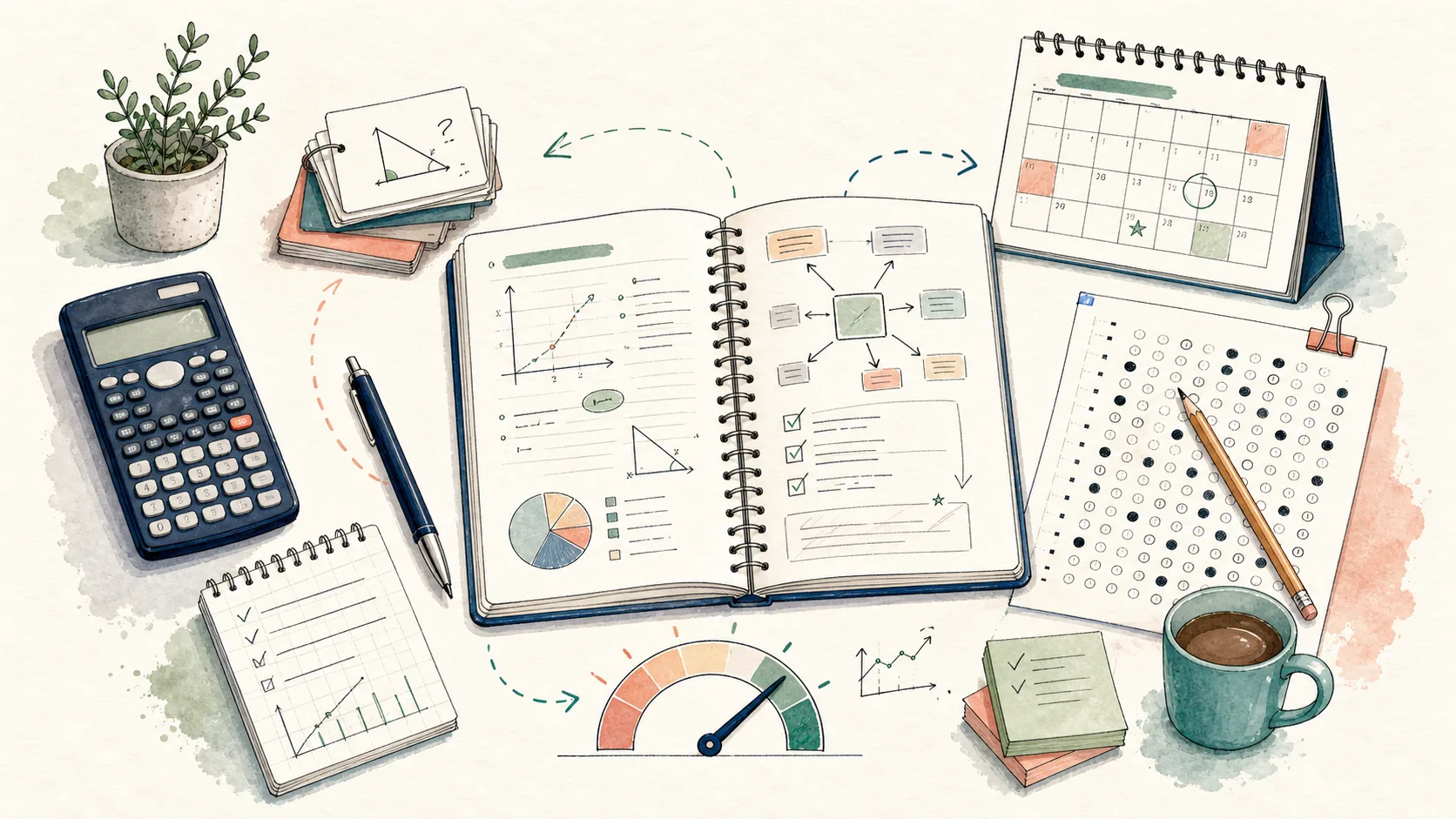
A strong SAT plan is not just "do more questions." It connects official practice, error review, timing work, content study, and a realistic test-date calendar.
Quick SAT 101 Summary
If you only need the essentials, start here:
| SAT Detail | What You Need to Know |
|---|---|
| Test owner | College Board |
| Current format | Digital, administered in the Bluebook app |
| Where you take it | At an official test center or through SAT School Day, not at home |
| Total testing time | 2 hours and 14 minutes, plus one 10-minute break |
| Main sections | Reading and Writing, then Math |
| Total questions | 98 questions: 54 Reading and Writing, 44 Math |
| Score scale | 400-1600 total, with 200-800 per section |
| Calculator policy | Calculator allowed throughout Math; Bluebook includes Desmos |
| Guessing penalty | None. Answer every question. |
| Adaptive design | Each section has two modules; Module 2 difficulty depends on Module 1 performance |
| Official practice | Bluebook practice tests, Student Question Bank, Khan Academy, and College Board resources |
What Is the SAT?
The SAT is a standardized college entrance exam developed by College Board. It is designed to measure academic skills that students build in high school and will continue using in college: reading carefully, interpreting evidence, using standard written English, solving algebraic and quantitative problems, analyzing data, and applying mathematical reasoning under time pressure.
The modern SAT is fully digital for nearly all students. Instead of filling in bubbles on paper, you test on a laptop or tablet through College Board's Bluebook application. You still test under supervision at an official test site or through an in-school administration. The "digital" part refers to the delivery platform, not to remote testing from home.
Colleges use SAT scores in different ways. Some colleges require test scores, some are test optional, some are test flexible, and a smaller group is test blind. Policies change, sometimes within the same admissions cycle, so your safest move is to check the testing policy for every college on your list. A strong SAT score can also matter for merit scholarships, honors programs, course placement, and state or district requirements.
The SAT is not an IQ test and it is not a measure of your worth as a student. It is a timed academic skills test. That distinction matters because timed academic skills can be improved. Students raise scores by learning the format, practicing official question types, reviewing mistakes, improving pacing, and strengthening weak content areas.
Who Should Take the SAT?
Most SAT test takers are high school juniors and seniors applying to college. Many students take it for the first time in spring of junior year and again in late summer or fall of senior year. Some sophomores take the SAT early for a baseline, but most students get better value from taking the PSAT or doing a Bluebook practice test before paying for an official SAT.
You should seriously consider taking the SAT if any of these apply:
- You are applying to colleges that require or recommend standardized test scores.
- Your GPA is strong, and you want another data point that supports your academic record.
- Your GPA has a weak spot, and you want a test score that shows college readiness.
- You are applying for merit scholarships that use SAT scores.
- You are an international student applying to U.S. universities.
- Your school or district offers SAT School Day and expects students to participate.
You may not need the SAT if every college on your list is test blind and no scholarship or program you want asks for scores. But "test optional" does not mean "scores never help." At many test-optional colleges, a score that is strong relative to the college's admitted-student range can still strengthen an application.
How the Digital SAT Is Structured
The SAT has two main sections: Reading and Writing and Math. Each section is split into two separately timed modules. You take Reading and Writing first, then receive a 10-minute break, then take Math.
| Section | Module 1 | Module 2 | Section Total |
|---|---|---|---|
| Reading and Writing | 27 questions, 32 minutes | 27 questions, 32 minutes | 54 questions, 64 minutes |
| Break | 10 minutes | ||
| Math | 22 questions, 35 minutes | 22 questions, 35 minutes | 44 questions, 70 minutes |
| Full Test | 98 questions, 134 minutes |
College Board's assessment framework also identifies embedded pretest questions. These are questions being tried out for future exams and do not count toward your score. Students are not told which questions are pretest questions, so the correct strategy is simple: treat every question as if it counts.
The SAT is shorter than the old paper exam, but it is not casual. You have about 71 seconds per Reading and Writing question and about 95 seconds per Math question. That is enough time if you know the question types and stay disciplined, but it is not enough time to reread every answer choice repeatedly or solve every math question in the slowest possible way.
How Adaptive Modules Work
The digital SAT uses a multistage adaptive design. That phrase sounds technical, but the student experience is straightforward:
- You take Module 1 in Reading and Writing.
- Bluebook uses your Module 1 performance to route you to a second Reading and Writing module.
- You take Module 1 in Math.
- Bluebook uses your Module 1 performance to route you to a second Math module.
The first module in each section contains a mix of easier, medium, and harder questions. The second module is selected based on your performance in the first module. If you show stronger performance, your second module will generally contain a harder mix of questions. If your first module shows weaker performance, your second module will generally contain a less difficult mix.
This does not mean the test changes after every question. You can move around within a module, flag questions, return to earlier questions in that same module, and review before time runs out. Once the module ends, however, you cannot return to it.
The adaptive design affects scoring because the test is measuring not only how many questions you answer correctly but also the difficulty and statistical value of those questions. College Board explains that students are not advantaged just because they see a harder second module and not disadvantaged just because they see a lower-difficulty module. Your score comes from the full pattern of answers across both modules.
The practical strategy is still clear: take Module 1 seriously. Careless mistakes early can limit how much evidence you give the scoring model about your highest skill level. Do not rush Module 1 because you assume Module 2 is where the "real" test begins. Both modules matter.
What Is on Reading and Writing?
The Reading and Writing section combines the old reading, writing, vocabulary, grammar, and editing skills into one section. Every question is tied to a short text. Most passages are much shorter than old paper SAT passages, often around 25 to 150 words, and each passage usually has one question.
You will see literature, history, social science, humanities, and science contexts. Some questions include a table, graph, or pair of short texts. You do not need outside knowledge of the topic. The answer must come from the passage, the sentence structure, the notes, or the data shown.
The section is built around four content domains:
| Reading and Writing Domain | Approximate Share | What It Tests |
|---|---|---|
| Information and Ideas | About 26% | Main ideas, details, evidence, inferences, and data-based reading |
| Craft and Structure | About 28% | Vocabulary in context, text structure, purpose, and cross-text connections |
| Expression of Ideas | About 20% | Transitions and rhetorical synthesis |
| Standard English Conventions | About 26% | Grammar, punctuation, sentence boundaries, and usage |
Information and Ideas
These questions ask what a text says and what follows logically from it. You may identify the main idea, choose evidence that supports a claim, complete a sentence with the best inference, or interpret a small chart. Strong students slow down enough to separate what the text says from what an answer choice merely suggests.
Common traps include answers that are true but not supported, answers that are too broad, and answers that use words from the passage while changing the meaning. A clean process is to read the question first, read the passage with the task in mind, predict the answer in plain language, and then match your prediction to the closest choice.
Craft and Structure
These questions test how language works. Vocabulary questions ask for a word that fits the sentence's logic, not the fanciest word. Structure and purpose questions ask why a sentence, detail, or paragraph is doing a certain job. Cross-text questions ask how two short passages relate.
For vocabulary, cover the answer choices mentally and predict the meaning first. For purpose questions, use a short verb phrase: "introduces a contrast," "gives an example," "states the claim," "limits the conclusion." The SAT rewards precise thinking more than dramatic interpretation.
Expression of Ideas
Expression of Ideas has two high-frequency tasks: transitions and rhetorical synthesis. Transition questions ask which word or phrase best connects two ideas. You should decide the relationship before looking at choices: addition, contrast, cause, result, example, sequence, or emphasis.
Rhetorical synthesis questions give you notes and a goal. The goal is the whole game. If the prompt asks you to emphasize a similarity, choose the answer that emphasizes the similarity. If it asks you to introduce a researcher, choose the answer that introduces the researcher. Do not choose an answer simply because it includes many facts from the notes.
Standard English Conventions
This is the grammar and punctuation domain. The most valuable topics are sentence boundaries, commas, semicolons, colons, subject-verb agreement, pronoun clarity, verb tense, modifiers, and parallel structure.
Grammar questions become easier when you name the rule. If the choices differ by comma and semicolon, the question is probably testing sentence boundaries. If the choices differ by verb form, identify the subject and determine number and tense. If the choices differ by pronouns, find the exact noun being replaced.
For deeper practice by domain, use our SAT Reading and Writing complete guide and targeted Reading and Writing strategy guide.
What Is on Math?
The Math section tests algebra, advanced math, problem solving, data analysis, geometry, and trigonometry. It includes multiple-choice questions and student-produced response questions, where you type the answer instead of selecting it.
The biggest digital SAT math change is calculator access. A calculator is allowed on the entire Math section, and Bluebook includes Desmos. You may also bring an approved physical calculator, but many students can handle nearly everything with built-in Desmos plus scratch work.
| Math Domain | Approximate Share | What It Tests |
|---|---|---|
| Algebra | About 35% | Linear equations, inequalities, systems, and linear functions |
| Advanced Math | About 35% | Quadratics, nonlinear functions, equivalent expressions, and function notation |
| Problem Solving and Data Analysis | About 15% | Ratios, rates, percentages, probability, statistics, and data displays |
| Geometry and Trigonometry | About 15% | Area, volume, angles, triangles, circles, and right-triangle trig |
Algebra
Algebra is the foundation of SAT Math. You need to solve linear equations, understand slope and intercepts, work with systems, interpret constants in context, and translate word problems into equations. Many students lose points not because the algebra is advanced but because they misread what the variables represent.
When a problem gives a real-world situation, write down what each variable means before solving. If a graph is involved, identify the slope, intercept, and units. If a system is involved, decide whether substitution, elimination, graphing, or Desmos is fastest.
Advanced Math
Advanced Math includes quadratics, exponentials, polynomials, rational expressions, and nonlinear functions. This is where the SAT often tests structure: equivalent forms, factors, roots, vertex form, intercepts, and how changing a coefficient changes a graph.
Desmos can be powerful here. You can graph equations, find intersections, check roots, and compare answer choices. But do not become dependent on Desmos for every step. The best students use Desmos to verify and accelerate; they still understand the algebra.
Problem Solving and Data Analysis
This domain rewards careful reading. It includes rates, ratios, percentages, units, data tables, scatterplots, sample statistics, and probability. Questions often look wordy but reduce to a small calculation.
Common mistakes include mixing up "percent of" and "percent increase," using the wrong denominator, ignoring units, and confusing correlation with causation. Circle or write the unit beside each number on scratch paper. That one habit prevents many errors.
Geometry and Trigonometry
Geometry and Trigonometry questions cover lines, angles, triangles, circles, area, volume, and basic sine, cosine, and tangent. The SAT provides some reference formulas, but you still need to know when to use them. Right-triangle trigonometry, special triangles, similar triangles, and circle equations are especially useful.
If a diagram is not drawn to scale, do not trust its appearance. Label the figure, write equations from relationships, and use known properties. If coordinates are involved, Desmos may help you check a graph or intersection, but geometry often rewards a simple drawing and a formula.
For more math help, use our Digital SAT Math complete guide, 10 SAT Math strategies, and score calculator.

SAT Math preparation should combine content fluency with fast decision-making: solve by hand, use Desmos when it saves time, and verify answers before moving on.
How SAT Scoring Works
The SAT reports two section scores:
- Reading and Writing: 200-800
- Math: 200-800
Your total score is the sum of those two section scores, so the total range is 400-1600.
The SAT does not simply convert "number correct" into a score with one fixed chart. The digital test uses item response theory and adaptive module information. In plain English, the scoring model considers which questions you answered correctly, which questions you missed, how difficult those questions were, and the overall pattern of your responses.
There is no penalty for wrong answers. A blank answer cannot help you, and a guess can. If you can eliminate even one or two choices, guessing becomes a meaningful scoring move.
Your score report may include:
- Total score
- Section scores
- Percentile information
- Score range
- Benchmarks for college and career readiness
- Performance insights by content domain
The College Board benchmark numbers often referenced are 480 for Reading and Writing and 530 for Math. A benchmark is not a college admission cutoff. It is a readiness indicator. Colleges make decisions using many factors, and each college has its own admitted-student score profile.
For admissions planning, your target score should be based on the schools and scholarships you care about. A 1250 may be excellent for one path and below range for another. A 1500 may be unnecessary for a college where your energy would be better spent on grades, essays, or major-specific work. Use the SAT strategically, not emotionally.
Score Goals, Superscoring, and Retakes
Many colleges superscore the SAT, meaning they consider your highest Reading and Writing score and highest Math score across different test dates. Not every college superscores, so verify your list, but superscoring can make retaking more efficient.
Suppose you earn a 690 Reading and Writing and 620 Math in March, then a 660 Reading and Writing and 700 Math in June. A college that superscores may treat that as a 1390: 690 plus 700. That means your second round of prep can focus on the weaker section without needing to protect every point in the stronger section.
A smart retake decision depends on four questions:
- Are you below the middle-50% range for schools where scores matter?
- Do you have enough time to prepare differently before the next test?
- Is one section clearly holding down your total?
- Would another test date interfere with grades, applications, or major deadlines?
Do not retake automatically. Retake when you have a plan. The best reason to retake is not "I hope I get lucky." It is "my practice data shows I can gain points by fixing these specific skills and timing errors."

Set a target score from real college and scholarship requirements, then reverse-engineer the section gains needed to reach it.
SAT Dates, Deadlines, and Fees
As of May 20, 2026, College Board lists one remaining SAT weekend date in the August 2025 through June 2026 cycle:
| SAT Test Date | Regular Registration Deadline | Late Registration / Change Deadline |
|---|---|---|
| June 6, 2026 | May 22, 2026 | May 26, 2026 |
College Board has also posted confirmed weekend SAT dates for the 2026-27 cycle:
| Season | Confirmed SAT Dates |
|---|---|
| Fall 2026 | August 22, September 12, October 3, November 7, December 5 |
| Spring 2027 | March 6, May 1, June 5 |
Registration deadlines are usually several weeks before the test date, and popular test centers can fill. If you need to borrow a device from College Board for SAT Weekend, College Board says you must register and request the device earlier, at least 30 days before test day.
For U.S. test takers, the SAT registration fee for test dates beginning August 23, 2025 is listed as $68. Additional fees may apply for late registration, cancellation, score services, or other changes. Fee waivers are available for eligible U.S. students and can cover free SAT tests and other college application benefits. Fees can change, so verify the official fee page before paying.
For a registration walkthrough, see our SAT registration guide and exam timetable tool.
Bluebook: What It Is and How To Prepare
Bluebook is College Board's digital testing app. It is where you take the SAT, complete exam setup, access your admission ticket, and take official practice tests. You should be comfortable with it before test day.
Your Bluebook checklist:
- Download Bluebook on the device you will use for testing.
- Open Bluebook and use the device check.
- Sign in with your College Board account.
- Complete exam setup when it becomes available, usually 1-5 days before test day for SAT Weekend.
- Save or print your admission ticket.
- Use the Practice and Prepare area for a test preview and full-length practice tests.
- Learn the timer, flagging, annotation, eliminator, reference sheet, and Desmos tools.
Do not make your first Bluebook experience the morning of the real exam. The platform is not difficult, but unfamiliar interfaces create avoidable stress. You want test day to feel like a repeat of something you have already practiced.
What To Bring on Test Day
College Board's test-day list is short, but the details matter. For SAT Weekend, prepare these items:
- Fully charged testing device with Bluebook installed and exam setup completed
- Admission ticket from Bluebook
- Acceptable physical photo ID
- College Board username and password
- Pencil or pen for scratch work
- Approved calculator if you want one, though Desmos is built into Bluebook
- Power cord or portable charger if allowed at your center
- Snack and drink for the break
Your device should be able to hold a charge for the testing period. College Board guidance says to expect several hours of battery need. Bring a charger, but do not assume you will have outlet access at your seat.
Leave prohibited items away from your desk. Phones, smartwatches, notes, books, recording devices, and unauthorized electronics can create serious testing problems. If you are unsure about an item, check the official policy before test day.
On test day, arrive early. The official Bluebook SAT Weekend page says to arrive 15 minutes before your test begins for check-in. In practical terms, plan to be near the building earlier than that so traffic, parking, room confusion, or ID checks do not make you late.
The Best Official SAT Resources
The strongest SAT prep starts with official material because official questions teach the real wording, skill mix, timing, and interface. Third-party resources can help, especially for extra explanations and content drills, but they should not replace official practice.
| Resource | Best Use | Link |
|---|---|---|
| College Board SAT structure page | Confirm format, timing, modules, and question counts | How the SAT Is Structured |
| Official adaptive testing video | Understand how digital SAT module routing works | What is Digital SAT Adaptive Testing? |
| Bluebook practice | Learn the app and take official full-length practice tests | Practice on Bluebook |
| Full-length practice test page | Find Bluebook tests and paper practice resources for accommodations | Full-Length Digital Practice Tests |
| Student Question Bank | Drill official questions by section, domain, skill, and difficulty | Student Question Bank |
| Khan Academy Official Digital SAT Prep | Learn content through free lessons, practice, hints, and videos | Khan Academy Digital SAT |
| Test-day list | Verify what to bring and what to leave home | What to Bring on SAT Test Day |
| Dates and deadlines | Confirm current registration and test dates | SAT Dates and Deadlines |
| Assessment framework PDF | Deep official specifications for educators and advanced students | Assessment Framework for the Digital SAT Suite |
The official video on adaptive testing is especially useful for students who are anxious about the second module. Watch it once, then stop obsessing over routing. The purpose of understanding the adaptive design is to improve your test behavior, not to make you overthink every question.
A Practical SAT Study Plan
The best SAT study plan has five phases: diagnose, learn, drill, simulate, and review.
Phase 1: Diagnose
Start with a full-length Bluebook practice test if you are within six months of your real SAT. Take it under realistic conditions: one sitting, timed modules, only approved tools, and no pausing to check explanations. Your first score is not a verdict. It is a map.
After the test, sort mistakes into categories:
- Content gap: You did not know the rule, formula, or method.
- Reading error: You missed a word, condition, unit, or question goal.
- Strategy error: You used a slow method or did not know how to approach the type.
- Timing error: You ran out of time or rushed because of earlier delays.
- Careless error: You knew the skill but made an avoidable execution mistake.
This mistake sorting is more important than the score itself. Two students with the same 1180 can need completely different plans.
Phase 2: Learn
Use Khan Academy, SATHelp guides, notes, or a tutor to learn the highest-impact gaps. Do not try to study every SAT topic equally. Start with the domains that are both common and weak for you.
For Reading and Writing, high-value areas often include sentence boundaries, transitions, rhetorical synthesis, words in context, and evidence questions. For Math, high-value areas often include linear functions, systems, percentages, quadratics, exponentials, and data interpretation.
Learning means you can explain the rule or method without looking. If you cannot explain why a semicolon works, when to use vertex form, or how to find a percentage change denominator, you have not learned it yet.
Phase 3: Drill
Drilling means focused practice on one skill. Use the Student Question Bank, Khan Academy exercises, SATHelp quizzes, or your own error log. Do not jump randomly between every topic. A student who misses comma rules should do a concentrated comma set, review every answer, and write the rule in their own words.
Good drilling is active:
- Predict before reading answer choices.
- Write the equation before touching Desmos.
- Explain why each wrong answer is wrong.
- Redo missed questions after a delay.
- Track repeated mistakes.
Passive prep feels easier but does less. Watching five videos in a row is not the same as solving, missing, reviewing, and retrying.
Phase 4: Simulate
Every one to three weeks, depending on your timeline, take another timed practice test or at least a timed section. Simulation builds stamina, pacing, and interface comfort. It also checks whether your drilling is transferring to mixed practice.
Do not burn official practice tests too quickly. A full-length test is valuable because it gives you a realistic score estimate. If you take one every two days without deep review, you are spending your best material without learning enough from it.
Phase 5: Review
Review is where score improvement happens. For every missed or guessed question, write:
- What was the tested skill?
- Why was my answer wrong?
- What made the correct answer correct?
- What cue should I notice next time?
- Do I need a rule, a drill set, or a timing adjustment?
Keep an error log. It can be a spreadsheet, notebook, or document. The format matters less than the habit. Patterns become visible only when you record them.

The practice loop is simple: test, review, drill, retest. Skipping review is the fastest way to turn SAT prep into busywork.
How Much Time Do You Need To Prepare?
The honest answer is that it depends on your starting score, goal score, schedule, and skill gaps. But these ranges are a useful starting point:
| Score Gain Goal | Typical Prep Window | What It Usually Requires |
|---|---|---|
| 30-70 points | 2-4 weeks | Format familiarity, pacing cleanup, and targeted review |
| 80-150 points | 6-10 weeks | Consistent skill work, several timed sections, and deep error analysis |
| 150-250 points | 10-16 weeks | Major content repair, routine practice, and multiple full simulations |
| 250+ points | 4+ months | A serious long-term plan, foundational content work, and steady review |
More hours do not automatically mean more points. Ten focused hours with an error log can beat thirty unfocused hours of random question grinding. The highest-return prep is specific: "I miss transition questions involving contrast," not "I am bad at English"; "I lose points on systems with parameters," not "I am bad at math."
Pacing Strategy for Each Section
Reading and Writing has 27 questions in 32 minutes per module. Your average is about 71 seconds per question, but not every question deserves the same time. Many grammar, transition, and vocabulary questions can be solved in under a minute. Hard evidence or cross-text questions may need more.
A useful Reading and Writing pacing rhythm:
- First pass: answer straightforward questions cleanly.
- Flag: mark questions where two choices remain or the passage logic is dense.
- Protect: do not spend three minutes on one question while easier points wait.
- Final pass: return to flagged questions and make the best supported choice.
Math has 22 questions in 35 minutes per module. Your average is about 95 seconds per question. Some questions will take 20 seconds; some may take three minutes. The key is recognizing when your method is not working.
A useful Math pacing rhythm:
- Translate the question before calculating.
- Choose the fastest valid method: algebra, Desmos, substitution, backsolving, or estimation.
- If stuck after about 90 seconds, make progress or flag.
- Never leave a student-produced response blank if you can make a reasonable guess.
Common SAT Myths
Myth: The digital SAT is easy because it is shorter.
Shorter does not mean easier. It means the test uses fewer questions to measure similar skills. Every question matters, and the adaptive design can make the second module challenging for strong students.
Myth: You need advanced math beyond high school.
The SAT does not test calculus. Most Math questions come from algebra, functions, data analysis, geometry, and basic trigonometry. The challenge is applying familiar ideas quickly and accurately.
Myth: You can ignore grammar because it is only a few questions.
Standard English Conventions is a major Reading and Writing domain. Grammar and punctuation are among the most learnable SAT points because the rules repeat.
Myth: You should leave hard questions blank.
There is no guessing penalty. If time is almost gone, choose something. A blank answer is the only answer with no chance.
Myth: A high SAT score guarantees admission.
It does not. Colleges also consider grades, course rigor, essays, recommendations, activities, context, and institutional priorities. A strong SAT score helps most when it supports the larger application.
Myth: Test optional means do not test.
Test optional means you can decide whether to submit. A strong score may still help, especially for scholarships or programs that value testing.
The Week Before the SAT
The final week is for sharpening, not reinventing your academic life. Do not try to learn every weak topic in the last few days. Prioritize sleep, routine, light review, and confidence with the Bluebook interface.
Seven-day checklist:
- Confirm your test center, date, and arrival time.
- Complete Bluebook exam setup when it opens.
- Save or print your admission ticket.
- Check your acceptable photo ID.
- Charge your device and test the charger.
- Pack allowed materials.
- Review your error log, not random new content.
- Do one or two short timed sets to stay sharp.
- Sleep normally for several nights, not just the night before.
The day before, avoid a full practice test. A full test can tire you out and create last-minute panic if the score is lower than expected. Do a light warmup, review formulas and grammar rules, pack your bag, and stop.
For a full test-day walkthrough, use our SAT test day guide.
What Parents Should Know
Parents can help most by reducing chaos around the test. Students need dates, transportation, registration support, a quiet practice schedule, and calm perspective. They usually do not need daily score pressure.
Helpful parent actions:
- Verify college testing policies with your student.
- Help schedule test dates around school, sports, travel, and application deadlines.
- Make sure Bluebook and device setup are handled early.
- Encourage official practice instead of expensive materials with no clear plan.
- Ask about the error log, not just the latest score.
- Treat practice scores as data, not drama.
If your student has a documented disability or medical need, start accommodations conversations early with the school counselor. Accommodation approval takes time, and test-day arrangements should not be left until registration week.
SAT 101 FAQ
Is the SAT harder than the ACT?
It depends on the student. The SAT gives more time per question and has a built-in Desmos calculator for Math. The ACT has a different structure and pacing profile. The best way to decide is to take one official SAT practice test and one official ACT practice test under timed conditions, then compare scores, comfort, and college requirements.
Can I take the SAT more than once?
Yes. Many students take it two or three times. Retaking makes sense when you have time to prepare differently and a realistic path to improvement.
Do colleges see all my SAT scores?
It depends on the college and how you send scores. Some colleges allow score choice, some request all scores, and many superscore. Always check each college's policy.
Can I use scratch paper?
Yes. You bring a pencil or pen, and scratch paper is provided at the test center. Do not bring your own scratch paper.
Is Desmos enough for SAT Math?
For many students, yes. Bluebook includes a strong graphing calculator. However, you should still know algebraic methods because some questions are faster by hand and some require setting up the correct relationship before a calculator helps.
Are Bluebook practice tests the best practice?
They are the best full-test simulation because they use the official app and official practice tests. Use them carefully, review them deeply, and supplement with the Student Question Bank and skill practice.
How early should I register?
Register as soon as you are confident about your date and location. Waiting can limit test-center options. If you need to borrow a device, follow College Board's earlier deadline guidance.
Does the SAT still have an essay?
The standard SAT Weekend exam does not include the old optional essay. Some state SAT School Day programs may have separate essay requirements, so check your school's instructions if you are testing through school.
Final Takeaway
The SAT is important, but it is not mysterious. The exam has two sections, four modules, official practice tools, known content domains, and a repeatable preparation process. Your job is to understand the format, set a target score based on real goals, use official resources, review mistakes honestly, and make test day feel familiar before it arrives.
Start with one timed Bluebook practice test. Build an error log. Fix the biggest patterns first. Practice with official questions. Learn Bluebook before test day. Register early. Bring the right materials. Answer every question.
That is SAT 101. The test is big, but the path through it is concrete.
Official Sources and Media Used
- College Board: How the SAT Is Structured
- College Board: Assessment Framework for the Digital SAT Suite
- College Board: How SAT Scores Are Calculated
- College Board: SAT Dates and Deadlines
- College Board: SAT Test Fees
- College Board: Digital SAT on Bluebook
- College Board: Practice on Bluebook
- College Board: Student Question Bank
- College Board: What to Bring on SAT Test Day
- College Board video: What is Digital SAT Adaptive Testing?
- Khan Academy: Official Digital SAT Prep
Share this article