SAT Test Format: Modules, Timing, Questions, Breaks
The definitive guide to the Digital SAT structure, section-level adaptive modules, timing allocations, question counts, and break policies.
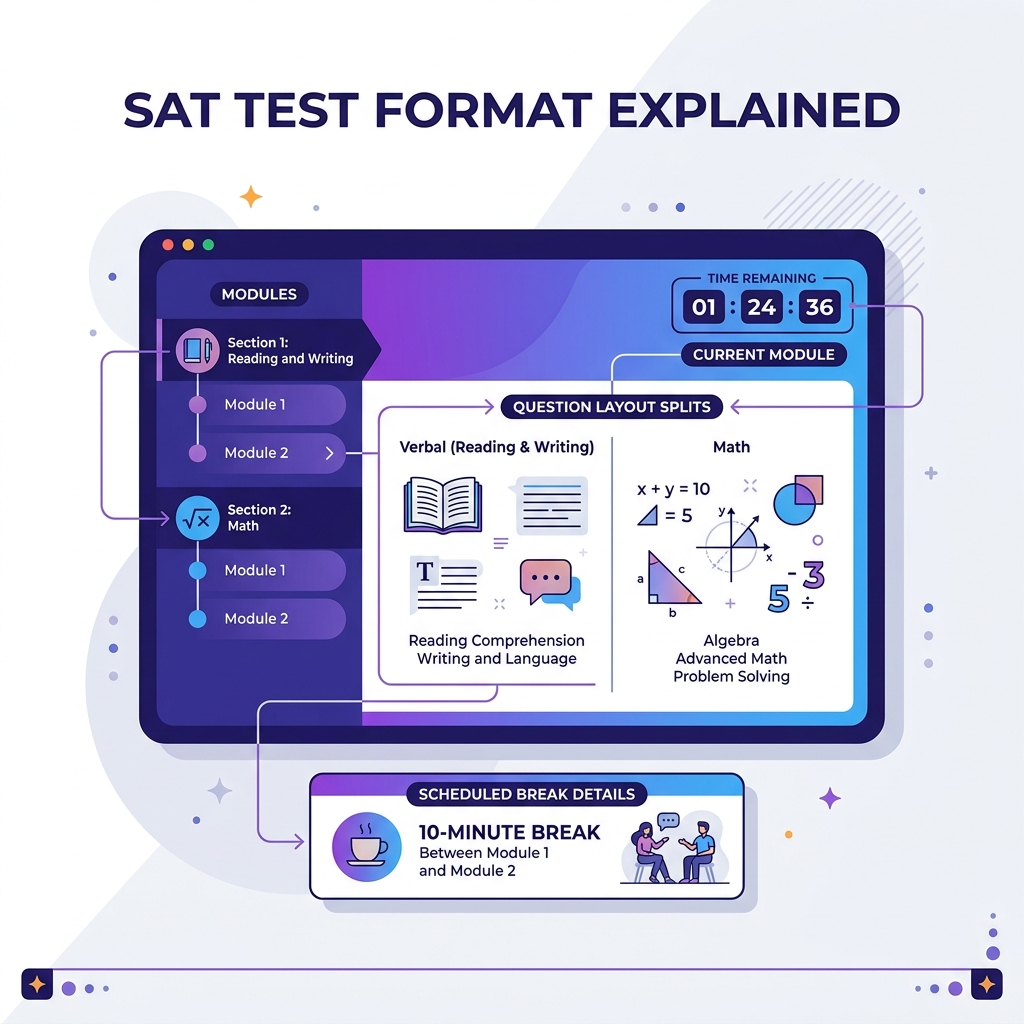
Quick Facts
- Format: Section-level adaptive exam taken on the Bluebook™ application
- Total Time: 2 hours and 14 minutes of active testing time
- Modules: Two sections (Reading & Writing, Math), each split into 2 modules
- Breaks: One scheduled 10-minute break between the Reading & Writing and Math sections
- Question Counts: Verbal has 54 questions (27 per module), Math has 44 questions (22 per module)
- Question Types: Multiple choice (all sections) and Student-Produced Responses (Math only)
- Integrated tools: On-screen clock, reference sheet, zoom, and Desmos calculator
After This Page
- Use this workshop to convert section timing and module structure into a practical first-pass, flag, review, and break routine.
- Turn the guide into one timed drill, one error-log entry, and one concrete next study assignment.
- Separate official SAT facts from independent study advice before making registration, device, scoring, or test-day decisions.
Use this box as a completion check: if you cannot produce these outputs, reread the relevant section before moving to another topic.
Understanding the exact format of the SAT is the first step toward achieving a top score. Pencils, bubble sheets, and long, multi-page reading passages are gone. The exam is fully digital, computer-adaptive, and runs on a tight, standardized schedule of modules, questions, and breaks.
This detailed guide reviews the essentials of the sat new format practice test structure. We break down the timing splits for both sections, analyze the question distributions across modules, outline the rules for the 10-minute break, and share pacing shortcuts to help you navigate your testing cycle in 2026.
Table of Contents
- The Digital SAT Structure: An Overview
- Section 1: Reading & Writing Pacing splits
- Section 2: Math Pacing Splits
- The Computer-Adaptive Testing (CAT) Routing Engine
- The Scheduled 10-Minute Break: Rules & Survival
- Standard English Conventions & Punctuation Rules
- Math Section Geometry Formulas & coordinate Midpoint
- Desmos Shortcuts for High-Speed Calculations
- Common Pacing Traps & Execution Mistakes
- Mini-Practice Test: Sample Verbal & Math Exercises
1. The Digital SAT Structure: An Overview
The SAT consists of two main, independent sections: Reading & Writing and Math. The total test duration is 2 hours and 14 minutes, split into four adaptive modules with a single break:
- Reading & Writing Section: Two 32-minute modules (54 questions total, 27 per module).
- The 10-Minute Break: A scheduled break between the Reading & Writing and Math sections.
- Math Section: Two 35-minute modules (44 questions total, 22 per module).
2. Section 1: Reading & Writing Pacing splits
The Reading & Writing section tests verbal reasoning, language conventions, and rhetorical analysis. You have 32 minutes to answer 27 questions in each module.
Timing Pacing Calculations
Let’s analyze the time allocation per question: \[\text{Time per question} = \frac{32 \text{ minutes} \times 60 \text{ seconds}}{27} = \frac{1920 \text{ seconds}}{27} \approx 71.1 \text{ seconds}\] Because every question has a short passage, you must divide your time between reading the passage and evaluating the options.
Pacing Splits Strategy
To manage your time effectively, divide the module into three pacing blocks:
- Block 1 (Questions 1-13): Craft & Structure (Words in Context) and Information & Ideas. Spend no more than 50 seconds per question on vocabulary.
- Block 2 (Questions 14-23): Standard English Conventions (Grammar/Punctuation). These are the fastest questions. Solve them in 40 seconds each.
- Block 3 (Questions 24-27): Expression of Ideas (Transitions/Rhetorical Synthesis). Allocate 60 seconds per question to read the bulleted notes carefully.
3. Section 2: Math Pacing Splits
The Math section measures algebraic fluency, data analysis, and geometric problem-solving. You have 35 minutes to answer 22 questions in each module.
Timing Pacing Calculations
Let’s analyze the time allocation per question: \[\text{Time per question} = \frac{35 \text{ minutes} \times 60 \text{ seconds}}{22} = \frac{2100 \text{ seconds}}{22} \approx 95.5 \text{ seconds}\] This is a more generous allocation than the Reading & Writing section, but you must still bank time on easier questions to spend on the harder multi-step problems at the end of the module.
Pacing Splits Strategy
- First Pass (15 minutes): Answer all easy-to-medium questions. If an algebraic setup takes more than 45 seconds to write down, flag it and move on.
- Second Pass (15 minutes): Open your flagged questions. Use the built-in Desmos graphing calculator to solve coordinates, quadratics, and systems of equations.
- Review Pass (5 minutes): Re-check your Student-Produced Response (SPR) entry boxes to ensure no typos were made.
4. The Computer-Adaptive Testing (CAT) Routing Engine
The Digital SAT is section-level adaptive. Your accuracy in Module 1 determines whether you route to the easier or harder Module 2.
+---------------------------------------+
|          Start: Section 1/2           |
+-------------------+-------------------+
                    |
                    v
+---------------------------------------+
|               Module 1                |
|       (Standard Mixed Items)          |
+-------------------+-------------------+
                    |
           Route Accuracy Check
                    |
          +---------+---------+
          |                   |
          v                   v
+---------+---------+ +-------+---------+
|  Easier Module 2  | |  Harder Module 2  |
| (Easy-to-Med)     | | (Med-to-Hard)     |
+---------+---------+ +-------+---------+
          |                   |
          v                   v
+---------+---------+ +-------+---------+
| Lower top-end     | | More top-end      |
| evidence          | | evidence          |
+-------------------+ +-------------------+
Your scaled score is calculated using Item Response Theory (IRT). The probability of answering a question correctly is represented by the 3PL curve: \[P(\theta) = c + \frac{1 - c}{1 + e^{-a(\theta - b)}}\]
College Board does not publish a fixed raw-score percentage for harder Module 2 routing. Treat Module 1 as an accuracy-first module: avoid careless misses on accessible questions, make strategic guesses when needed, and use review time to catch misreads before the module closes.
5. The Scheduled 10-Minute Break: Rules & Survival
The 10-minute break between the Reading & Writing and Math sections is a critical opportunity to recharge your mental energy. Follow these rules to avoid issues:
- Do Not Close the Lid: Keep your laptop lid open and the Bluebook app running. Closing the lid or exiting the app can trigger a security error and delay your test.
- No Electronic Devices: You are strictly prohibited from checking your phone, smart watch, or other electronic devices during the break. Keep all devices powered off in your bag.
- Snack for Stamina: Eat a quick snack containing complex carbohydrates and protein (e.g., nuts or a granola bar) outside the room to maintain your blood sugar levels.
6. Standard English Conventions & Punctuation Rules
Mastering these core punctuation rules is essential for Block 2 of the Reading & Writing section:
- Semicolons: A semicolon must separate two independent clauses: \[\text{Independent Clause} + \text{;} + \text{Independent Clause}\]
- Colons: A colon must follow a complete independent clause and can introduce a list, explanation, or emphasis: \[\text{Independent Clause} + \text{:} + \text{Explanation/List}\]
- Commas: Do not use a comma to link two independent clauses (comma splice). Use a comma and coordinating conjunction (FANBOYS): \[\text{Independent Clause} + \text{,} + \text{FANBOYS} + \text{Independent Clause}\]
Original Verbal Example: Punctuation
Let’s analyze a typical Standard English Conventions question:
Passage: In her landmark study of deep-sea hydrothermal vents, marine biologist Dr. Sylvia Earle documented several previously unknown species ______ including a unique strain of chemosynthetic bacteria that thrived in water temperatures exceeding \(100^\circ\text{C}\).
Which choice completes the text with the most logical punctuation?
- A) species;
- B) species,
- C) species:
- D) species
Step-by-Step Explanation:
- Analyze the clause structure: The clause before the blank is “In her landmark study of deep-sea hydrothermal vents, marine biologist Dr. Sylvia Earle documented several previously unknown species”. This is a complete independent clause.
- Analyze the clause after the blank: The phrase “including a unique strain…” is a modifying phrase, not an independent clause.
- Evaluate choices:
- A) species;: Semicolons must separate two independent clauses. Incorrect.
- B) species,: The comma correctly separates the independent clause from the modifying participial phrase. Correct.
- C) species:: While a colon can follow an independent clause, it is not used to introduce a standard modifying phrase starting with “including”. Incorrect.
- D) species: Lacks punctuation, causing a run-on structure. Incorrect.
7. Math Section Geometry Formulas & coordinate Midpoint
Mastering geometry formulas saves time on the Math section:
- Area of a Circle: \[A = \pi r^2\]
- Volume of a Cylinder: \[V = \pi r^2 h\]
- Coordinate Midpoint: The midpoint \(M(h, k)\) between points \(A(x_1, y_1)\) and \(B(x_2, y_2)\) is: \[M = \left(\frac{x_1 + x_2}{2}, \frac{y_1 + y_2}{2}\right)\]
Original Math Example: Coordinate Midpoint
Let’s work through a coordinate geometry problem:
Question: In the coordinate plane, the line segment \(PQ\) has endpoints \(P(-5, 11)\) and \(Q(7, -3)\). What is the midpoint \(M\) of the line segment \(PQ\)?
Step-by-Step Algebraic Solution:
- Recall the Midpoint Formula: \[M = \left(\frac{x_1 + x_2}{2}, \frac{y_1 + y_2}{2}\right)\]
- Substitute Endpoint Values:
- \(x_1 = -5, x_2 = 7\)
- \(y_1 = 11, y_2 = -3\)
- Calculate coordinates: \[h = \frac{-5 + 7}{2} = \frac{2}{2} = 1\] \[k = \frac{11 + (-3)}{2} = \frac{8}{2} = 4\] The midpoint coordinates are \((1, 4)\).
8. Desmos Shortcuts for High-Speed Calculations
Use the built-in Desmos calculator to solve complex algebraic systems in seconds:
- Shortcut: Intersections: Type both equations directly into Desmos (e.g., \(y = 2x - 5\) and \(y = -x^2 + 4x - 2\)). Click on the intersection points shown on the graph. Desmos will highlight the exact coordinates. This eliminates manual substitution and solving quadratics.
9. Common Pacing Traps & Execution Mistakes
Avoiding these timing errors is crucial for securing a high score:
- Pitfall 1: Spending too much time on single questions: Getting stuck on a hard question early in the module can leave you without enough time to answer easy questions at the end.
- The Fix: Apply the 45-second rule. If you do not know how to set up an equation after 45 seconds, select a provisional answer, flag it, and move on.
- Pitfall 2: Neglecting the last 5 minutes warning: When the timer alerts you that 5 minutes remain, stop working and make guesses for any blank questions in the navigation panel to ensure you get guessing points.
10. Mini-Practice Test: Sample Verbal & Math Exercises
Test your skills with this 4-question review quiz:
Verbal Section
Question 1: Craft and Structure (Transitions)
The primary function of red blood cells is to transport oxygen from the lungs to the body’s tissues. ______ they contain hemoglobin, a protein that binds to oxygen molecules and releases them where needed.
Which choice completes the text with the most logical transition?
- A) Specifically,
- B) However,
- C) Consequently,
- D) Furthermore,
Answer & Explanation:
- Answer: A) Specifically,
- Explanation: The first sentence states the primary function of red blood cells (transporting oxygen). The second sentence provides a specific detail explaining how they perform this function (by containing hemoglobin). This is an illustrative relationship. Specifically is the correct connector. However (contrast), Consequently (causal), and Furthermore (addition) do not fit.
Question 2: Standard English Conventions (Punctuation)
During the late Carboniferous period, Earth’s atmospheric oxygen levels reached an estimated \(35%\) ______ a concentration that allowed prehistoric insects to grow to gigantic sizes.
Which choice completes the text with the most logical punctuation?
- A) oxygen levels reached an estimated \(35%\);
- B) oxygen levels reached an estimated \(35%\),
- C) oxygen levels reached an estimated \(35%\):
- D) oxygen levels reached an estimated \(35%\)
Answer & Explanation:
- Answer: B) oxygen levels reached an estimated \(35%\),
- Explanation: The clause “a concentration that allowed…” is an appositive noun phrase modifying the oxygen concentration. Appositive phrases must be separated from the independent clause with a comma. A semicolon (A) is incorrect because the modifying phrase is dependent.
Math Section
Question 3: Algebra (Systems of Equations)
A system of equations is shown below: \[3x + y = 11\] \[2x - y = 4\] What is the value of the coordinate \(x\)?
Answer & Explanation:
- Answer: 3
- Explanation: Solve using elimination:
- Add the two equations directly to eliminate \(y\): \[(3x + y) + (2x - y) = 11 + 4\] \[5x = 15 \implies x = 3\] The value of the coordinate \(x\) is 3.
Question 4: Advanced Math (Quadratic Equations)
A quadratic equation is defined by \(f(x) = x^2 - 8x + 12\). What are the x-intercepts of the function?
Answer & Explanation:
- Answer: 2 and 6
- Explanation: The x-intercepts occur where \(f(x) = 0\): \[x^2 - 8x + 12 = 0\] Factor the quadratic equation: \[(x - 2)(x - 6) = 0\] Solve for \(x\): \[x - 2 = 0 \implies x = 2\] \[x - 6 = 0 \implies x = 6\] The x-intercepts are 2 and 6.
11. Official Sources, Trademark Disclaimer, and Final Notes
Trademark Disclaimer
SAT® and Bluebook™ are registered trademarks of the College Board, which was not involved in the production of, and does not endorse, this study guide or the resources hosted on SATHELP24x7.com.
Practice Application: SAT Test Format: Modules, Timing, Questions, Breaks
Decision Example
If general prep affects a real testing decision, separate the official fact from the independent study action before acting.
Follow-Up Drill
Write one timed task, one official-source verification task, and one error-log review task based on this page.
Completion Checklist
- I can state the official fact that matters.
- I can name the independent strategy I will try.
- I have one measurable practice task scheduled.
Next Step
Use the related links below to turn this guide into practice or source verification.
Continue practice →Guide Application Workshop
Format-to-pacing workshop
Use this workshop to convert section timing and module structure into a practical first-pass, flag, review, and break routine.
Section structure and timing should match official College Board guidance. Students should verify current format details before test day, especially if using older prep materials.
Student Scenario
A student knows the module timing but still runs out of time. The fix is to rehearse pacing checkpoints and a skip rule, not simply memorize the total number of minutes.
Use the scenario as a model for your own planning. Replace the sample student with your baseline, your deadline, and your weakest two domains. A useful guide should end with a written action: a timed set to complete, an official page to verify, a question category to review, or a study block to schedule.
Checkpoints for Using This Guide
These checkpoints convert reading into measurable work. Complete them in order and keep the proof column visible in your notes. If you cannot produce the proof, reread the relevant part of the guide or move to a focused practice page before continuing.
| Checkpoint | Student action | Evidence it worked |
|---|---|---|
| Module map | Write the two sections, two modules per section, and the average time per question. | The student can pace without checking a separate summary. |
| First-pass rule | Define how long to spend before flagging a question with no clear setup. | One difficult item does not consume time needed for easier items later. |
| Navigation fluency | Practice flagging, eliminating, returning, and reviewing answers in the digital interface. | Interface actions do not slow the student during a timed module. |
| Break discipline | Rehearse the scheduled break during a full practice session. | The student knows how to reset between Reading and Writing and Math. |
| Endgame routine | Use the final minutes to fill blanks, review flagged items, and avoid unnecessary answer changes. | The student finishes with an intentional process instead of panic. |
Practice Workshop
Work through these assignments after reading the guide. They are designed to expose whether the guide changed your behavior, not merely whether the page felt clear. Each assignment should produce a visible artifact: a timing note, a table, a source check, an error-log entry, or a revised study block.
Assignment 1
Halfway checkpoint drill
Run a timed module and note your position at the halfway point. Decide whether you need to speed up or slow down.
A pacing plan should be checked during the module, not discovered when time expires.
Finish the assignment by writing one next action in your planner. The action should be specific enough that you can complete it in a single study block, such as "re-solve five colon questions" or "verify the current registration deadline."
Assignment 2
Flag-and-return rehearsal
During a practice set, require yourself to flag two time-consuming questions and return after completing easier items.
The drill removes emotional resistance to skipping. Skipping is a timing strategy, not giving up.
Finish the assignment by writing one next action in your planner. The action should be specific enough that you can complete it in a single study block, such as "re-solve five colon questions" or "verify the current registration deadline."
Assignment 3
Break simulation
Between sections, take a timed ten-minute break during practice and return before the break ends.
A rehearsed break protects energy and avoids losing focus before Math begins.
Finish the assignment by writing one next action in your planner. The action should be specific enough that you can complete it in a single study block, such as "re-solve five colon questions" or "verify the current registration deadline."
Assignment 4
Answer-fill audit
At the two-minute mark, check for unanswered items, enter a best guess, and prioritize only the most promising flagged question.
Because there is no wrong-answer penalty, leaving blanks is avoidable point loss.
Finish the assignment by writing one next action in your planner. The action should be specific enough that you can complete it in a single study block, such as "re-solve five colon questions" or "verify the current registration deadline."
Assignment 5
Old-material filter
Review older SAT prep notes and mark anything that applies to the paper test but not the current digital structure.
Old rules can damage pacing and expectations. Keep the current format summary visible in your planner.
Finish the assignment by writing one next action in your planner. The action should be specific enough that you can complete it in a single study block, such as "re-solve five colon questions" or "verify the current registration deadline."
Error-Log Protocol
For every guide-related practice question you miss, create a compact error-log entry with five fields: source, domain, wrong decision, correct decision, and next drill. The wrong decision matters because it captures the habit that needs to change. The next drill matters because it turns the explanation into future behavior.
Review the log twice. The first review happens immediately, while the explanation is fresh. The second review happens after a delay, when you must solve without seeing the answer. A question is not retired until you can re-solve it accurately, explain the principle, and recognize the same pattern in a new context.
If multiple missed questions share the same cause, pause broad practice and run a narrow repair block. For example, three missed transition questions should trigger a transition-only drill; three missed function-notation questions should trigger a function-only drill. This prevents the guide from becoming general reading instead of targeted preparation.
Source-Check and Study-Action Matrix
A guide is strongest when it separates two kinds of information: official facts and independent study advice. Official facts answer questions such as timing, score scale, registration, test-day requirements, device rules, and calculator policy. Independent study advice answers questions such as how to review, how to pace, how to choose a drill, and how to organize mistakes. Use the matrix below each time you rely on this page for a decision.
| Information type | What to do | Example output |
|---|---|---|
| Official policy | Open the linked official source before acting on dates, deadlines, device setup, identification, fees, or accommodations. | A planner note that says which official page was checked and on what date. |
| Test structure | Confirm current section names, module timing, and question counts against official SAT Suite guidance. | A one-line format summary written in your own notes. |
| Study strategy | Apply the independent advice to a timed set or review block, then judge it by accuracy and timing evidence. | A completed drill with a result and one next action. |
| Practice-test result | Translate the result into domains and error types instead of treating the total score as the whole story. | A short list of two domains to repair before the next full test. |
| Retake or registration decision | Use official deadlines and your section-level evidence together before choosing a date. | A retake decision that includes score gap, available weeks, and deadline verification. |
Student Notes Template
Use this note template after reading the guide. The template prevents a common weak outcome: finishing a long page and having no evidence that the content changed your preparation. Keep the answers short and concrete. A good note should tell you what to practice during the next session without rereading the entire guide.
One fact I verified
Write one policy, date, timing detail, or official rule that you checked against a College Board page. Include the date you checked it so you know when the note may need refreshing.
One strategy I will test
Choose a strategy from the guide and apply it in a timed or review setting. The strategy is not adopted until it improves accuracy, speed, or clarity in your own work.
One weak domain
Name the specific domain or subskill that needs attention. Avoid broad labels like Math or verbal; use labels such as systems of equations, transition logic, or punctuation boundaries.
One next assignment
Write one task that can be completed in a single block. It should include a number, a source, and a review step, such as ten timed algebra questions plus error-log review.
Revisit the notes at the end of the week. If the next assignment was completed and reviewed, write the result. If it was not completed, decide whether the assignment was too large, too vague, or not aligned with the real weakness. This weekly adjustment is what turns a study guide into a working plan.
One-Week Implementation Plan
Use this one-week plan after finishing the guide. The aim is not to reread the page every day. The aim is to apply one part of the guide, check whether it works in practice, and update your study plan from evidence. Keep each day small enough to complete during a normal school week.
Day 1:Write a five-line summary of the guide and verify any official fact that could affect registration, testing, scoring, or device setup.
Day 2:Choose one skill from the guide and complete an untimed drill. Explain every answer choice or every setup step.
Day 3:Re-solve missed or uncertain items from Day 2 without looking at the explanation. Add unstable items to the error log.
Day 4:Run a timed mini-set that uses the same skill. Record time, confidence, and the first point where your process slowed.
Day 5:Create or find a second context for the same skill so you are not depending on the original wording.
Day 6:Complete a mixed set that includes unrelated SAT topics. Check whether the guide skill is still recognized quickly.
Day 7:Review the week and choose one next assignment: continue repair, move to maintenance, or take a checkpoint module.
If Day 6 breaks down, do not treat that as failure. Mixed practice is supposed to reveal whether a skill transfers when it is not announced. Return to the checkpoint table, identify the clue you missed, and repeat the timed mini-set with fewer distractors before trying mixed practice again.
Decision Rules for Next Steps
After applying the guide for one week, choose the next action from evidence. Continue repair if the same error appears more than once. Move to maintenance if accuracy is high, timing is stable, and you can explain the method without notes. Take a checkpoint module only when you have reviewed the main errors and want to test whether the repair holds under pressure.
Do not let a single strong practice set convince you that the skill is finished. A skill is stable when it works across at least three conditions: untimed practice, timed practice, and mixed practice. If it works only in one condition, keep it active in the planner but reduce the volume so it does not crowd out other weak domains.
If the guide involves official policy or logistics, schedule a later verification date. Administrative information can change, and students should not rely on old notes for registration, deadline, calculator, device, or test-day decisions. Put the verification reminder near the test date in your planner.
Final Application Bank
Complete at least four of these application tasks before considering the guide finished. They are short by design, but each requires a visible output that can be checked later. This keeps long-form reading connected to action.
Write a one-page summary that separates official facts from independent study advice.
Create a five-row error-log table using recent missed or guessed questions related to the guide topic.
Build a timed mini-set and mark the first moment where pacing, wording, or setup became difficult.
Choose one official source link from the page and write what decision it supports.
Rewrite one strategy from the guide as a checklist that can be used during practice.
Explain the guide topic to another student, then ask that student to solve one original example.
Add one planner reminder for a future source check, diagnostic, or delayed re-solve.
Run a mixed practice set and record whether the guide skill was recognized without prompting.
If the output from these tasks is vague, narrow the assignment. "Study scoring" is too broad; "verify the official score scale and write how section scores combine" is useful. "Practice format" is too broad; "run one timed module and record the halfway checkpoint" is useful. The guide has done its job only when it changes the next study action.
Explanation Standard for Guide-Based Practice
When you use this guide with practice questions, require every review note to meet a consistent explanation standard. The note should identify the tested idea, cite the prompt clue, state the correct decision, explain one tempting wrong path, and name the next practice action. This keeps guide reading tied to the way students actually gain points.
The tested idea should be narrow. "SAT format" is broad; "module pacing checkpoint" is narrow. "Practice tests" is broad; "delayed re-solve after an error-log entry" is narrow. "Study plan" is broad; "weekly review meeting after a timed module" is narrow. Narrow labels make review searchable and prevent the same weakness from hiding inside general notes.
The prompt clue should be visible. If a student cannot point to a phrase, number, graph feature, deadline, or source requirement, the explanation may be relying on memory instead of evidence. In guide-heavy topics, the clue may be an official policy category, such as registration, scoring, device setup, or test-day materials. In strategy topics, the clue may be a timing pattern, score split, or repeated error type.
The next practice action should be small enough to do. Avoid notes that say "review more" or "get better at pacing." Better actions include "run one timed module and record the halfway point," "verify the current official date page," "re-solve five missed transition items," or "write a two-column table comparing official facts with independent strategy." Small actions are easier to complete and easier to measure.
This explanation standard also helps avoid overclaiming. If a statement depends on official SAT policy, verify it with the official source. If a statement is a SATHELP24x7 strategy recommendation, label it as a study method and judge it by student results. Keeping those two categories separate makes the guide clearer, safer, and more useful.
Guide Completion Quality Check
A guide is complete only when it creates a decision outside the page. Before moving on, identify the decision this guide supports: a study priority, a practice-test schedule, a source-verification reminder, a pacing rule, a registration action, or a test-day checklist item. If no decision is created, reread the scenario and checkpoint sections and choose a smaller output.
Next, identify the evidence behind that decision. Evidence can be an official source, a baseline score, an error-log pattern, a timed module result, or a repeated uncertainty. Do not use confidence alone as evidence. Confidence often rises after reading an explanation, but the skill still needs to appear in practice before it is considered stable.
Finally, schedule the next checkpoint. For content topics, the checkpoint may be a delayed re-solve or a timed mini-set. For format or logistics topics, the checkpoint may be a date to verify official information again. For study planning, the checkpoint may be a weekly review meeting. A guide without a checkpoint can fade into passive reading.
Keep the completion note short: one decision, one evidence source, one next checkpoint. This format makes the guide easy to revisit later and helps students avoid over-planning. The next study action should be obvious when the note is opened.
Final Reflection Prompt
End the guide with a short reflection: what fact did you verify, what skill did you practice, what evidence changed your plan, and what checkpoint comes next? These four answers make the guide usable later because they summarize both knowledge and action.
If the reflection produces no next checkpoint, the study session is not finished. Add one measurable action before closing the page. A good checkpoint can be a timed module, a delayed re-solve, a source check, or a weekly review note. It should be small enough to complete and clear enough to evaluate.
Save the reflection in the same place as your study calendar. When you revisit the guide later, check whether the planned checkpoint happened and what the result showed. If the result improved, move the topic to maintenance. If the same weakness remains, choose a narrower drill and repeat the review cycle.
A useful guide note should also say when to stop. Stop active review when the skill works in untimed work, timed work, and mixed work, or when the official policy question has been verified and added to the planner. Continue active review only when evidence shows the decision is still unclear or unstable.
This stop rule protects study time. Students often reread familiar pages because rereading feels productive, but the better use of time is targeted practice, delayed review, or source verification. The guide should point to that next action and then get out of the way.
When the next action is complete, return only long enough to update the note. The guide should function as a reference and planning aid, not a place to hide from timed practice. Evidence from practice decides what happens next.
If the evidence is mixed, keep the topic active but narrow the next task. Smaller tasks make weak points easier to find. Once the weak point is visible, choose a drill that tests only that decision before returning to broad mixed practice. This keeps review efficient and prevents the guide from turning into repeated reading without measurable progress. If the narrower drill works twice, move back to mixed practice and verify that the skill still appears quickly. If it fails again, the issue is not effort; it is a sign that the rule, clue, or setup needs a clearer explanation before more volume is added. Make the next correction visible in the planner. Then test that correction in a short timed set. Record the result before continuing. Keep the follow-up specific and measurable. Repeat when needed.
Readiness Rubric
- Level 1: you can repeat facts from the guide but have not applied them to a practice set.
- Level 2: you can apply the guide in untimed work but still miss items when the wording changes.
- Level 3: you can apply the guide in timed work and explain most errors clearly.
- Level 4: you can apply the guide in mixed practice, update your plan from evidence, and verify official facts before acting.
Completion Checklist
- Know the current section and module structure.
- Use average pacing as a guide, not a rigid rule.
- Flag questions with no clear setup quickly.
- Fill every answer before time expires.
- Use the break as a reset between sections.
- Practice digital navigation before test day.
- Use Desmos when it improves speed or accuracy.
- Verify format facts through official sources.
How to Keep the Guide Current
Some SAT information is stable, such as the broad skill categories tested in Math and Reading and Writing. Other information can change, including dates, deadlines, fees, test-center instructions, calculator policies, and software procedures. Whenever a decision affects registration, test-day admission, device setup, or score reporting, use the linked official source rather than relying on memory.
A strong study system separates independent strategy from official policy. SATHELP24x7 can provide study routines, original practice, checklists, and explanation frameworks, but official College Board pages remain the authority for administrative requirements. Keep that distinction visible in your notes so you do not confuse a study recommendation with a policy rule.
College Board Official SAT Suite Technical Specifications
Frequently Asked Questions
How does the section-level adaptive structure affect my pacing?
The section-level adaptive structure means that your performance in Module 1 determines the difficulty of the questions you receive in Module 2. Because Module 1 contains a representative mix of easy, medium, and hard questions, you should prioritize accuracy early to build strong evidence for harder Module 2 routing. College Board does not publish fixed public routing cutoffs or score caps, so treat any exact threshold as an unofficial estimate. In Module 2, you must adapt your pacing: the harder module will feature a higher concentration of time-consuming questions, requiring you to use shortcuts like Desmos more frequently to stay on schedule.
What happens during the 10-minute break on the SAT?
The 10-minute break occurs between the Reading & Writing section and the Math section. When the timer for the second Verbal module expires, the Bluebook application will automatically transition to a break screen and start a 10-minute countdown. You must leave your testing device open on your desk; do not close the laptop lid or exit the application. You are permitted to leave the room to consume snacks or water, use the restroom, or stretch. You must return to your desk before the countdown timer expires, as the Math section will start automatically.
Are there any penalty points for wrong answers on the new format?
No. The Digital SAT does not apply any penalty points for incorrect answers. Your score is calculated based on the number of questions answered correctly and their relative difficulty parameters under an Item Response Theory (IRT) model. Because there is no penalty for guessing, you should never leave any questions blank on your exam. If you are running out of time at the end of a module, make an educated guess or select a temporary answer for every remaining question in the navigation panel.
What is a Student-Produced Response (SPR) question?
Student-Produced Response (SPR) questions are non-multiple-choice math questions where you must solve the problem and enter your numerical answer directly into a text box on the screen. Approximately 25% of the Math section consists of SPR questions. You can enter integers, fractions, or decimals. Negative numbers are permitted, but there are specific grid constraints: fractional answers must fit within 5 characters, and decimal answers must be entered accurately to the maximum number of grid spaces available. No letters, symbols, or operators are allowed.
Can I hide the on-screen digital clock during the test?
Yes. The Bluebook testing interface features a digital countdown timer at the top-center of the screen. You can click directly on the clock icon to hide the timer if it causes you test-anxiety or distracts you from reading. However, the application is programmed to automatically show the clock once you have only 5 minutes remaining in the module, and you cannot hide it during this final window. We recommend keeping it visible but checking it only when you are halfway through the module to monitor your pacing splits.
Are we allowed to bring our own scrap paper for calculations?
No. You are strictly prohibited from bringing any personal scrap paper, notebook sheets, or grid papers into the testing room. The proctor will distribute official scratch paper (stamped or signed to verify validity) at the start of the exam. You can write on both sides of the paper and request additional sheets from the proctor if you run out. You must hand in all scratch paper to the proctor at the end of the test before you are permitted to leave the room.
Can I use an external keyboard with my tablet during the test?
If you are taking the exam on a tablet (such as an iPad), you are permitted to connect a standard external physical keyboard (wired or wireless). In fact, using an external keyboard is highly recommended for tablet users to speed up typing variables and equations in the Desmos panel. However, you cannot use an external keyboard if you are taking the test on a standard laptop computer, nor are you permitted to connect a secondary screen, mouse pad, or drawing tablet.
What is the average time available per question on the Math section?
The Math section allocates a total of 70 minutes for 44 questions, which is split into two 35-minute modules of 22 questions each. This corresponds to an average of \(95.5\) seconds per question. While this is a generous time allocation compared to other standardized tests, some questions (like quadratic systems or statistical margin of error analyses) will take significantly longer. You must build pacing splits, solving easy linear questions in under 45 seconds to bank time for the harder questions at the end of the module.
How does the Bluebook reference sheet work on the Math section?
The Bluebook application includes a built-in reference sheet containing basic geometric formulas, such as the area of triangles, circles, and rectangles, and the volume of spheres, cylinders, and cones. You can access the reference sheet at any time during the Math section by clicking the 'Reference' icon at the top of the screen. A pop-up panel will display the formulas. While this sheet is useful, you should still memorize these formulas in advance to avoid wasting valuable seconds opening the panel during the test.