SAT Prep Roadmap: From Diagnostic to Target Score
Build an SAT prep roadmap from diagnostic test to target score with weekly milestones, mistake logs, content review, and pacing practice.
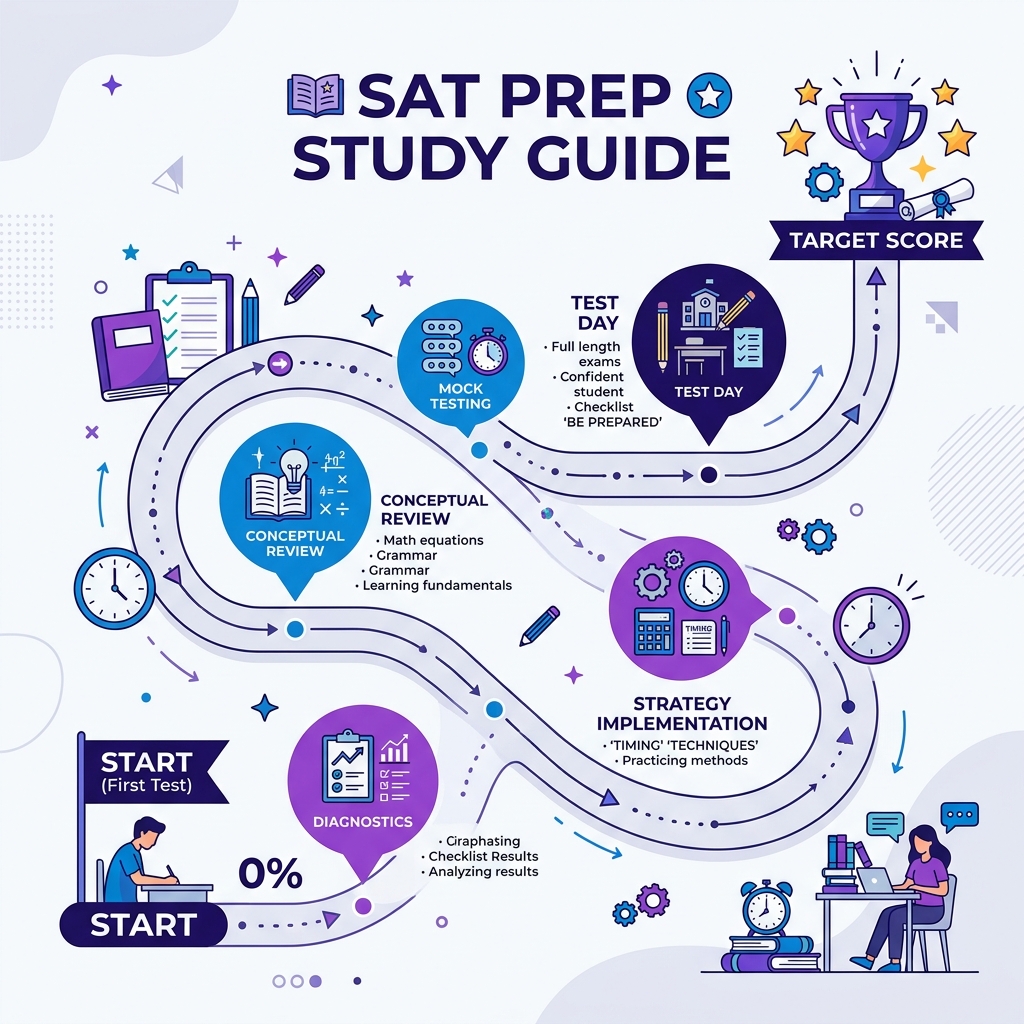
Quick Facts
- Phase 1 - Diagnostic: Establish baseline metrics using a timed mock exam in Bluebook
- Phase 2 - Content: Master core Algebra, Advanced Math, and Grammar conventions
- Phase 3 - Strategy: Learn Desmos shortcuts, transitions, and pacing splits
- Phase 4 - Stamina: Execute bi-weekly timed practice tests with detailed error logging
- Phase 5 - Consolidation: Complete final reviews, pack checklists, and manage sleep math
- Goal Alignment: Map study hours directly to target score gains to prevent burnout
- Resource Integration: Combine written guides with interactive calculators and quizzes
After This Page
- Use this workshop to turn a target score into weekly study decisions, not just a long list of resources.
- Turn the guide into one timed drill, one error-log entry, and one concrete next study assignment.
- Separate official SAT facts from independent study advice before making registration, device, scoring, or test-day decisions.
Use this box as a completion check: if you cannot produce these outputs, reread the relevant section before moving to another topic.
Raising your SAT score is a process that requires a structured, step-by-step roadmap. Haphazardly solving practice questions or reading study guides without a clear plan leads to inconsistent progress and prep burnout. To achieve your target score, you must apply a systematic preparation cycle that takes you from a baseline diagnostic test to test-day readiness.
This detailed guide reviews the essentials of the sat prep study guide roadmap. We break down the five distinct phases of preparation, share timing splits, outline error log protocols, and provide structured action items to help you secure a top score in 2026.
Table of Contents
- The 5-Phase Preparation Roadmap: An Overview
- Phase 1: Diagnostic Calibration (0-10%)
- Phase 2: Foundational Content Review (10-50%)
- Phase 3: Strategy Implementation (50-75%)
- Phase 4: Stamina Construction & Mock Testing (75-95%)
- Phase 5: The Test Week Consolidation (95-100%)
- The Error Log Protocol: Classifying and Re-Solving Mistakes
- Pacing Splits &Pacing Calculations
- Integrating Study Tools for Maximum Efficiency
- Mini-Practice Test: Sample Roadmap Exercises
1. The 5-Phase Preparation Roadmap: An Overview
A successful preparation roadmap is divided into five distinct phases, each with specific study goals and milestones:
| Phase | Timeline (8-Week Prep) | Primary Focus | Key Milestones |
|---|---|---|---|
| Phase 1: Diagnostic | Week 1 | Establish score baseline | Take timed diagnostic mock; set target score |
| Phase 2: Content | Weeks 2-4 | Master academic rules | Study algebra, quadratics, and grammar guides |
| Phase 3: Strategy | Weeks 5-6 | Learn testing tactics | Master Desmos shortcuts and pacing splits |
| Phase 4: Stamina | Weeks 7-8 | Build mock endurance | Take bi-weekly timed practice tests; run error logs |
| Phase 5: Consolidation | Test Week | Final review & prep | Review formulas sheet; pack test-day checklist |
2. Phase 1: Diagnostic Calibration (0-10%)
The goal of the first phase is to identify your starting score and locate your largest areas for growth.
- Action Item: Download the official Bluebook application and take the first available full-length practice test under timed, realistic conditions.
- Analyzing Results: Do not look at your composite score as a measure of capability. Look at it as a roadmap. If your Math score is 680 and your Reading & Writing score is 540, your score gap reveals that prioritizing grammar conventions and transitions will yield the fastest score gains.
3. Phase 2: Foundational Content Review (10-50%)
Once you have identified your baseline, spend the next 3 to 4 weeks reviewing the core academic rules tested on the exam.
- Math Content Focus:
- Algebra: Solving linear systems, graphing inequalities, and unit conversions.
- Advanced Math: Factoring quadratics, finding parabola vertices, and simplifying rational expressions.
- Verbal Content Focus:
- Standard Conventions: Subject-verb agreement, pronoun matching, and punctuation rules (commas, semicolons, dashes).
- Expression of Ideas: Transition word categories (contrast, addition, cause-and-effect).
4. Phase 3: Strategy Implementation (50-75%)
Having built a solid conceptual foundation, transition to learning test-taking strategies and software shortcuts.
- Desmos Graphing Calculator Shortcuts: Learn how to solve systems of equations, find quadratic vertices, and shade inequalities in Desmos in under 15 seconds.
- The Flag-and-Skip Pacing Method: Practice skipping difficult questions during your first pass to secure easy points early and avoid running out of time.
- Process of Elimination: Learn how to identify common distractor templates, such as “second-meaning” vocabulary traps in Reading & Writing.
5. Phase 4: Stamina Construction & Mock Testing (75-95%)
This phase is focused on consolidating your skills and building testing endurance.
- Action Item: Take a full-length, timed mock exam every 2 weeks.
- The Error Journal Protocol: For every question you answer incorrectly or guess on, copy it into an error log. Classify the error type (conceptual, procedural, pacing, careless), write the correct solution, and re-test yourself 3 days later.
6. Phase 5: The Test Week Consolidation (95-100%)
The final week before your exam should be reserved for light reviews and physiological preparation.
- Do Not Cram: Trying to learn complex new math concepts or memorizing thousands of rare vocabulary words during the final 3 days before your test is highly counterproductive.
- Physiological Prep (Sleep Math): Prioritize sleep. Let \(C(h)\) represent cognitive performance as a function of sleep hours \(h\): \[C(h) = -0.15(h - 8)^2 + 10.0\] Sleeping only 5 hours yields \(C(5) = 8.65\) (a 13.5% performance drop). Sleep at least 8 hours on Thursday and Friday nights.
7. The Error Log Protocol: Classifying and Re-Solving Mistakes
To get the most out of your practice, categorize every mistake:
- Conceptual: You did not know the math formula or grammar rule.
- Procedural: You knew the rule but made an algebraic setup mistake.
- Pacing: You ran out of time or rushed.
- Careless: You misread a sign, coordinate, or question constraint.
Original Verbal Example: Transitions
Let’s analyze a transition question common to Phase 3 preparation:
Passage: In the early 20th century, the geologist Alfred Wegener proposed the theory of continental drift, pointing to the jigsaw-like fit of South America and Africa as evidence that Earth’s continents were once joined. ______ Wegener was unable to identify a plausible physical mechanism to explain how solid landmasses could move through the ocean floor, leading most contemporary scientists to reject his hypothesis.
Which choice completes the text with the most logical transition?
- A) Specifically,
- B) In fact,
- C) Consequently,
- D) Unfortunately,
Step-by-Step Explanation:
- Analyze sentence 1: Wegener proposed continental drift with strong evidence (a positive scientific step).
- Analyze sentence 2: Wegener could not explain the mechanism, causing scientists to reject it (a negative obstacle).
- Identify the relationship: This is a contrast or adversarial relationship. The word should highlight the obstacle. Unfortunately fits this context.
- Evaluate choices:
- A) Specifically: Illustrates a point. Incorrect.
- B) In fact: Emphasizes a statement. Incorrect.
- C) Consequently: Shows cause-and-effect. Incorrect.
- D) Unfortunately: Highlights a setback. Correct.
8. Original Math Example: Circle Radius
Let’s work through a geometry problem common to Phase 4 mock tests:
Question: In the coordinate plane, a circle is defined by the equation: \[x^2 + y^2 - 14x + 8y = 32\] What is the radius \(r\) of the circle?
Step-by-Step Algebraic Solution:
- Recall the Circle Equation: The standard equation is: \[(x - h)^2 + (y - k)^2 = r^2\]
- Group terms: Group the \(x\) and \(y\) terms: \[(x^2 - 14x) + (y^2 + 8y) = 32\]
- Complete the square for \(x\): Add \(\left(\frac{-14}{2}\right)^2 = 49\) to both sides: \[(x^2 - 14x + 49) + (y^2 + 8y) = 32 + 49\]
- Complete the square for \(y\): Add \(\left(\frac{8}{2}\right)^2 = 16\) to both sides: \[(x^2 - 14x + 49) + (y^2 + 8y + 16) = 32 + 49 + 16\]
- Factor and simplify: \[(x - 7)^2 + (y + 4)^2 = 97\]
- Identify \(r^2\): \[r^2 = 97 \implies r = \sqrt{97}\] The radius of the circle is \(\sqrt{97}\).
9. Integrating Study Tools for Maximum Efficiency
To optimize your preparation roadmap, pair this guide with our interactive tools:
- Establish baseline timelines: Pin your target test date using our SAT Countdown Timer to organize your testing check-points.
- Generate calendars: Build a study schedule using the Study Plan Generator.
- Target grammar weaknesses: Drill specific grammar rules using the Grammar Flashcards Tool.
- Verify scores: Log your baseline and target scores in the Score Goal Planner to track your progression.
10. Mini-Practice Test: Sample Roadmap Exercises
Test your skills with this 4-question review quiz:
Verbal Section
Question 1: Craft and Structure (Transitions)
The cell membrane is selectively permeable, allowing essential nutrients to enter the cell while blocking harmful substances. ______ it maintains a stable internal environment, which is crucial for the cell’s survival.
Which choice completes the text with the most logical transition?
- A) However,
- B) Consequently,
- C) Furthermore,
- D) Specifically,
Answer & Explanation:
- Answer: B) Consequently,
- Explanation: The first sentence describes the membrane’s selective permeability (the action/cause). The second sentence explains the result of this selective permeability: the maintenance of a stable internal environment (the effect). This is a cause-and-effect relationship. Consequently is the correct causal connector. However (contrast), Furthermore (addition), and Specifically (illustration) do not model this relationship.
Question 2: Standard English Conventions (Punctuation)
In 1953, James Watson and Francis Crick proposed the double helix structure of DNA ______ a discovery that revolutionized the field of molecular biology.
Which choice completes the text with the most logical punctuation?
- A) DNA,
- B) DNA:
- C) DNA;
- D) DNA
Answer & Explanation:
- Answer: A) DNA,
- Explanation: The clause “a discovery that revolutionized…” is an appositive noun phrase modifying the double helix proposal. Appositive phrases at the end of a sentence must be separated with a comma. A colon (B) is incorrect because it implies a list or formal definition follows. A semicolon (C) is incorrect because the modifying phrase is dependent.
Math Section
Question 3: Algebra (Systems of Equations)
A system of equations is shown below: \[2x + y = 8\] \[3x - y = 7\] What is the value of the coordinate \(x\)?
Answer & Explanation:
- Answer: 3
- Explanation: Solve using elimination:
- Add the two equations directly to eliminate \(y\): \[(2x + y) + (3x - y) = 8 + 7\] \[5x = 15 \implies x = 3\] The value of the coordinate \(x\) is 3.
Question 4: Geometry (Right Triangles)
In right triangle \(ABC\), the measure of angle \(C\) is \(90^\circ\). If the length of side \(AB\) is \(10\) and the length of side \(BC\) is \(6\), what is the value of \(\sin(A)\)?
Answer & Explanation:
- Answer: 3/5 (or 0.6)
- Explanation: In right triangle \(ABC\) with right angle at \(C\):
- The side opposite angle \(A\) is \(BC = 6\).
- The hypotenuse is \(AB = 10\). Using the sine ratio definition: \[\sin(A) = \frac{\text{Opposite}}{\text{Hypotenuse}} = \frac{BC}{AB} = \frac{6}{10} = \frac{3}{5}\]
11. Official Sources, Trademark Disclaimer, and Final Notes
Trademark Disclaimer
SAT® and Bluebook™ are registered trademarks of the College Board, which was not involved in the production of, and does not endorse, this study guide or the resources hosted on SATHELP24x7.com.
Practice Application: SAT Prep Roadmap: From Diagnostic to Target Score
Decision Example
If general prep affects a real testing decision, separate the official fact from the independent study action before acting.
Follow-Up Drill
Write one timed task, one official-source verification task, and one error-log review task based on this page.
Completion Checklist
- I can state the official fact that matters.
- I can name the independent strategy I will try.
- I have one measurable practice task scheduled.
Next Step
Use the related links below to turn this guide into practice or source verification.
Continue practice →Guide Application Workshop
Roadmap execution workshop
Use this workshop to turn a target score into weekly study decisions, not just a long list of resources.
Current registration, test date, score-release, and official practice information should be verified with College Board before finalizing the plan.
Student Scenario
A student wants a 1400 but has no baseline. The right sequence is baseline first, score-gap calculation second, weekly section priorities third, and practice-test checkpoints fourth.
Use the scenario as a model for your own planning. Replace the sample student with your baseline, your deadline, and your weakest two domains. A useful guide should end with a written action: a timed set to complete, an official page to verify, a question category to review, or a study block to schedule.
Checkpoints for Using This Guide
These checkpoints convert reading into measurable work. Complete them in order and keep the proof column visible in your notes. If you cannot produce the proof, reread the relevant part of the guide or move to a focused practice page before continuing.
| Checkpoint | Student action | Evidence it worked |
|---|---|---|
| Baseline score | Take a timed baseline or use a recent official score report. | The plan has a starting point and a measurable gap. |
| Target score reason | Connect the target score to college, scholarship, or placement goals. | The student can decide whether the required effort is worth the timeline. |
| Section split | Identify which section has the larger gap from the target. | Weekly study time is weighted toward the highest-impact section. |
| Practice cadence | Schedule concept learning, drills, timed modules, full tests, and review days separately. | The student is not confusing testing with studying. |
| Final readiness | End with a test-day checklist, device check, and light review plan. | The plan closes with logistics and confidence, not last-minute overload. |
Practice Workshop
Work through these assignments after reading the guide. They are designed to expose whether the guide changed your behavior, not merely whether the page felt clear. Each assignment should produce a visible artifact: a timing note, a table, a source check, an error-log entry, or a revised study block.
Assignment 1
Target-score math
Write baseline Math, baseline Reading and Writing, target Math, target Reading and Writing, and total score gap.
A 100-point total gain can come from different section combinations. The plan should reflect the section with the clearest opportunity.
Finish the assignment by writing one next action in your planner. The action should be specific enough that you can complete it in a single study block, such as "re-solve five colon questions" or "verify the current registration deadline."
Assignment 2
Resource selection
Choose one guide, one practice engine, and one flashcard deck for the top two weak domains.
Too many resources create distraction. A roadmap should choose the smallest set that addresses the measured gap.
Finish the assignment by writing one next action in your planner. The action should be specific enough that you can complete it in a single study block, such as "re-solve five colon questions" or "verify the current registration deadline."
Assignment 3
Weekly review meeting
At the end of each week, write what improved, what repeated, and what the next week will emphasize.
This keeps the plan responsive to evidence without changing direction randomly every day.
Finish the assignment by writing one next action in your planner. The action should be specific enough that you can complete it in a single study block, such as "re-solve five colon questions" or "verify the current registration deadline."
Assignment 4
Mixed-practice checkpoint
After isolated domain repair, run a mixed set to confirm the skill survives switching contexts.
The real test does not announce every subskill. Mixed practice checks transfer.
Finish the assignment by writing one next action in your planner. The action should be specific enough that you can complete it in a single study block, such as "re-solve five colon questions" or "verify the current registration deadline."
Assignment 5
Retake decision
Before test day, define what score outcome would make a retake useful and how much time you would need before it.
Retake planning reduces pressure on one sitting and keeps decisions practical.
Finish the assignment by writing one next action in your planner. The action should be specific enough that you can complete it in a single study block, such as "re-solve five colon questions" or "verify the current registration deadline."
Error-Log Protocol
For every guide-related practice question you miss, create a compact error-log entry with five fields: source, domain, wrong decision, correct decision, and next drill. The wrong decision matters because it captures the habit that needs to change. The next drill matters because it turns the explanation into future behavior.
Review the log twice. The first review happens immediately, while the explanation is fresh. The second review happens after a delay, when you must solve without seeing the answer. A question is not retired until you can re-solve it accurately, explain the principle, and recognize the same pattern in a new context.
If multiple missed questions share the same cause, pause broad practice and run a narrow repair block. For example, three missed transition questions should trigger a transition-only drill; three missed function-notation questions should trigger a function-only drill. This prevents the guide from becoming general reading instead of targeted preparation.
Source-Check and Study-Action Matrix
A guide is strongest when it separates two kinds of information: official facts and independent study advice. Official facts answer questions such as timing, score scale, registration, test-day requirements, device rules, and calculator policy. Independent study advice answers questions such as how to review, how to pace, how to choose a drill, and how to organize mistakes. Use the matrix below each time you rely on this page for a decision.
| Information type | What to do | Example output |
|---|---|---|
| Official policy | Open the linked official source before acting on dates, deadlines, device setup, identification, fees, or accommodations. | A planner note that says which official page was checked and on what date. |
| Test structure | Confirm current section names, module timing, and question counts against official SAT Suite guidance. | A one-line format summary written in your own notes. |
| Study strategy | Apply the independent advice to a timed set or review block, then judge it by accuracy and timing evidence. | A completed drill with a result and one next action. |
| Practice-test result | Translate the result into domains and error types instead of treating the total score as the whole story. | A short list of two domains to repair before the next full test. |
| Retake or registration decision | Use official deadlines and your section-level evidence together before choosing a date. | A retake decision that includes score gap, available weeks, and deadline verification. |
Student Notes Template
Use this note template after reading the guide. The template prevents a common weak outcome: finishing a long page and having no evidence that the content changed your preparation. Keep the answers short and concrete. A good note should tell you what to practice during the next session without rereading the entire guide.
One fact I verified
Write one policy, date, timing detail, or official rule that you checked against a College Board page. Include the date you checked it so you know when the note may need refreshing.
One strategy I will test
Choose a strategy from the guide and apply it in a timed or review setting. The strategy is not adopted until it improves accuracy, speed, or clarity in your own work.
One weak domain
Name the specific domain or subskill that needs attention. Avoid broad labels like Math or verbal; use labels such as systems of equations, transition logic, or punctuation boundaries.
One next assignment
Write one task that can be completed in a single block. It should include a number, a source, and a review step, such as ten timed algebra questions plus error-log review.
Revisit the notes at the end of the week. If the next assignment was completed and reviewed, write the result. If it was not completed, decide whether the assignment was too large, too vague, or not aligned with the real weakness. This weekly adjustment is what turns a study guide into a working plan.
One-Week Implementation Plan
Use this one-week plan after finishing the guide. The aim is not to reread the page every day. The aim is to apply one part of the guide, check whether it works in practice, and update your study plan from evidence. Keep each day small enough to complete during a normal school week.
Day 1:Write a five-line summary of the guide and verify any official fact that could affect registration, testing, scoring, or device setup.
Day 2:Choose one skill from the guide and complete an untimed drill. Explain every answer choice or every setup step.
Day 3:Re-solve missed or uncertain items from Day 2 without looking at the explanation. Add unstable items to the error log.
Day 4:Run a timed mini-set that uses the same skill. Record time, confidence, and the first point where your process slowed.
Day 5:Create or find a second context for the same skill so you are not depending on the original wording.
Day 6:Complete a mixed set that includes unrelated SAT topics. Check whether the guide skill is still recognized quickly.
Day 7:Review the week and choose one next assignment: continue repair, move to maintenance, or take a checkpoint module.
If Day 6 breaks down, do not treat that as failure. Mixed practice is supposed to reveal whether a skill transfers when it is not announced. Return to the checkpoint table, identify the clue you missed, and repeat the timed mini-set with fewer distractors before trying mixed practice again.
Decision Rules for Next Steps
After applying the guide for one week, choose the next action from evidence. Continue repair if the same error appears more than once. Move to maintenance if accuracy is high, timing is stable, and you can explain the method without notes. Take a checkpoint module only when you have reviewed the main errors and want to test whether the repair holds under pressure.
Do not let a single strong practice set convince you that the skill is finished. A skill is stable when it works across at least three conditions: untimed practice, timed practice, and mixed practice. If it works only in one condition, keep it active in the planner but reduce the volume so it does not crowd out other weak domains.
If the guide involves official policy or logistics, schedule a later verification date. Administrative information can change, and students should not rely on old notes for registration, deadline, calculator, device, or test-day decisions. Put the verification reminder near the test date in your planner.
Final Application Bank
Complete at least four of these application tasks before considering the guide finished. They are short by design, but each requires a visible output that can be checked later. This keeps long-form reading connected to action.
Write a one-page summary that separates official facts from independent study advice.
Create a five-row error-log table using recent missed or guessed questions related to the guide topic.
Build a timed mini-set and mark the first moment where pacing, wording, or setup became difficult.
Choose one official source link from the page and write what decision it supports.
Rewrite one strategy from the guide as a checklist that can be used during practice.
Explain the guide topic to another student, then ask that student to solve one original example.
Add one planner reminder for a future source check, diagnostic, or delayed re-solve.
Run a mixed practice set and record whether the guide skill was recognized without prompting.
If the output from these tasks is vague, narrow the assignment. "Study scoring" is too broad; "verify the official score scale and write how section scores combine" is useful. "Practice format" is too broad; "run one timed module and record the halfway checkpoint" is useful. The guide has done its job only when it changes the next study action.
Explanation Standard for Guide-Based Practice
When you use this guide with practice questions, require every review note to meet a consistent explanation standard. The note should identify the tested idea, cite the prompt clue, state the correct decision, explain one tempting wrong path, and name the next practice action. This keeps guide reading tied to the way students actually gain points.
The tested idea should be narrow. "SAT format" is broad; "module pacing checkpoint" is narrow. "Practice tests" is broad; "delayed re-solve after an error-log entry" is narrow. "Study plan" is broad; "weekly review meeting after a timed module" is narrow. Narrow labels make review searchable and prevent the same weakness from hiding inside general notes.
The prompt clue should be visible. If a student cannot point to a phrase, number, graph feature, deadline, or source requirement, the explanation may be relying on memory instead of evidence. In guide-heavy topics, the clue may be an official policy category, such as registration, scoring, device setup, or test-day materials. In strategy topics, the clue may be a timing pattern, score split, or repeated error type.
The next practice action should be small enough to do. Avoid notes that say "review more" or "get better at pacing." Better actions include "run one timed module and record the halfway point," "verify the current official date page," "re-solve five missed transition items," or "write a two-column table comparing official facts with independent strategy." Small actions are easier to complete and easier to measure.
This explanation standard also helps avoid overclaiming. If a statement depends on official SAT policy, verify it with the official source. If a statement is a SATHELP24x7 strategy recommendation, label it as a study method and judge it by student results. Keeping those two categories separate makes the guide clearer, safer, and more useful.
Guide Completion Quality Check
A guide is complete only when it creates a decision outside the page. Before moving on, identify the decision this guide supports: a study priority, a practice-test schedule, a source-verification reminder, a pacing rule, a registration action, or a test-day checklist item. If no decision is created, reread the scenario and checkpoint sections and choose a smaller output.
Next, identify the evidence behind that decision. Evidence can be an official source, a baseline score, an error-log pattern, a timed module result, or a repeated uncertainty. Do not use confidence alone as evidence. Confidence often rises after reading an explanation, but the skill still needs to appear in practice before it is considered stable.
Finally, schedule the next checkpoint. For content topics, the checkpoint may be a delayed re-solve or a timed mini-set. For format or logistics topics, the checkpoint may be a date to verify official information again. For study planning, the checkpoint may be a weekly review meeting. A guide without a checkpoint can fade into passive reading.
Keep the completion note short: one decision, one evidence source, one next checkpoint. This format makes the guide easy to revisit later and helps students avoid over-planning. The next study action should be obvious when the note is opened.
Final Reflection Prompt
End the guide with a short reflection: what fact did you verify, what skill did you practice, what evidence changed your plan, and what checkpoint comes next? These four answers make the guide usable later because they summarize both knowledge and action.
If the reflection produces no next checkpoint, the study session is not finished. Add one measurable action before closing the page. A good checkpoint can be a timed module, a delayed re-solve, a source check, or a weekly review note. It should be small enough to complete and clear enough to evaluate.
Save the reflection in the same place as your study calendar. When you revisit the guide later, check whether the planned checkpoint happened and what the result showed. If the result improved, move the topic to maintenance. If the same weakness remains, choose a narrower drill and repeat the review cycle.
A useful guide note should also say when to stop. Stop active review when the skill works in untimed work, timed work, and mixed work, or when the official policy question has been verified and added to the planner. Continue active review only when evidence shows the decision is still unclear or unstable.
This stop rule protects study time. Students often reread familiar pages because rereading feels productive, but the better use of time is targeted practice, delayed review, or source verification. The guide should point to that next action and then get out of the way.
When the next action is complete, return only long enough to update the note. The guide should function as a reference and planning aid, not a place to hide from timed practice. Evidence from practice decides what happens next.
If the evidence is mixed, keep the topic active but narrow the next task. Smaller tasks make weak points easier to find. Once the weak point is visible, choose a drill that tests only that decision before returning to broad mixed practice. This keeps review efficient and prevents the guide from turning into repeated reading without measurable progress. If the narrower drill works twice, move back to mixed practice and verify that the skill still appears quickly. If it fails again, the issue is not effort; it is a sign that the rule, clue, or setup needs a clearer explanation before more volume is added. Make the next correction visible in the planner. Then test that correction in a short timed set. Record the result before continuing. Keep the follow-up specific and measurable. Repeat when needed.
Readiness Rubric
- Level 1: you can repeat facts from the guide but have not applied them to a practice set.
- Level 2: you can apply the guide in untimed work but still miss items when the wording changes.
- Level 3: you can apply the guide in timed work and explain most errors clearly.
- Level 4: you can apply the guide in mixed practice, update your plan from evidence, and verify official facts before acting.
Completion Checklist
- Start with a baseline score.
- Set a section-level target, not only a total score.
- Choose weekly priorities from missed-question data.
- Separate learning days from testing days.
- Review every diagnostic before taking another.
- Use official sources for date and registration choices.
- Protect sleep and taper time in the final week.
- Revisit the plan weekly based on evidence.
How to Keep the Guide Current
Some SAT information is stable, such as the broad skill categories tested in Math and Reading and Writing. Other information can change, including dates, deadlines, fees, test-center instructions, calculator policies, and software procedures. Whenever a decision affects registration, test-day admission, device setup, or score reporting, use the linked official source rather than relying on memory.
A strong study system separates independent strategy from official policy. SATHELP24x7 can provide study routines, original practice, checklists, and explanation frameworks, but official College Board pages remain the authority for administrative requirements. Keep that distinction visible in your notes so you do not confuse a study recommendation with a policy rule.
College Board Official Study Roadmap
Frequently Asked Questions
How long should I study to achieve a 100-point score increase?
A 100-point score increase typically requires approximately 40 to 60 hours of structured, active study. This study time should be spread over 6 to 8 weeks, corresponding to roughly 6 to 8 hours of preparation per week. Simply reading guides or clicking through practice questions without reviewing mistakes does not count as active study. Active study includes taking baseline diagnostics, maintaining an error log, re-solving missed questions from scratch, and memorizing core math formulas and grammar structures. For larger score gains (e.g., 200+ points), you should plan for 100 to 150 hours of total preparation.
What is the most effective way to start my SAT preparation from scratch?
The most effective way to start is to take a full-length, timed diagnostic practice test inside the Bluebook application. This baseline exam establishes your starting score and reveals your conceptual strengths and weaknesses. Do not study any content before taking this first test, as doing so will mask your natural baseline. Once you have your baseline score report, identify your target score based on the 75th percentile of your goal colleges. Then, use our Study Plan Generator to design a structured weekly study schedule.
How do I choose between an 8-week study plan and a 30-day intensive plan?
Choose your study plan based on your remaining preparation window and target score goal. If you have 2 to 3 months before your exam date, we highly recommend an 8-week balanced study plan. This timeline allows you to study for 60 to 90 minutes daily without experience burnout, leaving ample time to master complex Advanced Math topics and build reading stamina. If your test is in less than 5 weeks, use a 30-day intensive plan, which requires 90 to 120 minutes of daily practice focused on high-frequency concepts, transition lists, and weekly timed mocks.
What should I do if my score drops on a practice test?
Do not panic. Score fluctuations of 30 to 50 points between practice tests are completely normal and can be caused by factors such as test difficulty variances, testing environments, sleep levels, or test-day anxiety. A single score drop does not mean you are losing progress. Look at the specific subdomains where you lost points: did you miss questions due to new content gaps, or did you make careless processing errors under time pressure? Log these mistakes in your error journal, review the rules, and focus on reinforcing those areas during your next study cycle.
Can I self-study for the SAT, or do I need a private tutor?
Self-studying is highly effective for many students, provided you use structured resources and maintain study consistency. By utilizing detailed curriculum directories, standard formulas sheets, interactive flashcards, and error log protocols, you can build the academic and tactical skills needed for meaningful score growth. Private tutoring can be beneficial if you encounter specific content plateaus that you cannot resolve on your own, or if you need external accountability to maintain a study schedule, but it is not automatically required for strong SAT performance.
How does the SAT score goal planner help my preparation?
The Score Goal Planner is an interactive tool that helps you calculate how raising your score in individual sections (Verbal vs. Math) affects your composite score. It allows you to input your baseline metrics, target goal, and weekly study hours. The planner then suggests the most efficient allocation of your preparation time. For example, if you are starting with a 650 Math and a 550 Verbal, the tool will suggest allocating 70% of your study hours to Verbal, where you have a larger scoring ceiling and can secure faster gains.
How many practice tests should I take during my preparation roadmap?
We recommend taking between 4 and 6 full-length practice tests during a standard 8-to-12-week preparation roadmap. Taking too many tests (e.g., multiple tests per week) leads to prep fatigue and does not leave enough study days between exams to actually review your mistakes and learn the content. Space your mock tests 2 to 3 weeks apart. Use the weeks in between to drill specific topics, review your error log, and build conceptual mastery.
What is the 'Sleep Math' formula for the night before the test?
Sleep Math refers to calculating the impact of sleep deprivation on your cognitive processing speed and working memory on test day. In psychometrics, a student's cognitive performance coefficient \(C(h)\) as a function of hours of sleep \(h\) can be modeled as a parabolic curve peaking at 8 hours: \(C(h) = -0.15(h - 8)^2 + 10.0\). Sleeping only 5 hours reduces your performance coefficient to 8.65 (a 13.5% drop from optimal). Prioritize getting at least 8 hours of sleep on both Thursday and Friday nights before your exam.
How do I qualify for National Merit Scholarships using the SAT Suite?
To qualify for National Merit Scholarships, you must take the PSAT/NMSQT in October of your junior year. The National Merit Scholarship Corporation uses your scores to calculate a Selection Index score: \(SI = 2 \times (\text{Reading \& Writing score} / 10) + (\text{Math score} / 10)\). If your Selection Index score meets or exceeds the qualifying cutoff for your state (typically the top 1% of test-takers in that state), you will be recognized as a National Merit Semifinalist, opening up significant scholarship opportunities.