SAT Practice Test Guide: How to Use Practice Tests Correctly
The complete guide to taking, analyzing, and reviewing SAT practice tests, featuring error log protocols, timing strategies, and preparation loops.
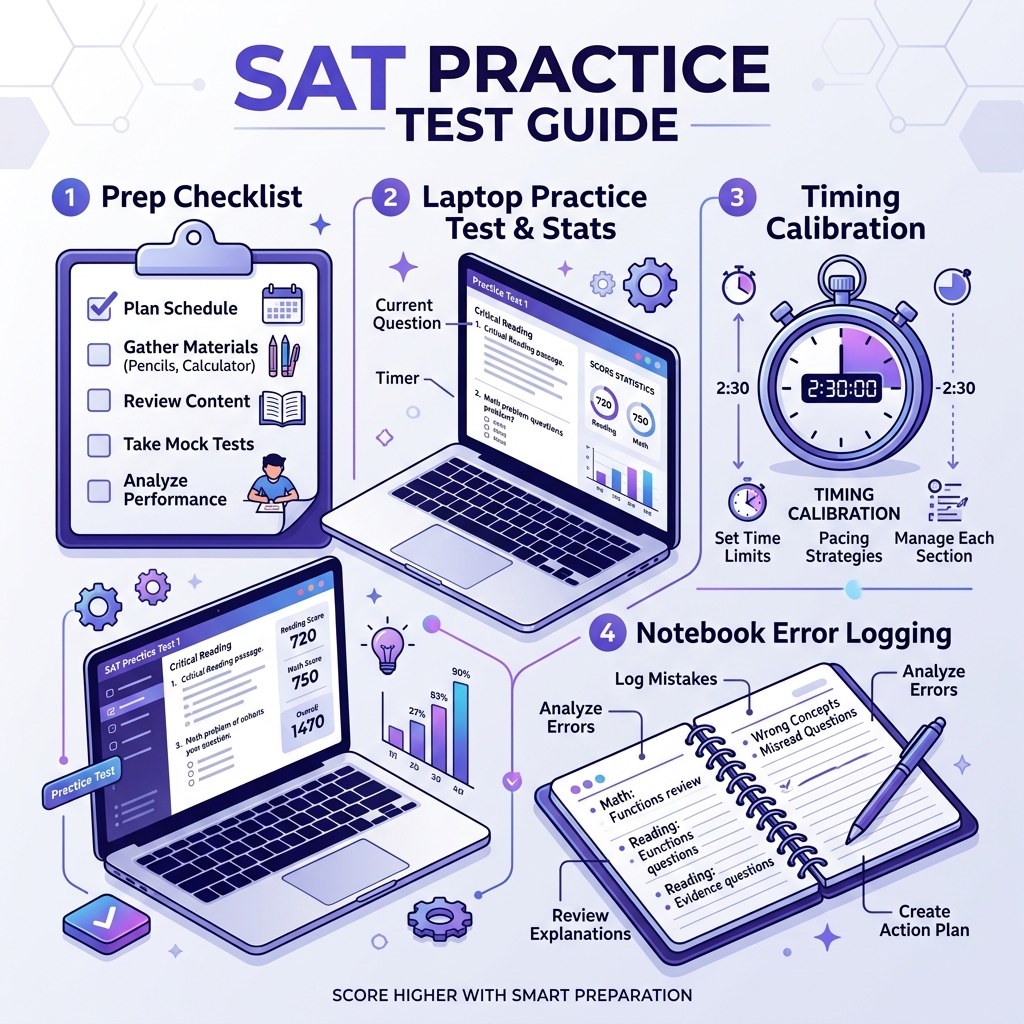
Quick Facts
- Goal: Learn how to utilize mock practice tests to identify content gaps and build testing stamina
- Simulation: Mimic realistic test conditions by disabling notifications, using approved devices, and timing breaks
- Error Logging: Track every missed question by category (conceptual, procedural, pacing, careless)
- Re-Testing Rule: Re-solve missed questions from scratch 3-5 days later to build procedural memory
- Diagnostic Pacing: Allocate specific timing goals for each module pass (first pass vs. review pass)
- Built-in Tools: Master the Bluebook review flags, question crossings, and Desmos integrations during practice
- Frequency Target: Take a full timed practice exam every 2 to 3 weeks during your core prep cycle
After This Page
- Use this workshop to make every practice test produce a concrete next step: a domain to study, a pacing habit to repair, or a question type to drill.
- Turn the guide into one timed drill, one error-log entry, and one concrete next study assignment.
- Separate official SAT facts from independent study advice before making registration, device, scoring, or test-day decisions.
Use this box as a completion check: if you cannot produce these outputs, reread the relevant section before moving to another topic.
Taking full-length practice tests is the cornerstone of any successful SAT preparation strategy. However, simply taking test after test without a structured review process is highly ineffective. Students who repeat tests without analyzing their mistakes often experience score plateaus and prep fatigue. To achieve a top score, you must learn how to take, analyze, and review your practice exams correctly.
This detailed guide reviews the essentials of the sat practice test cycle. We explain how to simulate realistic testing environments, format a high-yield Error Log, apply target timing splits, and utilize diagnostic data to shape your weekly study schedules in 2026.
Table of Contents
- The Goal of Practice Testing: Pacing & Stamina
- Simulating Test Center Environments at Home
- The 4-Step Prep Loop: Diagnostics to Re-Tests
- Mastering the Error Log Protocol: Error Classifications
- The Re-Testing Window: Reinforcing Muscle Memory
- Analyzing Correct Answers for Pacing Efficiency
- Understanding Your Diagnostic Adaptive Routing
- Verbal Pacing Splits: Time Management Calculations
- Math Pacing Splits: Time Management Calculations
- Mini-Practice Test: Sample Verbal & Math Exercises
1. The Goal of Practice Testing: Pacing & Stamina
Full-length practice exams serve three primary purposes:
- Stamina Construction: Taking a 2-hour, 14-minute computerized exam requires intense mental focus. Regular practice prevents fatigue during the final modules of the actual test.
- Pacing Pacing: Timed mocks help you build an internal clock, ensuring you allocate appropriate time to different question types and avoid getting stuck on a single hard problem.
- Concept Gap Identification: Mock tests expose exactly which formulas, vocabulary words, and grammar structures you have not yet mastered.
2. Simulating Test Center Environments at Home
If you take practice tests while sitting in bed, playing music, checking your phone, or pausing the timer, your scores will not reflect your true ability. You must simulate realistic test center conditions:
- Device Configuration: Use the same laptop or tablet you plan to use on test day. Disable all notifications, chat windows, and background apps.
- Time of Day: Start your practice test at 8:30 AM on a Saturday morning. This is the exact time testing begins at official centers. It prepares your brain to perform at peak capacity early in the morning.
- Desk Setup: Clear your desk of all clutter. You should only have your testing device, charger, an approved physical calculator, a pen/pencil, and two sheets of scratch paper.
- The Single Break: Follow the official 10-minute break between the Reading & Writing and Math sections. Do not extend the break or look at study materials.
3. The 4-Step Prep Loop: Diagnostics to Re-Tests
To ensure maximum score gains, organize your prep around this structured cycle:
+-------------------------------------------------------------+
| Step 1: Baseline Adaptive Mock                              |
| Take a timed diagnostic test in the Bluebook app.           |
+------------------------------+------------------------------+
                               |
                               v
+-------------------------------------------------------------+
| Step 2: Exhaustive Error Review                             |
| Analyze every incorrect and flagged question.               |
+------------------------------+------------------------------+
                               |
                               v
+-------------------------------------------------------------+
| Step 3: Targeted Concept Drills                             |
| Read specific guides and solve practice problems.            |
+------------------------------+------------------------------+
                               |
                               v
+-------------------------------------------------------------+
| Step 4: Re-Test Missed Questions                            |
| Re-solve the logged questions from scratch 3 days later.    |
+-------------------------------------------------------------+
4. Mastering the Error Log Protocol: Error Classifications
The Error Log is the single most powerful tool for raising your SAT score. For every question you answer incorrectly or guess on, you must log it in a dedicated journal.
Error Classifications
To fix your mistakes, you must first identify why you made them. Classify every error into one of these four categories:
- Conceptual Error: You did not know the underlying academic concept (e.g., you forgot the vertex x-coordinate formula \(x = -\frac{b}{2a}\) or did not know the difference between a colon and a semicolon).
- Procedural Error: You knew the concept but set up the solution steps incorrectly (e.g., you set up a linear system correctly but made an error during algebraic substitution).
- Pacing Error: You ran out of time or rushed through the question, leading to a hasty guess or leaving it blank.
- Careless Error: You understood the question but made a simple processing mistake (e.g., misread a coordinate sign, input a number incorrectly in Desmos, or solved for \(x\) when the question asked for \(2x - 3\)).
Original Verbal Example: Transitions
Let’s analyze a typical transition question that might end up in an error log:
Passage: For decades, marine biologists believed that the deep-ocean floor was a barren wasteland devoid of complex biological activity due to the complete absence of sunlight. ______ the discovery of hydrothermal vent ecosystems in 1977 revealed thriving communities of chemosynthetic bacteria, giant tube worms, and unique crabs that thrived in complete darkness.
Which choice completes the text with the most logical transition?
- A) Specifically,
- B) In addition,
- C) Consequently,
- D) However,
Step-by-Step Explanation:
- Analyze sentence 1: Biologists believed the ocean floor was a barren wasteland (old belief).
- Analyze sentence 2: The discovery of hydrothermal vent ecosystems revealed thriving communities (new conflicting discovery).
- Identify the relationship: This is a clear contrast relationship (the new discovery disproves the old belief).
- Evaluate choices:
- A) Specifically: Illustrates a point. Incorrect.
- B) In addition: Adds info. Incorrect.
- C) Consequently: Shows cause-and-effect. Incorrect.
- D) However: Signals contrast. Matches our prediction. Correct.
5. The Re-Testing Window: Reinforcing Muscle Memory
Writing down the correct answer in your error log is not enough. You must re-test yourself to verify that the correction has built new cognitive pathways:
- The 3-Day Rule: Do not re-test yourself immediately after reviewing the solution, as you will simply recall the answer from short-term memory. Wait exactly 3 days before trying to solve the question again from scratch.
- Zero Assistance: Re-solve the problem with no help, notes, or looking at your error journal. If you answer it correctly, mark it as resolved. If you miss it again, leave it in the log and repeat the process 3 days later.
6. Analyzing Correct Answers for Pacing Efficiency
Many students ignore the questions they got correct on mock tests. This is a missed opportunity to optimize your pacing. For every correct answer:
- Identify the Shortcut: Did you solve the question using a slow method? For example, if you solved a system of linear equations algebraically: \[2x - y = 5\] \[3x + y = 10\] Did you use substitution, or did you quickly add them to get \(5x = 15 \implies x = 3\)?
- Evaluate Desmos Usage: Could you have typed the equations directly into Desmos and clicked on the intersection in 10 seconds, saving 90 seconds for harder problems at the end of the module?
7. Understanding Your Diagnostic Pacing Splits
Use the table below to structure your time management during practice tests.
Pacing Goals per Module Section
| Section & Module | Total Questions | Target Time (First Pass) | Target Time (Flag Review Pass) |
|---|---|---|---|
| Verbal Module 1 | 27 questions | 25 minutes (approx. 55s/question) | 7 minutes |
| Verbal Module 2 (Harder) | 27 questions | 27 minutes (approx. 60s/question) | 5 minutes |
| Math Module 1 | 22 questions | 28 minutes (approx. 76s/question) | 7 minutes |
| Math Module 2 (Harder) | 22 questions | 30 minutes (approx. 82s/question) | 5 minutes |
8. Original Math Example: Circle Equations
Let’s work through a coordinate geometry problem common to practice tests:
Question: In the coordinate plane, the equation of a circle is represented by: \[x^2 + y^2 - 12x + 6y = 19\] What is the area of the circle?
Step-by-Step Algebraic Solution:
- Recall the Circle Area Formula: The area \(A\) of a circle is: \[A = \pi r^2\] We must find the radius squared \(r^2\) from the circle’s standard equation \((x - h)^2 + (y - k)^2 = r^2\).
- Group variables: Group the \(x\) terms together and the \(y\) terms together: \[(x^2 - 12x) + (y^2 + 6y) = 19\]
- Complete the square for \(x\): Take half of the coefficient of \(x\) (half of -12 is -6), square it (36), and add it to both sides: \[(x^2 - 12x + 36) + (y^2 + 6y) = 19 + 36\]
- Complete the square for \(y\): Take half of the coefficient of \(y\) (half of 6 is 3), square it (9), and add it to both sides: \[(x^2 - 12x + 36) + (y^2 + 6y + 9) = 19 + 36 + 9\]
- Factor and simplify: \[(x - 6)^2 + (y + 3)^2 = 64\]
- Identify \(r^2\): \[r^2 = 64\]
- Calculate the area: \[A = \pi r^2 = 64\pi\] The area of the circle is 64\(\pi\).
9. Next Steps: Integrating Practice with Study Tools
To implement a high-yield study cycle, pair your mock testing with these interactive tools:
- Establish baseline timelines: Pin your target test date using our SAT Countdown Timer to organize your testing check-points.
- Generate calendars: Build a study schedule using the Study Plan Generator.
- Target grammar weaknesses: Drill specific grammar rules using the Grammar Flashcards Tool.
- Verify scores: Log your baseline and target scores in the Score Goal Planner to track your progression.
10. Mini-Practice Test: Sample Verbal & Math Exercises
Test your diagnostic skills with this 4-question mock set:
Verbal Section
Question 1: Craft and Structure (Transitions)
The mechanical clock was invented in Europe during the 14th century, providing a standardized way to measure time independently of natural cycles. ______ prior to this invention, communities relied primarily on sundials and water clocks, which were highly dependent on weather conditions and seasonal shifts.
Which choice completes the text with the most logical transition?
- A) However,
- B) Consequently,
- C) Furthermore,
- D) Specifically,
Answer & Explanation:
- Answer: A) However,
- Explanation: The first sentence describes the standardization introduced by mechanical clocks. The second sentence contrasts this with the unreliable, weather-dependent sundials and water clocks used before. This is a contrast relationship. However is the correct contrast connector. Consequently (causal), Furthermore (additive), and Specifically (illustration) do not model this relationship.
Question 2: Standard English Conventions (Apostrophes)
In her research paper on avian ecology, ornithologist Dr. Maya Patel analyzed the nesting habits of several migratory species, noting that the ______ nests were built using local twigs and mud to withstand high winds.
Which choice completes the text with the most logical noun form?
- A) birds’
- B) bird’s
- C) birds
- D) birds’s
Answer & Explanation:
- Answer: A) birds’
- Explanation: The sentence refers to the nests of “several migratory species”, which is a plural context. Therefore, we need the plural possessive form of bird. The plural form is birds, and its possessive form is formed by adding an apostrophe after the s: birds’. Bird’s (B) is singular possessive. Birds (C) is simple plural with no possession. Birds’s (D) is grammatically incorrect.
Math Section
Question 3: Algebra (Systems of Equations)
A system of equations is shown below: \[3x + 2y = 12\] \[x - 2y = 4\] What is the value of the coordinate \(y\)?
Answer & Explanation:
- Answer: 0
- Explanation: Solve the system using elimination:
- Add the two equations directly to eliminate \(y\): \[(3x + 2y) + (x - 2y) = 12 + 4\] \[4x = 16 \implies x = 4\]
- Substitute \(x = 4\) back into the second equation: \[4 - 2y = 4\] \[-2y = 0 \implies y = 0\] The value of the coordinate \(y\) is 0.
Question 4: Advanced Math (Exponential Functions)
The population of a colony of bacteria doubles every \(3\) hours. If the initial population of the colony is \(200\) bacteria, which function represents the population \(P(t)\) of the colony after \(t\) hours?
Which choice represents the correct exponential function?
- A) \(P(t) = 200(2)^{3t}\)
- B) \(P(t) = 200(2)^{\frac{t}{3}}\)
- C) \(P(t) = 200(3)^{2t}\)
- D) \(P(t) = 200(3)^{\frac{t}{2}}\)
Answer & Explanation:
- Answer: B) \(P(t) = 200(2)^{\frac{t}{3}}\)
- Explanation: The general exponential growth model is:
\[P(t) = P_0(b)^{\frac{t}{d}}\]
where:
- \(P_0\) is the initial value (200).
- \(b\) is the growth factor (2, since it doubles).
- \(d\) is the doubling period (3 hours). Substituting these values yields \(P(t) = 200(2)^{\frac{t}{3}}\), which matches option B.
11. Official Sources, Trademark Disclaimer, and Final Notes
Trademark Disclaimer
SAT® and Bluebook™ are registered trademarks of the College Board, which was not involved in the production of, and does not endorse, this study guide or the resources hosted on SATHELP24x7.com.
Practice Application: SAT Practice Test Guide: How to Use Practice Tests Correctly
Decision Example
If general prep affects a real testing decision, separate the official fact from the independent study action before acting.
Follow-Up Drill
Write one timed task, one official-source verification task, and one error-log review task based on this page.
Completion Checklist
- I can state the official fact that matters.
- I can name the independent strategy I will try.
- I have one measurable practice task scheduled.
Next Step
Use the related links below to turn this guide into practice or source verification.
Continue practice →Guide Application Workshop
Practice-test review workshop
Use this workshop to make every practice test produce a concrete next step: a domain to study, a pacing habit to repair, or a question type to drill.
Use official Bluebook practice tests for the closest software and adaptive experience. Unofficial materials can support extra drills, but official practice should anchor baseline and checkpoint decisions.
Student Scenario
A student takes a practice test, sees a lower score than expected, and wants to take another immediately. The better move is to analyze the first test until each missed or guessed question has a cause and a repair task.
Use the scenario as a model for your own planning. Replace the sample student with your baseline, your deadline, and your weakest two domains. A useful guide should end with a written action: a timed set to complete, an official page to verify, a question category to review, or a study block to schedule.
Checkpoints for Using This Guide
These checkpoints convert reading into measurable work. Complete them in order and keep the proof column visible in your notes. If you cannot produce the proof, reread the relevant part of the guide or move to a focused practice page before continuing.
| Checkpoint | Student action | Evidence it worked |
|---|---|---|
| Test-condition match | Use a quiet desk, full timing, official break timing, permitted tools, and no phone interruptions. | The result reflects test readiness rather than a casual practice environment. |
| Wrong-answer review | For every miss, write the correct answer, your answer, the error category, and the repair action. | The score report becomes a study plan instead of only a number. |
| Correct-guess review | Mark correct answers that were guesses or low confidence and review them as unstable. | Hidden weaknesses are caught before they become test-day misses. |
| Delayed re-solve | Re-solve missed questions two to five days later without reading the explanation. | The student proves retention rather than short-term memory of a solution. |
| Next-test gate | Take another full test only after the top error category has received focused repair. | Practice tests are spaced enough to show actual learning. |
Practice Workshop
Work through these assignments after reading the guide. They are designed to expose whether the guide changed your behavior, not merely whether the page felt clear. Each assignment should produce a visible artifact: a timing note, a table, a source check, an error-log entry, or a revised study block.
Assignment 1
Pre-test checklist
Before the test, write the start time, break time, calculator plan, scratch-paper plan, and target pacing checkpoints.
A practice test without setup discipline can produce misleading results. The setup should mirror the official experience as closely as possible.
Finish the assignment by writing one next action in your planner. The action should be specific enough that you can complete it in a single study block, such as "re-solve five colon questions" or "verify the current registration deadline."
Assignment 2
Error-log build
After the test, create a table with section, question number, domain, error type, confidence level, and repair task.
Do not write vague notes such as "study math." Name the exact concept, such as linear equation translation or colon setup.
Finish the assignment by writing one next action in your planner. The action should be specific enough that you can complete it in a single study block, such as "re-solve five colon questions" or "verify the current registration deadline."
Assignment 3
Three-question deep dive
Choose the three most important missed questions and write a full explanation for each as if teaching another student.
Teaching-level explanations reveal gaps that quick answer checks hide.
Finish the assignment by writing one next action in your planner. The action should be specific enough that you can complete it in a single study block, such as "re-solve five colon questions" or "verify the current registration deadline."
Assignment 4
Pacing reconstruction
Use memory, scratch paper, and the score report to estimate where you spent too much time.
If time pressure caused errors, the repair is a pacing routine, not only more content practice.
Finish the assignment by writing one next action in your planner. The action should be specific enough that you can complete it in a single study block, such as "re-solve five colon questions" or "verify the current registration deadline."
Assignment 5
Repair-week design
Convert the top two error categories into three study sessions before scheduling another long test.
The next test should measure a repaired skill. Without repair, it simply repeats the baseline.
Finish the assignment by writing one next action in your planner. The action should be specific enough that you can complete it in a single study block, such as "re-solve five colon questions" or "verify the current registration deadline."
Error-Log Protocol
For every guide-related practice question you miss, create a compact error-log entry with five fields: source, domain, wrong decision, correct decision, and next drill. The wrong decision matters because it captures the habit that needs to change. The next drill matters because it turns the explanation into future behavior.
Review the log twice. The first review happens immediately, while the explanation is fresh. The second review happens after a delay, when you must solve without seeing the answer. A question is not retired until you can re-solve it accurately, explain the principle, and recognize the same pattern in a new context.
If multiple missed questions share the same cause, pause broad practice and run a narrow repair block. For example, three missed transition questions should trigger a transition-only drill; three missed function-notation questions should trigger a function-only drill. This prevents the guide from becoming general reading instead of targeted preparation.
Source-Check and Study-Action Matrix
A guide is strongest when it separates two kinds of information: official facts and independent study advice. Official facts answer questions such as timing, score scale, registration, test-day requirements, device rules, and calculator policy. Independent study advice answers questions such as how to review, how to pace, how to choose a drill, and how to organize mistakes. Use the matrix below each time you rely on this page for a decision.
| Information type | What to do | Example output |
|---|---|---|
| Official policy | Open the linked official source before acting on dates, deadlines, device setup, identification, fees, or accommodations. | A planner note that says which official page was checked and on what date. |
| Test structure | Confirm current section names, module timing, and question counts against official SAT Suite guidance. | A one-line format summary written in your own notes. |
| Study strategy | Apply the independent advice to a timed set or review block, then judge it by accuracy and timing evidence. | A completed drill with a result and one next action. |
| Practice-test result | Translate the result into domains and error types instead of treating the total score as the whole story. | A short list of two domains to repair before the next full test. |
| Retake or registration decision | Use official deadlines and your section-level evidence together before choosing a date. | A retake decision that includes score gap, available weeks, and deadline verification. |
Student Notes Template
Use this note template after reading the guide. The template prevents a common weak outcome: finishing a long page and having no evidence that the content changed your preparation. Keep the answers short and concrete. A good note should tell you what to practice during the next session without rereading the entire guide.
One fact I verified
Write one policy, date, timing detail, or official rule that you checked against a College Board page. Include the date you checked it so you know when the note may need refreshing.
One strategy I will test
Choose a strategy from the guide and apply it in a timed or review setting. The strategy is not adopted until it improves accuracy, speed, or clarity in your own work.
One weak domain
Name the specific domain or subskill that needs attention. Avoid broad labels like Math or verbal; use labels such as systems of equations, transition logic, or punctuation boundaries.
One next assignment
Write one task that can be completed in a single block. It should include a number, a source, and a review step, such as ten timed algebra questions plus error-log review.
Revisit the notes at the end of the week. If the next assignment was completed and reviewed, write the result. If it was not completed, decide whether the assignment was too large, too vague, or not aligned with the real weakness. This weekly adjustment is what turns a study guide into a working plan.
One-Week Implementation Plan
Use this one-week plan after finishing the guide. The aim is not to reread the page every day. The aim is to apply one part of the guide, check whether it works in practice, and update your study plan from evidence. Keep each day small enough to complete during a normal school week.
Day 1:Write a five-line summary of the guide and verify any official fact that could affect registration, testing, scoring, or device setup.
Day 2:Choose one skill from the guide and complete an untimed drill. Explain every answer choice or every setup step.
Day 3:Re-solve missed or uncertain items from Day 2 without looking at the explanation. Add unstable items to the error log.
Day 4:Run a timed mini-set that uses the same skill. Record time, confidence, and the first point where your process slowed.
Day 5:Create or find a second context for the same skill so you are not depending on the original wording.
Day 6:Complete a mixed set that includes unrelated SAT topics. Check whether the guide skill is still recognized quickly.
Day 7:Review the week and choose one next assignment: continue repair, move to maintenance, or take a checkpoint module.
If Day 6 breaks down, do not treat that as failure. Mixed practice is supposed to reveal whether a skill transfers when it is not announced. Return to the checkpoint table, identify the clue you missed, and repeat the timed mini-set with fewer distractors before trying mixed practice again.
Decision Rules for Next Steps
After applying the guide for one week, choose the next action from evidence. Continue repair if the same error appears more than once. Move to maintenance if accuracy is high, timing is stable, and you can explain the method without notes. Take a checkpoint module only when you have reviewed the main errors and want to test whether the repair holds under pressure.
Do not let a single strong practice set convince you that the skill is finished. A skill is stable when it works across at least three conditions: untimed practice, timed practice, and mixed practice. If it works only in one condition, keep it active in the planner but reduce the volume so it does not crowd out other weak domains.
If the guide involves official policy or logistics, schedule a later verification date. Administrative information can change, and students should not rely on old notes for registration, deadline, calculator, device, or test-day decisions. Put the verification reminder near the test date in your planner.
Final Application Bank
Complete at least four of these application tasks before considering the guide finished. They are short by design, but each requires a visible output that can be checked later. This keeps long-form reading connected to action.
Write a one-page summary that separates official facts from independent study advice.
Create a five-row error-log table using recent missed or guessed questions related to the guide topic.
Build a timed mini-set and mark the first moment where pacing, wording, or setup became difficult.
Choose one official source link from the page and write what decision it supports.
Rewrite one strategy from the guide as a checklist that can be used during practice.
Explain the guide topic to another student, then ask that student to solve one original example.
Add one planner reminder for a future source check, diagnostic, or delayed re-solve.
Run a mixed practice set and record whether the guide skill was recognized without prompting.
If the output from these tasks is vague, narrow the assignment. "Study scoring" is too broad; "verify the official score scale and write how section scores combine" is useful. "Practice format" is too broad; "run one timed module and record the halfway checkpoint" is useful. The guide has done its job only when it changes the next study action.
Explanation Standard for Guide-Based Practice
When you use this guide with practice questions, require every review note to meet a consistent explanation standard. The note should identify the tested idea, cite the prompt clue, state the correct decision, explain one tempting wrong path, and name the next practice action. This keeps guide reading tied to the way students actually gain points.
The tested idea should be narrow. "SAT format" is broad; "module pacing checkpoint" is narrow. "Practice tests" is broad; "delayed re-solve after an error-log entry" is narrow. "Study plan" is broad; "weekly review meeting after a timed module" is narrow. Narrow labels make review searchable and prevent the same weakness from hiding inside general notes.
The prompt clue should be visible. If a student cannot point to a phrase, number, graph feature, deadline, or source requirement, the explanation may be relying on memory instead of evidence. In guide-heavy topics, the clue may be an official policy category, such as registration, scoring, device setup, or test-day materials. In strategy topics, the clue may be a timing pattern, score split, or repeated error type.
The next practice action should be small enough to do. Avoid notes that say "review more" or "get better at pacing." Better actions include "run one timed module and record the halfway point," "verify the current official date page," "re-solve five missed transition items," or "write a two-column table comparing official facts with independent strategy." Small actions are easier to complete and easier to measure.
This explanation standard also helps avoid overclaiming. If a statement depends on official SAT policy, verify it with the official source. If a statement is a SATHELP24x7 strategy recommendation, label it as a study method and judge it by student results. Keeping those two categories separate makes the guide clearer, safer, and more useful.
Guide Completion Quality Check
A guide is complete only when it creates a decision outside the page. Before moving on, identify the decision this guide supports: a study priority, a practice-test schedule, a source-verification reminder, a pacing rule, a registration action, or a test-day checklist item. If no decision is created, reread the scenario and checkpoint sections and choose a smaller output.
Next, identify the evidence behind that decision. Evidence can be an official source, a baseline score, an error-log pattern, a timed module result, or a repeated uncertainty. Do not use confidence alone as evidence. Confidence often rises after reading an explanation, but the skill still needs to appear in practice before it is considered stable.
Finally, schedule the next checkpoint. For content topics, the checkpoint may be a delayed re-solve or a timed mini-set. For format or logistics topics, the checkpoint may be a date to verify official information again. For study planning, the checkpoint may be a weekly review meeting. A guide without a checkpoint can fade into passive reading.
Keep the completion note short: one decision, one evidence source, one next checkpoint. This format makes the guide easy to revisit later and helps students avoid over-planning. The next study action should be obvious when the note is opened.
Final Reflection Prompt
End the guide with a short reflection: what fact did you verify, what skill did you practice, what evidence changed your plan, and what checkpoint comes next? These four answers make the guide usable later because they summarize both knowledge and action.
If the reflection produces no next checkpoint, the study session is not finished. Add one measurable action before closing the page. A good checkpoint can be a timed module, a delayed re-solve, a source check, or a weekly review note. It should be small enough to complete and clear enough to evaluate.
Save the reflection in the same place as your study calendar. When you revisit the guide later, check whether the planned checkpoint happened and what the result showed. If the result improved, move the topic to maintenance. If the same weakness remains, choose a narrower drill and repeat the review cycle.
A useful guide note should also say when to stop. Stop active review when the skill works in untimed work, timed work, and mixed work, or when the official policy question has been verified and added to the planner. Continue active review only when evidence shows the decision is still unclear or unstable.
This stop rule protects study time. Students often reread familiar pages because rereading feels productive, but the better use of time is targeted practice, delayed review, or source verification. The guide should point to that next action and then get out of the way.
When the next action is complete, return only long enough to update the note. The guide should function as a reference and planning aid, not a place to hide from timed practice. Evidence from practice decides what happens next.
If the evidence is mixed, keep the topic active but narrow the next task. Smaller tasks make weak points easier to find. Once the weak point is visible, choose a drill that tests only that decision before returning to broad mixed practice. This keeps review efficient and prevents the guide from turning into repeated reading without measurable progress. If the narrower drill works twice, move back to mixed practice and verify that the skill still appears quickly. If it fails again, the issue is not effort; it is a sign that the rule, clue, or setup needs a clearer explanation before more volume is added. Make the next correction visible in the planner. Then test that correction in a short timed set. Record the result before continuing. Keep the follow-up specific and measurable. Repeat when needed.
Readiness Rubric
- Level 1: you can repeat facts from the guide but have not applied them to a practice set.
- Level 2: you can apply the guide in untimed work but still miss items when the wording changes.
- Level 3: you can apply the guide in timed work and explain most errors clearly.
- Level 4: you can apply the guide in mixed practice, update your plan from evidence, and verify official facts before acting.
Completion Checklist
- Use official practice for baseline and major checkpoints.
- Simulate timing and break rules.
- Review wrong and guessed-correct answers.
- Classify each error by cause.
- Write a repair action for each repeated category.
- Re-solve misses after a delay.
- Avoid taking another full test before review is complete.
- Use shorter timed modules between full tests.
How to Keep the Guide Current
Some SAT information is stable, such as the broad skill categories tested in Math and Reading and Writing. Other information can change, including dates, deadlines, fees, test-center instructions, calculator policies, and software procedures. Whenever a decision affects registration, test-day admission, device setup, or score reporting, use the linked official source rather than relying on memory.
A strong study system separates independent strategy from official policy. SATHELP24x7 can provide study routines, original practice, checklists, and explanation frameworks, but official College Board pages remain the authority for administrative requirements. Keep that distinction visible in your notes so you do not confuse a study recommendation with a policy rule.
College Board Official Practice Regulations
Frequently Asked Questions
How many official practice tests does the College Board provide?
The College Board provides official full-length practice tests directly inside the Bluebook application. Because the available count can change, verify the current list in Bluebook or on the official SAT Suite practice pages. These tests are the single most valuable resource in your preparation because they use the official software environment and adaptive structure. Reserve official tests for diagnostic checkpoints every 2 to 3 weeks rather than running through them without detailed review.
Should I take practice tests on paper or digitally?
Because the official SAT is a fully digital exam taken on the Bluebook app, you should take almost all of your full-length practice tests digitally on a compatible device. Taking paper practice tests does not prepare you for the technical constraints of the digital test, such as using the digital annotation tool, navigating the on-screen clock, flagging questions for review, or executing graphing shortcuts in the built-in Desmos calculator. Paper practice should only be used for untimed conceptual drills and reviewing specific math formulas or grammar sheets.
How do I calculate my estimated score from non-Bluebook practice tests?
Calculating an exact score from non-adaptive practice materials is difficult because the official SAT uses a section-level adaptive engine and Item Response Theory (IRT) parameters that weight questions individually. If you are taking a non-adaptive linear practice test, you must refer to the specific scoring conversion table provided with that practice test. These tables map your raw number of correct answers to a scaled score range based on the difficulty profile of that specific test. For the most accurate score estimates, always rely on the scores generated automatically inside the Bluebook application.
Is it beneficial to take practice tests untimed?
Taking untimed practice tests (or using 'accommodation time' modes) is highly beneficial during the early stages of your preparation. When you are first learning core algebraic concepts, circle equations, or grammar rules, your focus should be entirely on accuracy rather than speed. Working without a timer allows you to understand the logic of each question. Once you are consistently answering 80% of untimed questions correctly in a domain, you should transition to timed practice to build up your pacing and learn how to manage your time under pressure.
What is the best way to analyze my mistakes on a mock exam?
The best way to analyze your mistakes is to maintain a structured Error Log. For every question you answer incorrectly or flag as a guess, copy the question into a dedicated notebook. Next, categorize the error: (1) Conceptual (you did not know the math formula or grammar rule); (2) Procedural (you knew the rule but set up the solution incorrectly); (3) Pacing (you ran out of time or rushed); or (4) Careless (you misread a coordinate or constraint). Write out the step-by-step correct solution and explain in your own words what you will do differently next time. Re-solve the question 3 to 5 days later to ensure you have mastered the concept.
How should I structure my breaks during a practice test?
To simulate realistic test conditions, you must follow the official break structure exactly. The SAT features a single 10-minute break between the Reading & Writing section and the Math section. During your practice sessions, do not pause the exam between modules, do not check your phone, and do not walk away from your desk except during the designated 10-minute gap. Leave your device open on your desk with the timer running down, eat a quick snack outside the room, and return to your desk before the 10 minutes expire to maintain your mental stamina.
Can I review the questions I got correct on practice tests?
Yes, reviewing correct answers is a highly underrated study habit. For every question you got correct, check if your solution method was the most efficient. If you solved a systems of equations question algebraically in 2 minutes, but could have solved it in 15 seconds by plotting intersections in Desmos, you should log that shortcut. Additionally, if you got a question correct by guessing between two options, treat it as an incorrect answer: log it in your error journal and study the underlying concepts to ensure you can solve it with confidence next time.
What should I do if my practice test scores plateau?
A score plateau indicates that you have saturated your current problem-solving methods and need to adjust your approach. First, review your error log to see if a single subdomain (e.g., transitions or quadratic systems) is responsible for the majority of your missed points. Second, practice drills focusing exclusively on that weak area under timed conditions. Third, work on your pacing: if you are dropping points at the end of modules due to rushing, practice the 'flag-and-skip' strategy to secure easy points early and allocate more time to hard questions.
Are unofficial practice tests from third-party websites accurate?
Unofficial practice tests can be highly useful for content drills and building speed, but their score estimations are often less accurate than official College Board materials. Third-party tests can sometimes feature questions that are slightly harder or formatted differently than the official specifications. Use unofficial practice tests for raw concept reviews, but always rely on the official Bluebook adaptive mock tests to establish your true baseline score and track your progress over time.