SAT Exam vs SAT Assessment: Meaning, Purpose, and Use
The complete guide to understanding the differences between the SAT Exam and the SAT School Day Assessment, including purposes, formatting, and practice strategies.
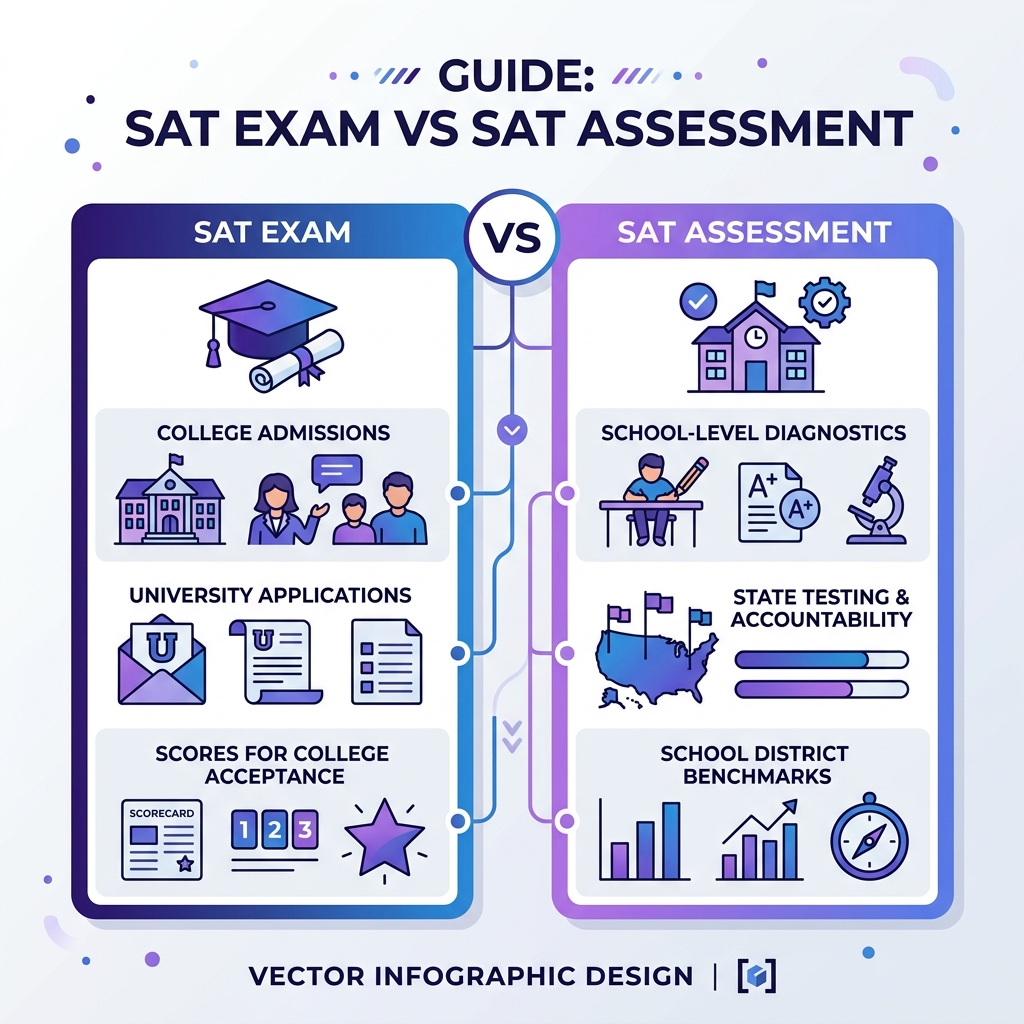
Quick Facts
- Term 1 - SAT Exam: Refers to the standard national weekend test used for college admissions
- Term 2 - SAT Assessment: Refers to school-day tests, PSATs, and state accountability testing
- Equivalency: SAT School Day scores are identical in value and format to weekend SAT scores
- Score Scales: SAT (400-1600), PSAT/NMSQT (320-1520), PSAT 8/9 (240-1440)
- Vertical Alignment: Scores are vertically scaled to measure year-over-year academic growth
- Logistics: School Day testing is organized by schools during weekdays, avoiding weekend fees
- Practice Method: Use the same diagnostic and topic drills for both administrations
After This Page
- Use this workshop to explain the difference between weekend SAT testing, school-day testing, and SAT Suite assessments without implying that all programs share the same registration process.
- Turn the guide into one timed drill, one error-log entry, and one concrete next study assignment.
- Separate official SAT facts from independent study advice before making registration, device, scoring, or test-day decisions.
Use this box as a completion check: if you cannot produce these outputs, reread the relevant section before moving to another topic.
The terminology surrounding standardized testing can easily confuse beginners. Students often hear terms like “SAT Exam,” “SAT Assessment,” “SAT School Day,” “PSAT/NMSQT,” and “SAT Suite of Assessments” used interchangeably. To build a successful preparation strategy, you must understand exactly what these terms mean, how they differ logistically, and how college admissions offices evaluate the scores.
This detailed guide reviews the essentials of the sat assessment test landscape. We compare weekend national exams with school-day administrations, map the vertically aligned score scales across the entire College Board suite, and provide structured study next-steps to help you navigate your testing cycle in 2026.
Table of Contents
- Definitions: SAT Exam vs. SAT Assessment
- The SAT School Day Program: Key Logistics
- The SAT Suite of Assessments: Vertically Aligned Scales
- Vertical Scale Math & Pacing Comparisons
- How College Admissions Offices View School Day Scores
- Verbal Section Comparison: SAT vs. PSAT
- Math Section Comparison: SAT vs. PSAT
- Preparation Roadmaps: Studying for the Suite
- Common Terminology Errors & Misconceptions
- Mini-Practice Test: Suite-Level Sample Questions
1. Definitions: SAT Exam vs. SAT Assessment
To clear up any confusion, let us define these terms precisely:
- SAT Exam (Weekend Administration): This is the traditional national test taken on designated Saturdays at official public testing locations (often local high schools or universities). Students must register individually via their personal College Board account, upload a photo, and pay the registration fee ($68).
- SAT Assessment (School Day Administration): This is a weekday administration organized and funded directly by school districts or state education departments. Students take the test during the regular school week on a Tuesday or Wednesday. Registration is handled by the school, often for free, and you do not need to register individually on weekends or upload photos.
- The SAT Suite of Assessments: The umbrella term for the College Board’s entire vertically aligned testing curriculum, which includes the PSAT 8/9, PSAT 10, PSAT/NMSQT, and the SAT.
2. The SAT School Day Program: Key Logistics
The SAT School Day program was introduced to make standardized testing more accessible by eliminating weekend travel barriers, scheduling conflicts, and registration costs.
Comparison Table: Saturday vs. School Day
| Parameter | Saturday SAT Exam | SAT School Day Assessment |
|---|---|---|
| Testing Day | Saturday Morning | Weekday (Tuesday/Wednesday) |
| Testing Location | Designated Public Testing Center | Your Own High School |
| Registration Organizer | Individual Student via College Board Portal | High School Counselor / District |
| Fee | Paid by Student ($68 plus regional fees) | Paid by School District/State (Free to student) |
| Photo Upload | Mandatory during registration | Not Required |
| Test Content & Timing | Identical (2 hours, 14 minutes) | Identical (2 hours, 14 minutes) |
| Scoring Scale | 400-1600 (College Board official) | 400-1600 (College Board official) |
3. The SAT Suite of Assessments: Vertically Aligned Scales
The entire College Board testing curriculum is built on a unified measurement scale. This design, known as vertical scaling, allows educators to track a student’s academic growth year-over-year.
The Unified Scale Map
Because the tests are vertically scaled, they are not scored on the same range:
- SAT (Grade 11/12): Score range is 400 to 1600 (200-800 per section).
- PSAT/NMSQT & PSAT 10 (Grade 10/11): Score range is 320 to 1520 (160-760 per section).
- PSAT 8/9 (Grade 8/9): Score range is 240 to 1440 (120-720 per section).
SAT Scale:       |---------------------------------------------| (400-1600)
PSAT 10/NMSQT:      |---------------------------------------| (320-1520)
PSAT 8/9:              |---------------------------------| (240-1440)
The Concept of Vertical Equatoring
Under a vertically scaled model, a score of 1100 represents the same level of academic proficiency regardless of which test you took:
- If you score an 1100 on the PSAT 10 in October of sophomore year, this indicates that if you had taken the SAT on that exact same day, your estimated score would have been approximately 1100.
- This score offset prevents “ceiling effects” on the easier tests (since the PSAT does not contain the most advanced questions, a perfect score on the PSAT is capped at 1520 to reflect that you have not yet demonstrated mastery of the harder SAT concepts).
4. Vertical Scale Math & Pacing Comparisons
Although the scoring scales differ, the difficulty parameters are aligned using Item Response Theory (IRT) models.
IRT Probability Calculations
The probability of a student with ability level \(\theta\) answering a question correctly is represented by: \[P(\theta) = c + \frac{1 - c}{1 + e^{-a(\theta - b)}}\]
where:
- \(b\) is the question difficulty parameter.
- \(\theta\) is the student’s estimated ability level.
On the PSAT 8/9, the average difficulty parameter \(b\) is centered lower on the ability scale: \[b_{\text{PSAT 8/9}} < b_{\text{PSAT 10}} < b_{\text{SAT}}\]
This mathematical alignment ensures that while the test questions are appropriate for the student’s grade level, the scores remain statistically comparable across the entire suite.
5. How College Admissions Offices View School Day Scores
One of the most common questions students ask is whether colleges discount or value School Day scores differently compared to traditional weekend scores.
Admissions Policies
- Complete Equivalency: Admissions offices make no distinction between School Day scores and Saturday scores. They are processed identically.
- No Indicator on Score Reports: When you send your score report to a university, the report lists the test date and your scaled scores. It does not label the test as “School Day” or “Saturday.”
- Superscoring Compatibility: If a college superscores, you can combine a Reading & Writing score from a weekday School Day test with a Math score from a Saturday weekend test.
6. Verbal Section Comparison: SAT vs. PSAT
While the core verbal domains (Craft & Structure, Information & Ideas, Expression of Ideas, Standard English Conventions) are identical, the tests differ slightly in question volume and timing.
Verbal Structural Comparison Table
| Parameter | PSAT 8/9 Verbal | PSAT 10 & NMSQT Verbal | SAT Exam & School Day |
|---|---|---|---|
| Total Questions | 44 questions | 54 questions | 54 questions |
| Modules | 2 modules (22 items each) | 2 modules (27 items each) | 2 modules (27 items each) |
| Total Time | 56 minutes | 64 minutes | 64 minutes |
| Time per Question | 76 seconds | 71 seconds | 71 seconds |
Original Verbal Example: Standard English Conventions
Let’s analyze a punctuation question that appears across the Suite:
Passage: In 1908, the conservationist John Muir published a collection of essays detailing the geological formations of Yosemite Valley; in his writings, Muir argued that the valley’s steep cliffs were carved primarily by ancient ______ a theory that challenged the prevailing scientific consensus of his era.
Which choice completes the text with the most logical punctuation?
- A) glaciers,
- B) glaciers:
- C) glaciers;
- D) glaciers
Step-by-Step Explanation:
- Analyze the surrounding structure: The clause “a theory that challenged the prevailing scientific consensus of his era” is an appositive noun phrase modifying the word “theory”, which in turn references the explanation of glaciers carving the valley.
- Determine punctuation rules: An appositive noun phrase at the end of a sentence must be separated from the word it modifies with a comma.
- Evaluate choices:
- A) glaciers,: The comma correctly separates the independent clause from the modifying appositive phrase. Correct.
- B) glaciers:: A colon is incorrect here because it would imply a direct list or formal definition following it, rather than a modifying appositive phrase. Incorrect.
- C) glaciers;: A semicolon is incorrect because a semicolon must separate two independent clauses, and the modifying phrase is dependent. Incorrect.
- D) glaciers: Lacks the required punctuation, causing a run-on modification. Incorrect.
7. Math Section Comparison: SAT vs. PSAT
The Math sections across the suite differ in the maximum level of difficulty and algebra complexity tested.
Math Structural Comparison Table
| Parameter | PSAT 8/9 Math | PSAT 10 & NMSQT Math | SAT Exam & School Day |
|---|---|---|---|
| Total Questions | 38 questions | 44 questions | 44 questions |
| Modules | 2 modules (19 items each) | 2 modules (22 items each) | 2 modules (22 items each) |
| Total Time | 60 minutes | 70 minutes | 70 minutes |
| Time per Question | 94.7 seconds | 95.5 seconds | 95.5 seconds |
| Advanced Math Density | Minimal (basic quadratics only) | Moderate | High (complex quadratics, circles) |
Original Math Example: Coordinate Midpoint
Let’s work through a coordinate geometry problem common to the PSAT/NMSQT and SAT:
Question: In the coordinate plane, the line segment \(AB\) has endpoints \(A(-3, 8)\) and \(B(5, -2)\). What are the coordinates of the midpoint \(M\) of the line segment \(AB\)?
Step-by-Step Algebraic Solution:
- Recall the Midpoint Formula: The coordinates of the midpoint \(M(h, k)\) are the averages of the coordinates of the endpoints: \[M = \left(\frac{x_1 + x_2}{2}, \frac{y_1 + y_2}{2}\right)\]
- Substitute Endpoint Values:
- \(x_1 = -3\), \(x_2 = 5\)
- \(y_1 = 8\), \(y_2 = -2\)
- Calculate the coordinates: \[h = \frac{-3 + 5}{2} = \frac{2}{2} = 1\] \[k = \frac{8 + (-2)}{2} = \frac{6}{2} = 3\] The midpoint coordinates are \((1, 3)\).
8. Preparation Roadmaps: Studying for the Suite
Because all tests in the SAT Suite are aligned to the same core curriculum, you do not need separate study plans for different administrations.
The Prep Integration Strategy
- Sophomore Year (PSAT 10): Focus on foundational algebra (solving linear equations) and standard English grammar rules.
- Junior Year (PSAT/NMSQT): Focus on time management, intermediate algebra, coordinate geometry, and transition words.
- Junior/Senior Year (SAT Exam / School Day): Focus on advanced non-linear algebra (quadratics, circle equations), Desmos graphing calculator shortcuts, and mock testing under strict timed conditions.
9. Common Terminology Errors & Misconceptions
To prevent logistical errors, avoid these common misunderstandings:
Misconception 1: “I must register on College Board for SAT School Day.”
- The Reality: You do not register on the College Board portal for the SAT School Day test. Your high school counselor coordinates registration directly. If you try to register online for a School Day date, you will only see weekend options.
Misconception 2: “PSAT scores are sent to colleges.”
- The Reality: Colleges do not receive or evaluate your PSAT scores during the admissions process. PSAT scores are used purely for National Merit qualification and as a diagnostic baseline to guide your SAT preparation.
10. Mini-Practice Test: Suite-Level Sample Questions
Test your skills with this 4-question diagnostic set:
Verbal Section
Question 1: Craft and Structure (Words in Context)
Although the researcher’s initial data seemed to support the hypothesis that atmospheric pollutants were causing the decline in local amphibian populations, subsequent long-term studies yielded ______ results that failed to establish a clear correlation.
Which choice completes the text with the most logical and precise word or phrase?
- A) definitive
- B) inconclusive
- C) consistent
- D) redundant
Answer & Explanation:
- Answer: B) inconclusive
- Explanation: The sentence opens with the contrast transition “Although”. The first part states the data “seemed to support” the hypothesis, so the second part must contrast this by showing the data failed to support it. Inconclusive means not leading to a firm conclusion, matching the context perfectly. Definitive and Consistent are opposites of the required meaning, and Redundant does not fit.
Question 2: Standard English Conventions (Pronouns)
During the summer months, the Arctic tern undertakes an extraordinary migration, flying from its breeding grounds in the northern hemisphere to the waters off Antarctica, where ______ feeds on small fish and krill.
Which choice completes the text with the most logical pronoun?
- A) they
- B) it
- C) these
- D) he
Answer & Explanation:
- Answer: B) it
- Explanation: The subject is “the Arctic tern”, which is a singular noun phrase. The pronoun must agree in number. It is singular and gender-neutral. They (plural) and These (plural demonstrative) do not agree, and He implies a specific gender not supported by the context.
Math Section
Question 3: Algebra (Linear Equations)
If \(3x + 7 = 22\), what is the value of the expression \(4x - 5\)?
Answer & Explanation:
- Answer: 15
- Explanation: Solve for \(x\): \[3x + 7 = 22 \implies 3x = 15 \implies x = 5\] Evaluate the target expression: \[4(5) - 5 = 20 - 5 = 15\]
Question 4: Geometry (Right Triangles)
In right triangle \(ABC\), the measure of angle \(C\) is \(90^\circ\). If \(\sin(A) = \frac{3}{5}\), what is the value of \(\cos(B)\)?
Answer & Explanation:
- Answer: 3/5 (or 0.6)
- Explanation: In any right triangle, the acute angles \(A\) and \(B\) are complementary: \[A + B = 90^\circ\] According to the cofunction identity of trigonometry, the sine of an angle is equal to the cosine of its complement: \[\sin(A) = \cos(90^\circ - A) = \cos(B)\] Therefore: \[\cos(B) = \sin(A) = \frac{3}{5}\]
11. Official Sources, Trademark Disclaimer, and Final Notes
Trademark Disclaimer
SAT® and Bluebook™ are registered trademarks of the College Board, which was not involved in the production of, and does not endorse, this study guide or the resources hosted on SATHELP24x7.com.
Practice Application: SAT Exam vs SAT Assessment: Meaning, Purpose, and Use
Decision Example
If general prep affects a real testing decision, separate the official fact from the independent study action before acting.
Follow-Up Drill
Write one timed task, one official-source verification task, and one error-log review task based on this page.
Completion Checklist
- I can state the official fact that matters.
- I can name the independent strategy I will try.
- I have one measurable practice task scheduled.
Next Step
Use the related links below to turn this guide into practice or source verification.
Continue practice →Guide Application Workshop
SAT terminology and use-case workshop
Use this workshop to explain the difference between weekend SAT testing, school-day testing, and SAT Suite assessments without implying that all programs share the same registration process.
Terminology, eligibility, school-day access, and registration details can vary. Students should verify their specific test program with their school or official College Board pages.
Student Scenario
A junior hears "SAT assessment" from a school counselor and "SAT exam" from a college website. The right response is to identify the exact program, confirm whether the score is an official SAT score, and then follow the correct registration or school instructions.
Use the scenario as a model for your own planning. Replace the sample student with your baseline, your deadline, and your weakest two domains. A useful guide should end with a written action: a timed set to complete, an official page to verify, a question category to review, or a study block to schedule.
Checkpoints for Using This Guide
These checkpoints convert reading into measurable work. Complete them in order and keep the proof column visible in your notes. If you cannot produce the proof, reread the relevant part of the guide or move to a focused practice page before continuing.
| Checkpoint | Student action | Evidence it worked |
|---|---|---|
| Program identification | Write whether the test is weekend SAT, SAT School Day, PSAT/NMSQT, PSAT 10, or PSAT 8/9. | The student knows which score scale, registration path, and audience applies. |
| Score-use clarity | Ask whether the score can be sent to colleges, used for practice, or used for school accountability. | The student does not assume every SAT Suite score has the same admissions role. |
| Registration path | Identify whether registration happens through College Board, through a school, or through another official coordinator. | The student follows the right deadline and does not miss school-day instructions. |
| Practice alignment | Match the study materials to the target test while keeping core Reading and Writing and Math skills aligned. | The student prepares for the correct difficulty and score scale. |
| Family explanation | Write a one-paragraph explanation of the test program for a parent or counselor. | The student can make practical decisions without confusing similar test names. |
Practice Workshop
Work through these assignments after reading the guide. They are designed to expose whether the guide changed your behavior, not merely whether the page felt clear. Each assignment should produce a visible artifact: a timing note, a table, a source check, an error-log entry, or a revised study block.
Assignment 1
Terminology sort
Create a table with one row each for weekend SAT, SAT School Day, PSAT/NMSQT, PSAT 10, and PSAT 8/9. Add audience, score scale, and main use.
The table should make clear that similar names do not always mean identical registration, stakes, or score reporting.
Finish the assignment by writing one next action in your planner. The action should be specific enough that you can complete it in a single study block, such as "re-solve five colon questions" or "verify the current registration deadline."
Assignment 2
Counselor question list
If your school offers a school-day test, write three questions for the counselor: date, device requirements, and whether students must complete any pre-test steps.
School-day logistics are local. A clear question list prevents students from guessing based on weekend SAT rules.
Finish the assignment by writing one next action in your planner. The action should be specific enough that you can complete it in a single study block, such as "re-solve five colon questions" or "verify the current registration deadline."
Assignment 3
Score planning exercise
Choose a target college list and decide whether a future weekend SAT, school-day SAT, or practice-only assessment best supports the application plan.
The study plan should reflect how the score will be used, not only what the test is called.
Finish the assignment by writing one next action in your planner. The action should be specific enough that you can complete it in a single study block, such as "re-solve five colon questions" or "verify the current registration deadline."
Assignment 4
Practice transfer drill
Take one Math drill and one Reading and Writing drill, then write how the skill transfers across SAT Suite tests.
Core algebra and grammar skills transfer, but the difficulty and score interpretation may differ by test level.
Finish the assignment by writing one next action in your planner. The action should be specific enough that you can complete it in a single study block, such as "re-solve five colon questions" or "verify the current registration deadline."
Assignment 5
Source verification step
Find the official page or school notice that applies to your test program and save the deadline or instruction in your planner.
A reliable plan cites the relevant source. Avoid acting on general articles when a school-specific instruction exists.
Finish the assignment by writing one next action in your planner. The action should be specific enough that you can complete it in a single study block, such as "re-solve five colon questions" or "verify the current registration deadline."
Error-Log Protocol
For every guide-related practice question you miss, create a compact error-log entry with five fields: source, domain, wrong decision, correct decision, and next drill. The wrong decision matters because it captures the habit that needs to change. The next drill matters because it turns the explanation into future behavior.
Review the log twice. The first review happens immediately, while the explanation is fresh. The second review happens after a delay, when you must solve without seeing the answer. A question is not retired until you can re-solve it accurately, explain the principle, and recognize the same pattern in a new context.
If multiple missed questions share the same cause, pause broad practice and run a narrow repair block. For example, three missed transition questions should trigger a transition-only drill; three missed function-notation questions should trigger a function-only drill. This prevents the guide from becoming general reading instead of targeted preparation.
Source-Check and Study-Action Matrix
A guide is strongest when it separates two kinds of information: official facts and independent study advice. Official facts answer questions such as timing, score scale, registration, test-day requirements, device rules, and calculator policy. Independent study advice answers questions such as how to review, how to pace, how to choose a drill, and how to organize mistakes. Use the matrix below each time you rely on this page for a decision.
| Information type | What to do | Example output |
|---|---|---|
| Official policy | Open the linked official source before acting on dates, deadlines, device setup, identification, fees, or accommodations. | A planner note that says which official page was checked and on what date. |
| Test structure | Confirm current section names, module timing, and question counts against official SAT Suite guidance. | A one-line format summary written in your own notes. |
| Study strategy | Apply the independent advice to a timed set or review block, then judge it by accuracy and timing evidence. | A completed drill with a result and one next action. |
| Practice-test result | Translate the result into domains and error types instead of treating the total score as the whole story. | A short list of two domains to repair before the next full test. |
| Retake or registration decision | Use official deadlines and your section-level evidence together before choosing a date. | A retake decision that includes score gap, available weeks, and deadline verification. |
Student Notes Template
Use this note template after reading the guide. The template prevents a common weak outcome: finishing a long page and having no evidence that the content changed your preparation. Keep the answers short and concrete. A good note should tell you what to practice during the next session without rereading the entire guide.
One fact I verified
Write one policy, date, timing detail, or official rule that you checked against a College Board page. Include the date you checked it so you know when the note may need refreshing.
One strategy I will test
Choose a strategy from the guide and apply it in a timed or review setting. The strategy is not adopted until it improves accuracy, speed, or clarity in your own work.
One weak domain
Name the specific domain or subskill that needs attention. Avoid broad labels like Math or verbal; use labels such as systems of equations, transition logic, or punctuation boundaries.
One next assignment
Write one task that can be completed in a single block. It should include a number, a source, and a review step, such as ten timed algebra questions plus error-log review.
Revisit the notes at the end of the week. If the next assignment was completed and reviewed, write the result. If it was not completed, decide whether the assignment was too large, too vague, or not aligned with the real weakness. This weekly adjustment is what turns a study guide into a working plan.
One-Week Implementation Plan
Use this one-week plan after finishing the guide. The aim is not to reread the page every day. The aim is to apply one part of the guide, check whether it works in practice, and update your study plan from evidence. Keep each day small enough to complete during a normal school week.
Day 1:Write a five-line summary of the guide and verify any official fact that could affect registration, testing, scoring, or device setup.
Day 2:Choose one skill from the guide and complete an untimed drill. Explain every answer choice or every setup step.
Day 3:Re-solve missed or uncertain items from Day 2 without looking at the explanation. Add unstable items to the error log.
Day 4:Run a timed mini-set that uses the same skill. Record time, confidence, and the first point where your process slowed.
Day 5:Create or find a second context for the same skill so you are not depending on the original wording.
Day 6:Complete a mixed set that includes unrelated SAT topics. Check whether the guide skill is still recognized quickly.
Day 7:Review the week and choose one next assignment: continue repair, move to maintenance, or take a checkpoint module.
If Day 6 breaks down, do not treat that as failure. Mixed practice is supposed to reveal whether a skill transfers when it is not announced. Return to the checkpoint table, identify the clue you missed, and repeat the timed mini-set with fewer distractors before trying mixed practice again.
Decision Rules for Next Steps
After applying the guide for one week, choose the next action from evidence. Continue repair if the same error appears more than once. Move to maintenance if accuracy is high, timing is stable, and you can explain the method without notes. Take a checkpoint module only when you have reviewed the main errors and want to test whether the repair holds under pressure.
Do not let a single strong practice set convince you that the skill is finished. A skill is stable when it works across at least three conditions: untimed practice, timed practice, and mixed practice. If it works only in one condition, keep it active in the planner but reduce the volume so it does not crowd out other weak domains.
If the guide involves official policy or logistics, schedule a later verification date. Administrative information can change, and students should not rely on old notes for registration, deadline, calculator, device, or test-day decisions. Put the verification reminder near the test date in your planner.
Final Application Bank
Complete at least four of these application tasks before considering the guide finished. They are short by design, but each requires a visible output that can be checked later. This keeps long-form reading connected to action.
Write a one-page summary that separates official facts from independent study advice.
Create a five-row error-log table using recent missed or guessed questions related to the guide topic.
Build a timed mini-set and mark the first moment where pacing, wording, or setup became difficult.
Choose one official source link from the page and write what decision it supports.
Rewrite one strategy from the guide as a checklist that can be used during practice.
Explain the guide topic to another student, then ask that student to solve one original example.
Add one planner reminder for a future source check, diagnostic, or delayed re-solve.
Run a mixed practice set and record whether the guide skill was recognized without prompting.
If the output from these tasks is vague, narrow the assignment. "Study scoring" is too broad; "verify the official score scale and write how section scores combine" is useful. "Practice format" is too broad; "run one timed module and record the halfway checkpoint" is useful. The guide has done its job only when it changes the next study action.
Explanation Standard for Guide-Based Practice
When you use this guide with practice questions, require every review note to meet a consistent explanation standard. The note should identify the tested idea, cite the prompt clue, state the correct decision, explain one tempting wrong path, and name the next practice action. This keeps guide reading tied to the way students actually gain points.
The tested idea should be narrow. "SAT format" is broad; "module pacing checkpoint" is narrow. "Practice tests" is broad; "delayed re-solve after an error-log entry" is narrow. "Study plan" is broad; "weekly review meeting after a timed module" is narrow. Narrow labels make review searchable and prevent the same weakness from hiding inside general notes.
The prompt clue should be visible. If a student cannot point to a phrase, number, graph feature, deadline, or source requirement, the explanation may be relying on memory instead of evidence. In guide-heavy topics, the clue may be an official policy category, such as registration, scoring, device setup, or test-day materials. In strategy topics, the clue may be a timing pattern, score split, or repeated error type.
The next practice action should be small enough to do. Avoid notes that say "review more" or "get better at pacing." Better actions include "run one timed module and record the halfway point," "verify the current official date page," "re-solve five missed transition items," or "write a two-column table comparing official facts with independent strategy." Small actions are easier to complete and easier to measure.
This explanation standard also helps avoid overclaiming. If a statement depends on official SAT policy, verify it with the official source. If a statement is a SATHELP24x7 strategy recommendation, label it as a study method and judge it by student results. Keeping those two categories separate makes the guide clearer, safer, and more useful.
Guide Completion Quality Check
A guide is complete only when it creates a decision outside the page. Before moving on, identify the decision this guide supports: a study priority, a practice-test schedule, a source-verification reminder, a pacing rule, a registration action, or a test-day checklist item. If no decision is created, reread the scenario and checkpoint sections and choose a smaller output.
Next, identify the evidence behind that decision. Evidence can be an official source, a baseline score, an error-log pattern, a timed module result, or a repeated uncertainty. Do not use confidence alone as evidence. Confidence often rises after reading an explanation, but the skill still needs to appear in practice before it is considered stable.
Finally, schedule the next checkpoint. For content topics, the checkpoint may be a delayed re-solve or a timed mini-set. For format or logistics topics, the checkpoint may be a date to verify official information again. For study planning, the checkpoint may be a weekly review meeting. A guide without a checkpoint can fade into passive reading.
Keep the completion note short: one decision, one evidence source, one next checkpoint. This format makes the guide easy to revisit later and helps students avoid over-planning. The next study action should be obvious when the note is opened.
Final Reflection Prompt
End the guide with a short reflection: what fact did you verify, what skill did you practice, what evidence changed your plan, and what checkpoint comes next? These four answers make the guide usable later because they summarize both knowledge and action.
If the reflection produces no next checkpoint, the study session is not finished. Add one measurable action before closing the page. A good checkpoint can be a timed module, a delayed re-solve, a source check, or a weekly review note. It should be small enough to complete and clear enough to evaluate.
Save the reflection in the same place as your study calendar. When you revisit the guide later, check whether the planned checkpoint happened and what the result showed. If the result improved, move the topic to maintenance. If the same weakness remains, choose a narrower drill and repeat the review cycle.
A useful guide note should also say when to stop. Stop active review when the skill works in untimed work, timed work, and mixed work, or when the official policy question has been verified and added to the planner. Continue active review only when evidence shows the decision is still unclear or unstable.
This stop rule protects study time. Students often reread familiar pages because rereading feels productive, but the better use of time is targeted practice, delayed review, or source verification. The guide should point to that next action and then get out of the way.
When the next action is complete, return only long enough to update the note. The guide should function as a reference and planning aid, not a place to hide from timed practice. Evidence from practice decides what happens next.
If the evidence is mixed, keep the topic active but narrow the next task. Smaller tasks make weak points easier to find. Once the weak point is visible, choose a drill that tests only that decision before returning to broad mixed practice. This keeps review efficient and prevents the guide from turning into repeated reading without measurable progress. If the narrower drill works twice, move back to mixed practice and verify that the skill still appears quickly. If it fails again, the issue is not effort; it is a sign that the rule, clue, or setup needs a clearer explanation before more volume is added. Make the next correction visible in the planner. Then test that correction in a short timed set. Record the result before continuing. Keep the follow-up specific and measurable. Repeat when needed.
Readiness Rubric
- Level 1: you can repeat facts from the guide but have not applied them to a practice set.
- Level 2: you can apply the guide in untimed work but still miss items when the wording changes.
- Level 3: you can apply the guide in timed work and explain most errors clearly.
- Level 4: you can apply the guide in mixed practice, update your plan from evidence, and verify official facts before acting.
Completion Checklist
- Identify the exact test program.
- Confirm the applicable score scale.
- Determine whether the score can be sent to colleges.
- Verify who manages registration.
- Ask your school about local school-day logistics when relevant.
- Use SAT-level practice for SAT preparation.
- Use PSAT results as diagnostics when appropriate.
- Avoid calling SATHELP24x7 or any third-party resource official.
How to Keep the Guide Current
Some SAT information is stable, such as the broad skill categories tested in Math and Reading and Writing. Other information can change, including dates, deadlines, fees, test-center instructions, calculator policies, and software procedures. Whenever a decision affects registration, test-day admission, device setup, or score reporting, use the linked official source rather than relying on memory.
A strong study system separates independent strategy from official policy. SATHELP24x7 can provide study routines, original practice, checklists, and explanation frameworks, but official College Board pages remain the authority for administrative requirements. Keep that distinction visible in your notes so you do not confuse a study recommendation with a policy rule.
College Board Official SAT Suite Overview
Frequently Asked Questions
Is the SAT School Day Assessment different from the weekend SAT Exam?
No. In terms of test content, formatting, timing, difficulty, and scoring scale, the SAT School Day Assessment is completely identical to the standard weekend SAT Exam. Both are taken digitally using the same Bluebook application, feature the same adaptive modules, and result in an official College Board score on the standard 400-1600 scale. The only differences are logistical: the School Day test is administered at your own high school on a weekday during regular school hours, registration is organized directly by your school (often for free), and you do not need to upload a photo during registration.
What is the College Board's SAT Suite of Assessments?
The SAT Suite of Assessments is a collection of vertically aligned standardized tests designed by the College Board to measure student progress from 8th grade through 12th grade. The suite includes: (1) PSAT 8/9, designed for 8th and 9th graders; (2) PSAT 10, designed for sophomores; (3) PSAT/NMSQT (National Merit Scholarship Qualifying Test), administered to juniors to qualify for National Merit recognition; and (4) the SAT itself (which includes both weekend national administrations and School Day programs).
Why are the PSAT score scales lower than the SAT score scale?
The PSAT/NMSQT and PSAT 10 score scales range from 320 to 1520, and the PSAT 8/9 score scale ranges from 240 to 1440, compared to the SAT's 400 to 1600 scale. This offset exists because the tests are vertically scaled. A score of 1200 on a PSAT indicates that you are on track to score approximately a 1200 on the SAT if you were to take it on the same day. Because the PSAT is designed for younger students and does not contain the most advanced math and verbal questions found on the SAT, the upper score ranges are capped to prevent inflating scores.
Do colleges prefer the weekend SAT Exam over the School Day Assessment?
No. College admissions offices view scores from the SAT School Day Assessment and the weekend SAT Exam as completely equivalent. They do not distinguish between them on your application, nor do they favor one administration over another. When you submit your scores via the College Board portal, they appear as standard SAT scores. You can also mix and match your scores from both weekday and weekend administrations to compile a higher 'superscore' if your target colleges support it.
What is the National Merit Scholarship Qualifying Test (NMSQT)?
The PSAT/NMSQT is a specific version of the PSAT taken by high school juniors in October. In addition to serving as a diagnostic practice run for the SAT, it is the sole entry mechanism for the prestigious National Merit Scholarship Program. High-scoring juniors who score in the top 1% of their state (measured by the Selection Index score) can qualify as National Merit Semifinalists, which can lead to significant college scholarship opportunities and institutional recognition.
How does vertical scaling work across the SAT Suite?
Vertical scaling means that the tests are built on a single, continuous measurement scale. The questions on each test are calibrated using Item Response Theory (IRT) relative to a common reference ability level \(\theta\). By mapping the difficulty profiles of the PSAT 8/9, PSAT 10, and SAT to this common scale, educators can track a student's academic growth over multiple years. For example, if a student scores a 900 on the PSAT 8/9 in 8th grade, a 1050 on the PSAT 10 in 10th grade, and a 1200 on the SAT in 11th grade, this represents measurable year-over-year progress on a single scale.
Can I use fee waivers for the SAT School Day administration?
If your school district participates in the SAT School Day program, the administration is often provided to all enrolled students at no cost, meaning you do not need a fee waiver. However, if your school requires payment or if you want to register for a weekend SAT retake, eligible low-income students can request fee waivers from their guidance counselor. A fee waiver covers the cost of up to two weekend SAT exams and provides college application fee waivers.
Should I prepare differently for the PSAT compared to the SAT?
No. Because the PSAT and SAT are built on the same core curriculum framework and utilize the same computer-adaptive format on the Bluebook app, your preparation strategies should be identical. Studying for the SAT automatically prepares you for the PSAT. The only minor differences are that the PSAT is slightly shorter, has slightly fewer questions, and does not contain the absolute hardest advanced math and verbal items found on the SAT. Utilize standard SAT practice quizzes and grammar rules sheets for both exams.
Can international students take the SAT School Day test?
Yes, some international schools participate in the SAT School Day program, but it is far less common outside the United States. The vast majority of international students register for the standard weekend SAT administrations at designated international testing sites. International students should check with their school administration to see if School Day testing is offered at their institution.