Digital SAT Essentials: Format, Timing, Scoring, and Practice
The complete guide to the Digital SAT format, timing schedules, item response theory scoring, and structured practice strategies.
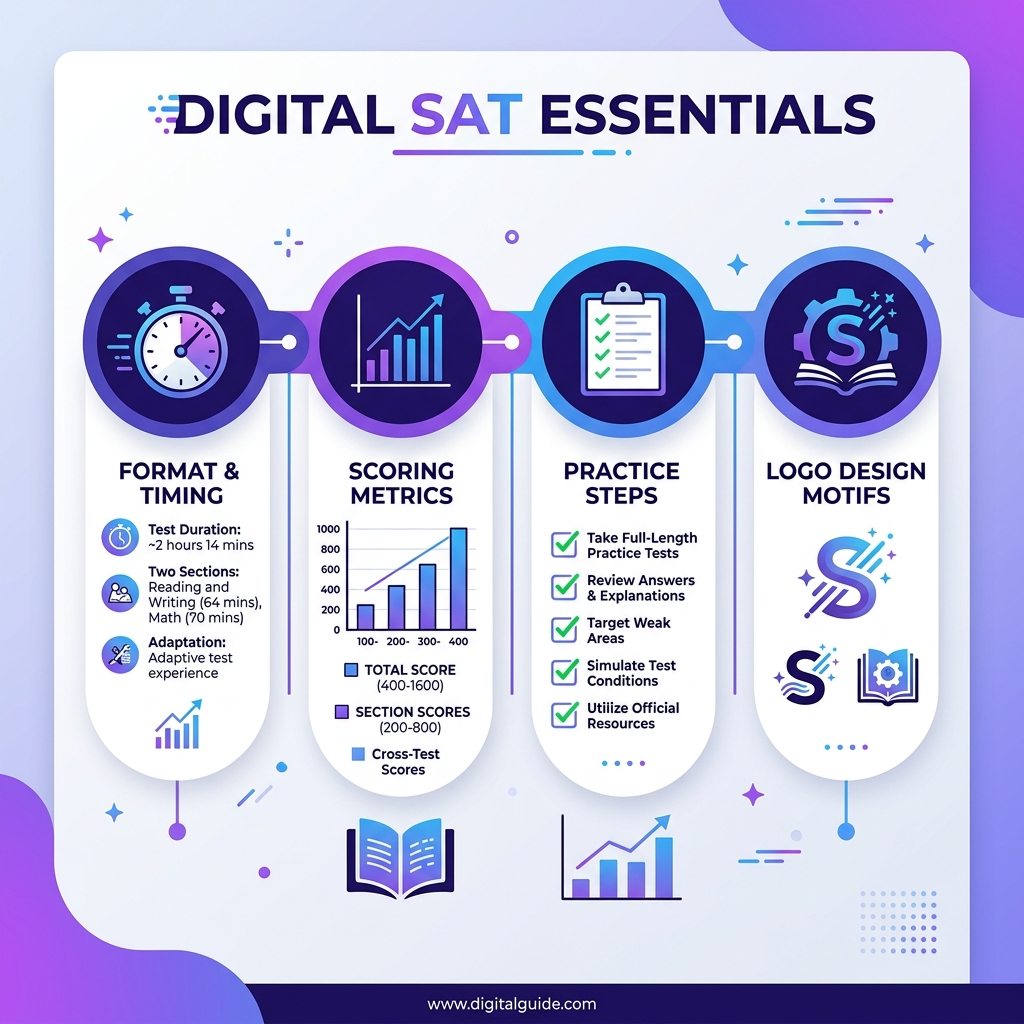
Quick Facts
- Delivery: Fully digital on the College Board's official Bluebook™ application
- Total Timing: 2 Hours and 14 Minutes of active testing time
- Pacing target: Verbal allocates 71 seconds/question, Math allocates 95 seconds/question
- Section Scale: 200-800 per section, composite total 400-1600
- Scoring Algorithm: Uses Item Response Theory (IRT) based on question difficulty, discrimination, and guessing
- Adaptivity: Routing occurs between Module 1 and Module 2 based on accuracy
- Diagnostic Setup: Take a full baseline mock test under timed conditions to identify weak domains
After This Page
- Use this workshop to turn format knowledge into daily decisions: when to practice modules, how to review score reports, how to use the embedded tools, and when to verify current official policies.
- Turn the guide into one timed drill, one error-log entry, and one concrete next study assignment.
- Separate official SAT facts from independent study advice before making registration, device, scoring, or test-day decisions.
Use this box as a completion check: if you cannot produce these outputs, reread the relevant section before moving to another topic.
The transition to the Digital SAT has redefined standardized testing. The exam is shorter, adaptive, and fully integrated with digital tools like the Desmos graphing calculator. To maximize your score, you must understand the rules of the test: the exact format, the pacing parameters, how the adaptive engine shapes your score, and how to execute a high-yield practice regimen.
This detailed guide reviews the essentials of the digital sat practice landscape. We break down the test structure, analyze the scoring mechanics, share timing shortcuts, and outline a step-by-step preparation calendar to help you secure a top score in 2026.
Table of Contents
- Format Breakdown: The Digital Structure
- Timing Pacing & Pacing Math
- The Adaptive Scoring Engine: Module Routing & IRT
- Standard English Conventions & Verbal Strategies
- Math Section Mastery: Core Domains
- Desmos Shortcuts for High-Speed Calculations
- Designing Your Diagnostic Practice Loop
- The Night-Before & Morning-Of Checklist
- Common Student Pitfalls & Execution Mistakes
- Mini-Practice Test: Sample Verbal & Math Questions
1. Format Breakdown: The Digital Structure
The Digital SAT is divided into two major, independent sections: Reading & Writing and Math. The entire exam takes 2 hours and 14 minutes of active testing time, plus a single 10-minute break between the sections.
Section 1: Reading & Writing (Verbal)
- Total Time: 64 minutes
- Structure: 2 modules (32 minutes each)
- Questions: 54 questions total (27 questions per module)
- Format: Short passages (25 to 150 words) with one question per passage.
- Question Types: Multiple-choice only.
Section 2: Math
- Total Time: 70 minutes
- Structure: 2 modules (35 minutes each)
- Questions: 44 questions total (22 questions per module)
- Format: Word problems, equation sets, and coordinate graphs.
- Question Types: Approximately 75% multiple-choice and 25% Student-Produced Responses (where you must type the numerical answer directly into the interface).
2. Timing Pacing & Pacing Math
Pacing is the single most common execution challenge for test-takers. Running out of time in Module 2 can cause you to leave multiple questions blank or make rushed, uneducated guesses.
The Pacing Math
Let’s analyze the time allocation per question across both sections:
Verbal Section Pacing
You have 32 minutes to answer 27 questions: \[\text{Time per question} = \frac{32 \times 60 \text{ seconds}}{27} = \frac{1920 \text{ seconds}}{27} \approx 71.1 \text{ seconds}\] Because every question has a short passage, you must allocate approximately 30 seconds for reading and 40 seconds for evaluating options and selecting the correct answer.
Math Section Pacing
You have 35 minutes to answer 22 questions: \[\text{Time per question} = \frac{35 \times 60 \text{ seconds}}{22} = \frac{2100 \text{ seconds}}{22} \approx 95.5 \text{ seconds}\] This is a more generous allocation, but because Math contains multi-step word problems and quadratic systems, you must bank time on easier questions to spend on difficult problems at the end of the module.
The Flag-and-Skip Strategy
Within the Bluebook application, you can navigate between questions in any order. This allows you to apply the two-pass pacing strategy:
- First Pass: Solve all questions that you know how to set up immediately. If a question requires a long reading passage or a complex equation, read it, select a temporary answer, click Flag for Review at the top of the screen, and move to the next question.
- Second Pass: Once you reach the end of the module, open the navigation grid. Click directly on your flagged questions and spend your remaining time solving them.
3. The Adaptive Scoring Engine: Module Routing & IRT
The Digital SAT utilizes a section-level adaptive structure. Your accuracy in Module 1 determines the difficulty profile of Module 2.
                  +-----------------------+
                  |  Start: Section 1/2   |
                  +-----------+-----------+
                              |
                              v
                  +-----------+-----------+
                  |       Module 1        |
                  | (Mixed Difficulty)    |
                  +-----------+-----------+
                              |
                     Perform Routing Check
                              |
             +----------------+----------------+
             |                                 |
             v                                 v
+------------+-----------+        +------------+-----------+
|    Easier Module 2     |        |    Harder Module 2     |
| (Easy-to-Medium Items) |        | (Medium-to-Hard Items) |
+------------+-----------+        +------------+-----------+
             |                                 |
             v                                 v
+------------+-----------+        +------------+-----------+
|  Lower top-end evidence |       | More top-end evidence  |
|  fewer hard items       |       | more hard items        |
+------------------------+        +------------------------+
The Scoring Curve (IRT)
The College Board does not score the test by counting the number of correct answers. It uses Item Response Theory (IRT). Under this model, your ability parameter \(\theta\) is calculated based on three properties of each question:
- Difficulty (\(b\)): The relative hardness of the question.
- Discrimination (\(a\)): How well it distinguishes between high-scoring and low-scoring students.
- Guessing (\(c\)): The probability of guessing correctly.
The probability \(P(\theta)\) of a student with ability level \(\theta\) answering a question correctly is represented by: \[P(\theta) = c + \frac{1 - c}{1 + e^{-a(\theta - b)}}\]
If you route to the easier Module 2, the section contains fewer high-difficulty items, which gives the scoring model less evidence for top-end ability. College Board does not publish a fixed public score cap or routing cutoff, so prioritize Module 1 accuracy without relying on unofficial percentages.
4. Standard English Conventions & Verbal Strategies
The Reading & Writing section requires mastery of grammar rules, transition categories, and textual analysis.
Standard English Conventions Cheat Sheet
- Commas vs. Semicolons: Use a comma and coordinating conjunction (FANBOYS) or a semicolon to link two independent clauses: \[\text{Independent Clause} + \text{;} + \text{Independent Clause}\] \[\text{Independent Clause} + \text{,} + \text{coordinating conjunction} + \text{Independent Clause}\]
- Colons: A colon must follow a complete independent clause. It can introduce a list, an explanation, or a single word: \[\text{Independent Clause} + \text{:} + \text{Explanation/List}\]
- Dashes: A pair of em-dashes (—) can set off a non-essential parenthetical element, functioning identically to parenthetical commas or parentheses: \[\text{Subject} + \text{—} + \text{Parenthetical modification} + \text{—} + \text{Verb}\]
Original Verbal Example: Transitions
Let’s analyze a typical Expression of Ideas question:
Passage: In the late 19th century, botanist George Washington Carver revolutionized agricultural practices in the southern United States by advocating for crop rotation, urging farmers to plant nitrogen-fixing sweet potatoes and cowpeas. ____ many tenant farmers were reluctant to adopt these techniques due to the upfront costs of purchasing new seeds and adjusting traditional planting cycles.
Which choice completes the text with the most logical transition?
- A) Specifically,
- B) However,
- C) Consequently,
- D) Furthermore,
Step-by-Step Explanation:
- Analyze sentence 1: Carver advocated for crop rotation (a positive, beneficial agricultural advance).
- Analyze sentence 2: Many farmers were reluctant to adopt the techniques due to costs (a negative, contrasting reaction).
- Identify the relationship: The relationship between the two statements is contrast/contradiction.
- Evaluate choices:
- A) Specifically: Used for illustration. Incorrect.
- B) However: Used for contrast. Matches our prediction. Correct.
- C) Consequently: Used for cause-and-effect. Incorrect.
- D) Furthermore: Used for addition. Incorrect.
5. Math Section Mastery: Core Domains
The Math section covers four core domains: Algebra, Advanced Math, Problem Solving and Data Analysis, and Geometry & Trigonometry.
Core Formulas to Memorize
While a basic reference sheet is provided, memorizing these formulas saves time:
- Quadratic Formula: For \(ax^2 + bx + c = 0\), the roots are: \[x = \frac{-b \pm \sqrt{b^2 - 4ac}}{2a}\]
- Vertex x-coordinate: The axis of symmetry of a parabola is: \[x = -\frac{b}{2a}\]
- Slope Formula: \[m = \frac{y_2 - y_1}{x_2 - x_1}\]
- Standard Circle Equation: \[(x - h)^2 + (y - k)^2 = r^2\] where \((h, k)\) is the center and \(r\) is the radius.
Original Math Example: Circle Equations
Let’s work through a Geometry coordinate geometry question:
Question: A circle in the coordinate plane is represented by the equation: \[x^2 + y^2 + 8x - 6y = 11\] What are the coordinates of the center of the circle, and what is its radius \(r\)?
Step-by-Step Algebraic Solution:
- Group variables: Group the \(x\) terms together and the \(y\) terms together: \[(x^2 + 8x) + (y^2 - 6y) = 11\]
- Complete the square for \(x\): Take half of the coefficient of \(x\) (half of 8 is 4), square it (16), and add it to both sides: \[(x^2 + 8x + 16) + (y^2 - 6y) = 11 + 16\]
- Complete the square for \(y\): Take half of the coefficient of \(y\) (half of -6 is -3), square it (9), and add it to both sides: \[(x^2 + 8x + 16) + (y^2 - 6y + 9) = 11 + 16 + 9\]
- Factor and simplify: \[(x + 4)^2 + (y - 3)^2 = 36\]
- Identify coordinates and radius: Compare this to the standard equation \((x - h)^2 + (y - k)^2 = r^2\):
- \(h = -4\)
- \(k = 3\)
- \(r^2 = 36 \implies r = 6\) The center of the circle is \((-4, 3)\) and the radius is \(6\).
6. Desmos Shortcuts for High-Speed Calculations
The integrated Desmos calculator allows you to solve coordinate math problems rapidly.
Desmos Shortcut: Solving Systems of Linear Inequalities
Many coordinate math questions present a system of inequalities and ask if a point (e.g., \((2, -1)\)) is a solution.
- Shortcut: Type the inequalities exactly as written into the Desmos input rows (e.g., \(y > 2x - 3\) and \(y \le -x + 1\)). The graph will shade the overlapping solution region. Type the coordinate point in a third row: \((2, -1)\). Look at the graph. If the point lies inside the overlapping shaded region (and on any solid boundaries, but not dashed boundaries), it is a valid solution.
Desmos Shortcut: Vertex Form Verification
If a question asks you to convert a quadratic expression from standard form \(y = x^2 - 8x + 12\) to vertex form \(y = (x - 4)^2 - 4\):
- Shortcut: Input the standard equation into row 1. Input the vertex form options into subsequent rows. Look at the graphs. The option that produces a curve overlapping the standard curve is the correct algebraic transformation.
7. Designing Your Diagnostic Practice Loop
To improve your score, you must apply a structured study loop. Haphazardly solving practice questions without reviewing mistakes leads to score plateaus.
The 4-Step Study Loop
+-------------------------------------------------------------+
| Step 1: Baseline Diagnostic Exam                            |
| Take a timed mock test to locate your starting score.       |
+------------------------------+------------------------------+
                               |
                               v
+-------------------------------------------------------------+
| Step 2: Content Gap Identification                          |
| Mark every incorrect answer and identify the exact concept. |
+------------------------------+------------------------------+
                               |
                               v
+-------------------------------------------------------------+
| Step 3: Targeted Topic Study                                 |
| Study specific guides, write key formulas, and drill rules. |
+------------------------------+------------------------------+
                               |
                               v
+-------------------------------------------------------------+
| Step 4: Re-Test Verification                                |
| Take another mock test to measure score gains.              |
+-------------------------------------------------------------+
The Error Log Protocol
For every question you miss on a practice test, write down the following details in a dedicated notebook:
- The Question: Copy or print the question.
- The Mistake: Explain why you missed it (e.g., “misread inequality constraint”, “forgot standard circle equation”, “made arithmetic error in Desmos”).
- The Rule: Write down the mathematical formula or grammar rule required to solve it correctly.
- The Re-Test: Re-solve the question from scratch 3 days later to ensure you have built the correct procedural memory.
8. The Night-Before & Morning-Of Checklist
Logistical errors on test day can prevent you from testing. Follow this list to ensure a smooth testing experience.
Packing Checklist
Pack these items in your bag the night before the exam:
- Physical Admission Ticket: Printed from your College Board portal after completing the digital pre-setup in Bluebook.
- Approved Photo ID: Passport, driver’s license, or current school ID. Digital representations are not accepted.
- Testing Device: Your laptop (Mac/Windows) or tablet (iPad/school Chromebook) with the Bluebook application installed and updated.
- Power Cord: You must be able to plug in if battery levels drop.
- Approved Physical Calculator: To use next to your laptop screen.
- Snack & Water: For the 10-minute break.
9. Common Student Pitfalls & Execution Mistakes
Avoiding these tactical traps can save you dozens of points on test day.
Pitfall 1: Leaving Questions Blank
Unlike the old paper SAT, the Digital SAT does not penalize you for incorrect answers. There is no guessing penalty.
- The Trap: Leaving a question blank because you ran out of time or did not know how to solve it.
- The Fix: In the final 60 seconds of any module, select an option for every remaining question in the navigation grid, even if they are pure guesses. You have a 25% chance of getting each correct.
Pitfall 2: Misinterpreting the Interactive Pacing Clock
The on-screen timer displays the time remaining in the current module.
- The Trap: Spending too much time looking at the clock, which increases testing anxiety and causes you to lose focus.
- The Fix: Click on the timer to hide it. Check it only once: when you are halfway through the module (e.g., at 16 minutes for Verbal, or 17 minutes for Math).
10. Mini-Practice Test: Sample Verbal & Math Questions
Test your skills with this 4-question review quiz:
Verbal Section
Question 1: Craft and Structure (Words in Context)
Although the director’s early documentaries were praised for their raw, unvarnished depiction of working-class life, his recent feature films have been criticized as ______ stylistic exercises that prioritize visual flair over narrative depth.
Which choice completes the text with the most logical and precise word or phrase?
- A) substantive
- B) superficial
- C) innovative
- D) candid
Answer & Explanation:
- Answer: B) superficial
- Explanation: The sentence contrasts the director’s early documentaries (which were praised for being “raw, unvarnished” and depicting real life) with his recent films (which are criticized for prioritizing “visual flair over narrative depth”). The blank must describe films that lack depth. Superficial means lacking depth or substance, matching the context perfectly. Substantive (meaningful) and Candid (honest) are opposites of the required meaning, and Innovative does not fit the negative criticism.
Question 2: Expression of Ideas (Transitions)
Many species of plants produce secondary metabolites that serve as defense mechanisms against herbivores; for example, milkweeds synthesize cardenolides, which are toxic compounds that deter caterpillars. ______ some specialized insects, such as the monarch butterfly caterpillar, have evolved physiological adaptations that allow them to consume these toxins without experiencing adverse effects.
Which choice completes the text with the most logical transition?
- A) Furthermore,
- B) In conclusion,
- C) Consequently,
- D) However,
Answer & Explanation:
- Answer: D) However,
- Explanation: The first sentence states that milkweeds synthesize toxins to deter caterpillars. The second sentence states that monarch caterpillars have evolved adaptations that allow them to eat these toxins safely. This is a contrast relationship (the caterpillar defeats the plant’s defense). However is the correct contrast transition. Furthermore (addition), In conclusion (summary), and Consequently (cause-and-effect) do not fit.
Math Section
Question 3: Algebra (Systems of Equations)
A system of equations is shown below: \[4x - y = 7\] \[2x + 3y = 21\] What is the value of the product \(xy\)?
Answer & Explanation:
- Answer: 15
- Explanation: Solve the system of equations:
- Multiply the first equation by 3 to set up elimination: \[3(4x - y) = 3(7) \implies 12x - 3y = 21\]
- Add this equation to the second equation: \[(12x - 3y) + (2x + 3y) = 21 + 21\] \[14x = 42\] \[x = 3\]
- Substitute \(x = 3\) back into the first equation: \[4(3) - y = 7\] \[12 - y = 7 \implies y = 5\]
- Calculate the product \(xy\): \[xy = (3)(5) = 15\]
Question 4: Advanced Math (Quadratic Functions)
A quadratic function is defined by \(f(x) = x^2 - 10x + 21\). What is the minimum value of the function?
Answer & Explanation:
- Answer: -4
- Explanation: The minimum value of a quadratic function \(f(x) = ax^2 + bx + c\) with \(a > 0\) occurs at the vertex.
- Find the x-coordinate of the vertex using the formula \(x = -\frac{b}{2a}\): \[x = -\frac{-10}{2(1)} = 5\]
- Evaluate the function at \(x = 5\) to find the minimum value: \[f(5) = (5)^2 - 10(5) + 21\] \[f(5) = 25 - 50 + 21 = -4\] The minimum value of the function is -4.
11. Official Sources, Trademark Disclaimer, and Final Notes
Trademark Disclaimer
SAT® and Bluebook™ are registered trademarks of the College Board, which was not involved in the production of, and does not endorse, this study guide or the resources hosted on SATHELP24x7.com.
Practice Application: Digital SAT Essentials: Format, Timing, Scoring, and Practice
Decision Example
If general prep affects a real testing decision, separate the official fact from the independent study action before acting.
Follow-Up Drill
Write one timed task, one official-source verification task, and one error-log review task based on this page.
Completion Checklist
- I can state the official fact that matters.
- I can name the independent strategy I will try.
- I have one measurable practice task scheduled.
Next Step
Use the related links below to turn this guide into practice or source verification.
Continue practice →Guide Application Workshop
Digital SAT essentials application workshop
Use this workshop to turn format knowledge into daily decisions: when to practice modules, how to review score reports, how to use the embedded tools, and when to verify current official policies.
Treat timing, scoring scale, registration, Bluebook, and calculator rules as official-source facts. Any date, deadline, fee, or policy should be checked directly with College Board before a student acts on it.
Student Scenario
A student has eight weeks before a test date and has only read format summaries. The student should now take a timed baseline, log errors by section and domain, choose two weekly focus areas, and reserve official practice tests for checkpoints rather than casual drills.
Use the scenario as a model for your own planning. Replace the sample student with your baseline, your deadline, and your weakest two domains. A useful guide should end with a written action: a timed set to complete, an official page to verify, a question category to review, or a study block to schedule.
Checkpoints for Using This Guide
These checkpoints convert reading into measurable work. Complete them in order and keep the proof column visible in your notes. If you cannot produce the proof, reread the relevant part of the guide or move to a focused practice page before continuing.
| Checkpoint | Student action | Evidence it worked |
|---|---|---|
| Format memory | Write the section names, module count, question count, and timing from memory, then check against the official structure page. | The student can describe the test without mixing older paper SAT rules with the current digital format. |
| Bluebook familiarity | Open the testing app or official practice environment and rehearse timer, flag, review, annotation, and calculator actions. | The student can move through a module without wasting time searching for basic controls. |
| Score interpretation | Review section scores separately and connect each section to its missed-question domains. | The next study block is based on evidence instead of a general desire to improve. |
| Practice-test pacing | Schedule full tests only when there is enough time afterward for a detailed error-log review. | Every long test produces a written action list for the next week. |
| Policy verification | Before registration, device setup, or test-day packing, check the relevant official College Board page. | The student is not relying on stale third-party calendar or policy information. |
Practice Workshop
Work through these assignments after reading the guide. They are designed to expose whether the guide changed your behavior, not merely whether the page felt clear. Each assignment should produce a visible artifact: a timing note, a table, a source check, an error-log entry, or a revised study block.
Assignment 1
Module timing rehearsal
Run one short timed Reading and Writing set and one short timed Math set. Record the time remaining after the halfway point and at the final two questions.
If timing pressure begins early, reduce first-pass time per question. If errors happen only late, practice the flag-and-return routine and avoid over-investing in one hard item.
Finish the assignment by writing one next action in your planner. The action should be specific enough that you can complete it in a single study block, such as "re-solve five colon questions" or "verify the current registration deadline."
Assignment 2
Official practice reservation
List available official practice tests and assign them to baseline, midpoint, and final rehearsal roles rather than using them randomly.
A practice test is most valuable when it answers a planned question, such as whether pacing improved or whether grammar repairs held under time.
Finish the assignment by writing one next action in your planner. The action should be specific enough that you can complete it in a single study block, such as "re-solve five colon questions" or "verify the current registration deadline."
Assignment 3
Domain map creation
Create a two-column map for Reading and Writing domains and Math domains. Add one planned drill for each weak area.
This prevents format knowledge from staying abstract. Every domain should connect to a study task, tool, or practice set.
Finish the assignment by writing one next action in your planner. The action should be specific enough that you can complete it in a single study block, such as "re-solve five colon questions" or "verify the current registration deadline."
Assignment 4
Scratch-paper protocol
Practice writing only the information needed to solve: equation setup, answer target, units, and a check mark after verification.
Messy scratch work creates preventable mistakes. A concise protocol helps especially when using Desmos and student-produced responses.
Finish the assignment by writing one next action in your planner. The action should be specific enough that you can complete it in a single study block, such as "re-solve five colon questions" or "verify the current registration deadline."
Assignment 5
Retake decision rule
Write in advance what score gap, section split, or college target would justify another test date.
A retake should be a planned academic decision, not a reaction to disappointment. Use official deadline pages before choosing a new date.
Finish the assignment by writing one next action in your planner. The action should be specific enough that you can complete it in a single study block, such as "re-solve five colon questions" or "verify the current registration deadline."
Error-Log Protocol
For every guide-related practice question you miss, create a compact error-log entry with five fields: source, domain, wrong decision, correct decision, and next drill. The wrong decision matters because it captures the habit that needs to change. The next drill matters because it turns the explanation into future behavior.
Review the log twice. The first review happens immediately, while the explanation is fresh. The second review happens after a delay, when you must solve without seeing the answer. A question is not retired until you can re-solve it accurately, explain the principle, and recognize the same pattern in a new context.
If multiple missed questions share the same cause, pause broad practice and run a narrow repair block. For example, three missed transition questions should trigger a transition-only drill; three missed function-notation questions should trigger a function-only drill. This prevents the guide from becoming general reading instead of targeted preparation.
Source-Check and Study-Action Matrix
A guide is strongest when it separates two kinds of information: official facts and independent study advice. Official facts answer questions such as timing, score scale, registration, test-day requirements, device rules, and calculator policy. Independent study advice answers questions such as how to review, how to pace, how to choose a drill, and how to organize mistakes. Use the matrix below each time you rely on this page for a decision.
| Information type | What to do | Example output |
|---|---|---|
| Official policy | Open the linked official source before acting on dates, deadlines, device setup, identification, fees, or accommodations. | A planner note that says which official page was checked and on what date. |
| Test structure | Confirm current section names, module timing, and question counts against official SAT Suite guidance. | A one-line format summary written in your own notes. |
| Study strategy | Apply the independent advice to a timed set or review block, then judge it by accuracy and timing evidence. | A completed drill with a result and one next action. |
| Practice-test result | Translate the result into domains and error types instead of treating the total score as the whole story. | A short list of two domains to repair before the next full test. |
| Retake or registration decision | Use official deadlines and your section-level evidence together before choosing a date. | A retake decision that includes score gap, available weeks, and deadline verification. |
Student Notes Template
Use this note template after reading the guide. The template prevents a common weak outcome: finishing a long page and having no evidence that the content changed your preparation. Keep the answers short and concrete. A good note should tell you what to practice during the next session without rereading the entire guide.
One fact I verified
Write one policy, date, timing detail, or official rule that you checked against a College Board page. Include the date you checked it so you know when the note may need refreshing.
One strategy I will test
Choose a strategy from the guide and apply it in a timed or review setting. The strategy is not adopted until it improves accuracy, speed, or clarity in your own work.
One weak domain
Name the specific domain or subskill that needs attention. Avoid broad labels like Math or verbal; use labels such as systems of equations, transition logic, or punctuation boundaries.
One next assignment
Write one task that can be completed in a single block. It should include a number, a source, and a review step, such as ten timed algebra questions plus error-log review.
Revisit the notes at the end of the week. If the next assignment was completed and reviewed, write the result. If it was not completed, decide whether the assignment was too large, too vague, or not aligned with the real weakness. This weekly adjustment is what turns a study guide into a working plan.
One-Week Implementation Plan
Use this one-week plan after finishing the guide. The aim is not to reread the page every day. The aim is to apply one part of the guide, check whether it works in practice, and update your study plan from evidence. Keep each day small enough to complete during a normal school week.
Day 1:Write a five-line summary of the guide and verify any official fact that could affect registration, testing, scoring, or device setup.
Day 2:Choose one skill from the guide and complete an untimed drill. Explain every answer choice or every setup step.
Day 3:Re-solve missed or uncertain items from Day 2 without looking at the explanation. Add unstable items to the error log.
Day 4:Run a timed mini-set that uses the same skill. Record time, confidence, and the first point where your process slowed.
Day 5:Create or find a second context for the same skill so you are not depending on the original wording.
Day 6:Complete a mixed set that includes unrelated SAT topics. Check whether the guide skill is still recognized quickly.
Day 7:Review the week and choose one next assignment: continue repair, move to maintenance, or take a checkpoint module.
If Day 6 breaks down, do not treat that as failure. Mixed practice is supposed to reveal whether a skill transfers when it is not announced. Return to the checkpoint table, identify the clue you missed, and repeat the timed mini-set with fewer distractors before trying mixed practice again.
Decision Rules for Next Steps
After applying the guide for one week, choose the next action from evidence. Continue repair if the same error appears more than once. Move to maintenance if accuracy is high, timing is stable, and you can explain the method without notes. Take a checkpoint module only when you have reviewed the main errors and want to test whether the repair holds under pressure.
Do not let a single strong practice set convince you that the skill is finished. A skill is stable when it works across at least three conditions: untimed practice, timed practice, and mixed practice. If it works only in one condition, keep it active in the planner but reduce the volume so it does not crowd out other weak domains.
If the guide involves official policy or logistics, schedule a later verification date. Administrative information can change, and students should not rely on old notes for registration, deadline, calculator, device, or test-day decisions. Put the verification reminder near the test date in your planner.
Final Application Bank
Complete at least four of these application tasks before considering the guide finished. They are short by design, but each requires a visible output that can be checked later. This keeps long-form reading connected to action.
Write a one-page summary that separates official facts from independent study advice.
Create a five-row error-log table using recent missed or guessed questions related to the guide topic.
Build a timed mini-set and mark the first moment where pacing, wording, or setup became difficult.
Choose one official source link from the page and write what decision it supports.
Rewrite one strategy from the guide as a checklist that can be used during practice.
Explain the guide topic to another student, then ask that student to solve one original example.
Add one planner reminder for a future source check, diagnostic, or delayed re-solve.
Run a mixed practice set and record whether the guide skill was recognized without prompting.
If the output from these tasks is vague, narrow the assignment. "Study scoring" is too broad; "verify the official score scale and write how section scores combine" is useful. "Practice format" is too broad; "run one timed module and record the halfway checkpoint" is useful. The guide has done its job only when it changes the next study action.
Explanation Standard for Guide-Based Practice
When you use this guide with practice questions, require every review note to meet a consistent explanation standard. The note should identify the tested idea, cite the prompt clue, state the correct decision, explain one tempting wrong path, and name the next practice action. This keeps guide reading tied to the way students actually gain points.
The tested idea should be narrow. "SAT format" is broad; "module pacing checkpoint" is narrow. "Practice tests" is broad; "delayed re-solve after an error-log entry" is narrow. "Study plan" is broad; "weekly review meeting after a timed module" is narrow. Narrow labels make review searchable and prevent the same weakness from hiding inside general notes.
The prompt clue should be visible. If a student cannot point to a phrase, number, graph feature, deadline, or source requirement, the explanation may be relying on memory instead of evidence. In guide-heavy topics, the clue may be an official policy category, such as registration, scoring, device setup, or test-day materials. In strategy topics, the clue may be a timing pattern, score split, or repeated error type.
The next practice action should be small enough to do. Avoid notes that say "review more" or "get better at pacing." Better actions include "run one timed module and record the halfway point," "verify the current official date page," "re-solve five missed transition items," or "write a two-column table comparing official facts with independent strategy." Small actions are easier to complete and easier to measure.
This explanation standard also helps avoid overclaiming. If a statement depends on official SAT policy, verify it with the official source. If a statement is a SATHELP24x7 strategy recommendation, label it as a study method and judge it by student results. Keeping those two categories separate makes the guide clearer, safer, and more useful.
Guide Completion Quality Check
A guide is complete only when it creates a decision outside the page. Before moving on, identify the decision this guide supports: a study priority, a practice-test schedule, a source-verification reminder, a pacing rule, a registration action, or a test-day checklist item. If no decision is created, reread the scenario and checkpoint sections and choose a smaller output.
Next, identify the evidence behind that decision. Evidence can be an official source, a baseline score, an error-log pattern, a timed module result, or a repeated uncertainty. Do not use confidence alone as evidence. Confidence often rises after reading an explanation, but the skill still needs to appear in practice before it is considered stable.
Finally, schedule the next checkpoint. For content topics, the checkpoint may be a delayed re-solve or a timed mini-set. For format or logistics topics, the checkpoint may be a date to verify official information again. For study planning, the checkpoint may be a weekly review meeting. A guide without a checkpoint can fade into passive reading.
Keep the completion note short: one decision, one evidence source, one next checkpoint. This format makes the guide easy to revisit later and helps students avoid over-planning. The next study action should be obvious when the note is opened.
Final Reflection Prompt
End the guide with a short reflection: what fact did you verify, what skill did you practice, what evidence changed your plan, and what checkpoint comes next? These four answers make the guide usable later because they summarize both knowledge and action.
If the reflection produces no next checkpoint, the study session is not finished. Add one measurable action before closing the page. A good checkpoint can be a timed module, a delayed re-solve, a source check, or a weekly review note. It should be small enough to complete and clear enough to evaluate.
Save the reflection in the same place as your study calendar. When you revisit the guide later, check whether the planned checkpoint happened and what the result showed. If the result improved, move the topic to maintenance. If the same weakness remains, choose a narrower drill and repeat the review cycle.
A useful guide note should also say when to stop. Stop active review when the skill works in untimed work, timed work, and mixed work, or when the official policy question has been verified and added to the planner. Continue active review only when evidence shows the decision is still unclear or unstable.
This stop rule protects study time. Students often reread familiar pages because rereading feels productive, but the better use of time is targeted practice, delayed review, or source verification. The guide should point to that next action and then get out of the way.
When the next action is complete, return only long enough to update the note. The guide should function as a reference and planning aid, not a place to hide from timed practice. Evidence from practice decides what happens next.
If the evidence is mixed, keep the topic active but narrow the next task. Smaller tasks make weak points easier to find. Once the weak point is visible, choose a drill that tests only that decision before returning to broad mixed practice. This keeps review efficient and prevents the guide from turning into repeated reading without measurable progress. If the narrower drill works twice, move back to mixed practice and verify that the skill still appears quickly. If it fails again, the issue is not effort; it is a sign that the rule, clue, or setup needs a clearer explanation before more volume is added. Make the next correction visible in the planner. Then test that correction in a short timed set. Record the result before continuing. Keep the follow-up specific and measurable. Repeat when needed.
Readiness Rubric
- Level 1: you can repeat facts from the guide but have not applied them to a practice set.
- Level 2: you can apply the guide in untimed work but still miss items when the wording changes.
- Level 3: you can apply the guide in timed work and explain most errors clearly.
- Level 4: you can apply the guide in mixed practice, update your plan from evidence, and verify official facts before acting.
Completion Checklist
- Confirm current section timing and question counts with College Board.
- Practice Bluebook navigation before taking a full test.
- Use official practice tests as checkpoints, not daily drills.
- Review every missed and guessed question.
- Tie score goals to section-level weaknesses.
- Verify registration, deadline, calculator, and test-day rules on official pages.
- Keep third-party strategies clearly labeled as independent advice.
- Do not copy or store official questions in personal materials beyond allowed review workflows.
How to Keep the Guide Current
Some SAT information is stable, such as the broad skill categories tested in Math and Reading and Writing. Other information can change, including dates, deadlines, fees, test-center instructions, calculator policies, and software procedures. Whenever a decision affects registration, test-day admission, device setup, or score reporting, use the linked official source rather than relying on memory.
A strong study system separates independent strategy from official policy. SATHELP24x7 can provide study routines, original practice, checklists, and explanation frameworks, but official College Board pages remain the authority for administrative requirements. Keep that distinction visible in your notes so you do not confuse a study recommendation with a policy rule.
College Board Official Bluebook & Scoring suite
Frequently Asked Questions
How does the built-in countdown timer function in Bluebook?
The Bluebook application features an on-screen digital countdown timer at the top-center of the screen. By default, it shows the remaining minutes and seconds for the current module. You can click on the timer to hide it if it causes you test-anxiety, but the app will automatically display a warning alert when you have only 5 minutes remaining in the module. You cannot pause the timer under standard testing conditions; it runs continuously until the module's time expires. If you have an approved accommodation for extended time, the timer will automatically adjust to reflect your authorized duration.
What should I know about harder Module 2 routing?
The College Board does not publish an exact number of correct answers or a public raw-score percentage required to receive a harder Module 2. Because routing is based on the scoring model and can vary by form, any third-party cutoff should be treated as an unofficial heuristic. The practical strategy is to protect accuracy throughout Module 1, especially on easy and medium questions, so the scoring model has stronger evidence for assigning a more difficult second module.
How does the SAT calculate my final scaled score from my answers?
Your final SAT score is not a simple percentage of correct answers. First, your performance on Module 1 determines whether you route to the easier or harder Module 2. Second, each question you answer has specific statistical weights: its difficulty level, how well it separates high and low performers (discrimination), and the probability of guessing it correctly. The scoring engine uses these parameters in a maximum likelihood estimation model to calculate your final ability level \(\theta\), which is then mapped to the standard 200-800 scale. Because of this weighting, missing a difficult question carries a smaller score penalty than missing an easy question.
Can I use external paper-based notes during the digital test?
No. You cannot bring any personal notes, books, scratch papers, or reference materials into the testing room. The proctor will distribute official scratch paper (stamped to verify authenticity) at the beginning of the exam, along with a standard pencil or pen if needed. You can request additional sheets of scratch paper if you fill up the ones you have. All scratch paper must be returned to the proctor before you are allowed to exit the testing room. Writing on any personal materials, desks, or electronic devices is strictly prohibited.
What is the recommended frequency for taking full-length practice tests?
We recommend taking a full-length, timed practice test every 2 to 3 weeks during a standard study cycle. Taking mock exams too frequently (e.g., every few days) can lead to prep fatigue and does not allow sufficient time between tests to actually study and patch your conceptual weaknesses. Use the time between mock exams to review your error log, study core guides, and complete targeted topic drills. In the final 2 weeks before your official test date, you can take up to one mock test per week to build up your physical stamina and finalize your pacing strategies.
What happens if my testing device loses Wi-Fi connection during the test?
Your exam progress is protected by Bluebook's local auto-save system. The application does not require a continuous internet connection while you are active on a module; it only requires connection at the start to download the exam and at the end to upload your answers. If the Wi-Fi drops mid-test, the app will continue to function normally. If the connection is still down when the timer expires, the app will display a screen instructions to upload your answers. Do not close the app or turn off your device. The proctor will help you connect to a temporary hotspot or give you instructions to upload the files from home.
How is the SAT Math section structured in terms of calculator usage?
The Math section allows you to use a calculator on 100% of the questions. This is a major departure from the legacy paper SAT, which featured a dedicated 'no-calculator' section. You can utilize the built-in Desmos graphing calculator, which is accessible via a panel on the right side of the screen, or you can bring your own approved physical calculator (graphing or scientific). You are allowed to use both calculators during the exam, keeping your physical calculator on your desk next to your laptop or tablet.
What are the eligibility requirements for SAT fee waivers?
SAT fee waivers are available to low-income 11th and 12th-grade students in the United States and U.S. territories. Eligibility is determined based on criteria such as participation in the National School Lunch Program, family income falling within the USDA Income Eligibility Guidelines, enrollment in federal assistance programs, or homelessness. An approved fee waiver covers up to two free SAT registrations, unlimited score reports, waived late fees, and free college application waivers. Students should contact their high school guidance counselor to request a fee waiver code.
How long does it take for official SAT scores to be released?
Score-release timing can vary by administration and testing program. Verify the current release window in your College Board account or on official College Board score pages. You will receive an email notification when your scores are ready, and you can log in to your College Board student portal to view your scaled scores, percentile ranks, and performance breakdown.